

Chicago ended 2025 with $219 million more than expected in its core operating fund, thanks in large part to solid tax revenues and many departments spending less than budgeted, a senior official in Mayor Brandon Johnson’s administration said as the city presented its annual financial report.
Adding to the good news is that overall funding levels for fragile pension funds have improved. But long-term liabilities increased by $1.9 billion and the city’s reserves continued to shrink.
“Overall, we had a very good result on a cash basis for the general fund. The corporate funds are solid, and the pension funds are solid, which I think reflects progress compared to previous years,” Comptroller Mike Belsky told the Tribune on Tuesday. “If you look at what’s under our control, we’re doing a really good job.”
But the city’s “unallocated” reserve balance – described by some experts as the most closely watched figure in municipal finance that signals the city’s fiscal space – rose from $0 in 2024 to -$52 million in 2025. That means that in the event of a financial emergency, Chicago’s government will struggle to find the necessary funds to deal with the problem.
Including the balance from the sale of the Skyway and the parking meters, which the city sees as budget stabilization funds, the total reserves are just over $700 million. That’s down from both the peak of $1.9 billion, when the city had plenty of federal money for pandemic relief, and the pre-COVID-19 balance of about $1.1 billion. The city has spent much of that balance on additional pension payments in recent years, leaving little for emergencies or major unexpected costs.
In addition to the pension payments, according to the city administration, the negative balance is also due to a large, poorly timed individual case: the costs of retroactive pay for firefighters were included in the balance sheet in 2025, but the $166 million that the city borrowed for the payment ended up this year. Steven Mahr, the city’s interim chief financial officer, said he expects the balance sheet to turn positive by the end of 2026.
The so-called ACFR is a retrospective report that measures how the city’s budgeted expenses and revenues have performed compared to expectations. It also provides insights into the performance of other major long-term debt, airport and water system funds, and fixed income funds.
The ACFR is one of several publications in the run-up to the budget negotiations. The big reveal of next year’s projected deficit and the mayor’s proposals to close that deficit are still pending. Last week, the task force he appointed released a series of long-term solutions that city governments can choose from to address the city’s ongoing structural budget gaps, long-standing debt and pension obligations. Many of the highest-impact ones would require state approval, which city leaders would have to fight for, or would be difficult for city councilors to approve, especially in an election year.
In 2025 alone, Chicago’s total liabilities increased by approximately $2 billion, reflecting rising estimated costs of repaying long-term debt and lines of credit, required reserves for pension benefits, and expected legal settlement costs.
Additional payments to the city’s four pension funds over the past three years may have helped improve things, although all are still drastically underfunded. These “additional” grants were made to ensure that pension managers did not have to cash out their investments in order to afford to pay out benefits.
Officials hoped that more money remaining in investments would lead to higher returns. According to the report, all four pension funds achieved higher investment returns in 2025 than in 2024 after years of additional payments. Overall, the fair value funding ratio, which indicates how much the funds must pay for future benefits, increased slightly from 25.63% to 28.15%. Their total liability is still about $36.4 billion, according to the report.
The city, meanwhile, has paid out billions from its investments to ensure pension funds receive money on time and to pay down other debts. Mahr said a “main reason” for the decline in investment was delayed property tax revenue. Problems with the county’s long-running modernization of the county’s property tax systems have delayed billing and botched payments to taxing agencies including the city, CPS and hundreds of suburban parks, school and library districts.
Revenue from the city’s main operating “general fund” was 7.5% higher than in 2024 – about $20 million more than expected – while expenses were $200 million under budget. Nearly all city departments, including some of the largest, kept spending low: the fleet and facilities management, streets and sanitation, and family and support services departments collectively saved nearly $46 million.
Some of those cuts were due to spending less money than planned on homelessness services and early childhood education, according to the report. The city allocated $50 million to homeless services but spent $38 million and planned to spend $11 million on early childhood education but spent $9.4 million. The Health Department also spent about $3 million less than planned on violence reduction, according to the report.
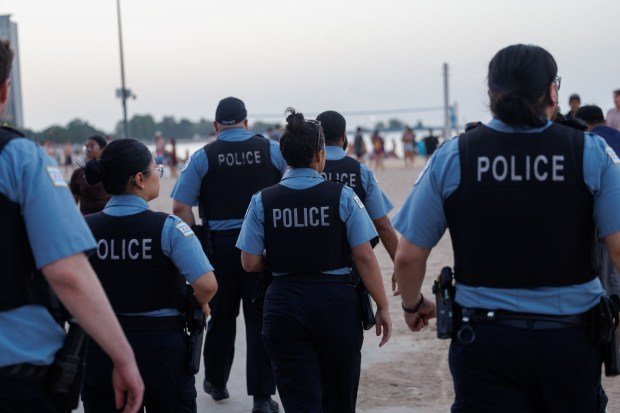 Chicago police walk along the Lakefront Trail while responding to a report of a fight at Oak Street Beach on June 30, 2026. (Armando L. Sanchez/Chicago Tribune)
In contrast, the Chicago Police Department continued its trend of overbudget, exceeding its $1.8 billion allocation by $162 million. This resulted from staffing – overtime, according to Belsky – and the costs of settlements and external consulting. For the latter, the city budgeted $82.5 million, but the department spent $131 million.
According to the report, transaction and transportation tax revenues recorded a significant increase compared to the previous year. Councilors have changed rideshare congestion surcharges as part of the 2025 budget, charging weekend drivers for the first time while increasing parking, permit and pass fees. In total, that brought in $460 million, up from $413 million in 2024. Fees for things like car and real estate leasing, cloud computing software and online work tools brought in $1.1 billion in 2025 thanks to the city’s rate increase. That’s up from $853 million the year before.
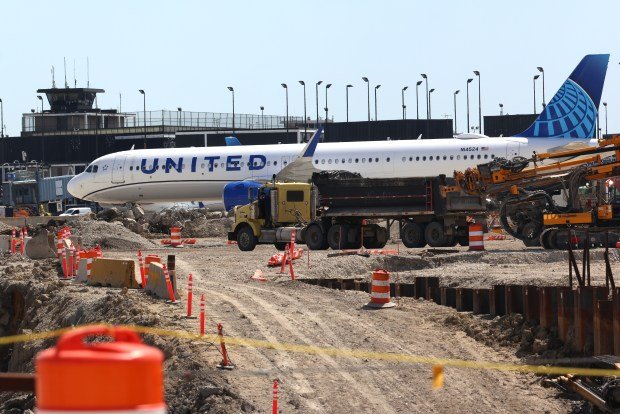 A United Airlines jet near construction of the new Concourse D at O’Hare International Airport in Chicago, April 23, 2026. O’Hare’s operating revenue increased $108.7 million. (Antonio Perez/Chicago Tribune)
The city’s corporate funds were also in better shape at the end of last year. O’Hare International Airport’s operating revenue increased $108.7 million thanks to higher terminal fees and landing fees following a rebound in business travel. Midway International Airport’s revenue increased $21 million.
“Thoughtful budgeting, accurate revenue projections and careful stewardship of taxpayer dollars have helped generate a significant surplus while strengthening the city’s financial foundation,” Johnson said in a news release. “These results put Chicago in a stronger position to continue to provide the services residents rely on and to invest in our neighborhoods.”
https://www.chicagotribune.com/2026/07/01/chicago-2025-annual-financial-report/
