


European policymakers say financial regulators are struggling to keep pace with the rapid development of artificial intelligence as they grapple with how to encourage adoption while mitigating risks to market integrity and stability.
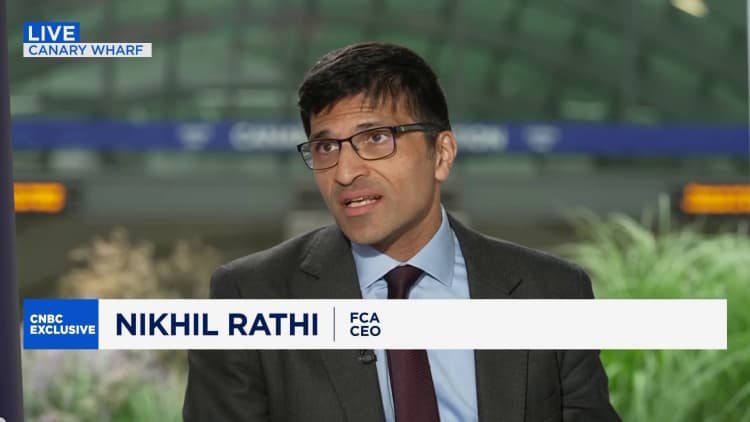
Nikhil Rathi, CEO of the UK’s Financial Conduct Authority, said the traditional rule-making cycle “is not working” at a time of rapid technological change, particularly as the development of agent AI accelerates.
“Technology is advancing incredibly quickly, and we need to think differently about some of the innovations we’re seeing in AI,” Rathi told CNBC’s “Squawk Box Europe” on Thursday.
Rathi highlighted the UK Financial Stability Board’s efforts in Frontier AI, as well as the launch of the UK’s AI Safety Institute as part of a broader initiative to help policymakers, regulators and companies better understand the risks and adopt the technology safely.
Christine Lagarde, President of the European Central Bank, said AI is a source of productivity and profits. However, in an interview with French newspaper Les Échos, she also warned that the technology also posed a “big risk.”
“For about a decade we have been talking about cybersecurity risks, hacking, data theft and so on,” Lagarde said. “But as AI models accelerate and deepen, we face a much more serious risk because it is happening very, very quickly and because the means to defend it – and the funding required for it – have yet to be found.”
Her comments came after the impact of AI on productivity and market integrity became the central topic of discussion this week at the ECB’s annual meeting in Sintra, Portugal – Europe’s version of the Jackson Hole symposium.
Sarah Breeden, deputy governor of the Bank of England, said artificial intelligence could increase volatility during times of market stress.
In her Sintra speech on Tuesday, Breeden said that for now, commercial companies are using autonomous AI primarily for lower-risk operational tasks such as research. “But that could change quickly,” she said.
Table of Contents
Guardrails and circuit breakers?
The increased use of agent AI in financial markets may require greater oversight, she said, such as guardrails “analogous to circuit breakers or kill switches” that would “restrict or halt trading across the market if faulty AI models cause the market to collapse.”
But leading bankers and regulators also recognize that Europe is lagging behind in AI investments and in developing pioneering companies that will drive breakthroughs.
Boris Vujčić, Vice President of the European Central Bank, said: “Europe is now in a situation where it obviously needs to develop its own capabilities in the AI field. There has also been a lot of talk about sovereignty issues in the AI field. Europe has shown in the past that it is capable of adapting new technologies…[to] Increasing productivity growth. [But] it wasn’t always on the border.”

Rathi said market authorities ultimately need to find a better balance in this rapidly evolving technology.
He said that while technological innovation presents exciting opportunities for the UK, particularly when it comes to the country’s productivity and growth challenges, it is vital that markets are not exposed to risks that regulators cannot yet fully monitor.
“The reality is that some of these technologies are now being implemented in weeks or months and the traditional rulemaking cycle simply doesn’t work that way. So we need to think about new tools and a different way of engaging with the market, for example on financial crime and AI risks, to ensure we achieve our goal of market integrity,” he said.
He added: “We don’t want to stand in the way of the rollout, but we need to be transparent about where the risks lie.”
Choose CNBC as your preferred source on Google and never miss a moment from the most trusted name in business news.
https://www.cnbc.com/2026/07/03/ai-outpacing-rules-europe-top-bankers-regulators-warn.html
