

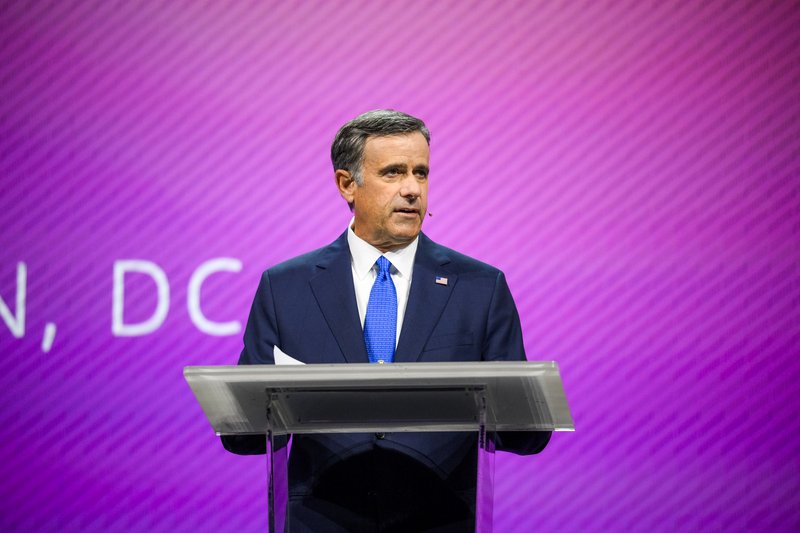
The CIA has reorganized several of its key acquisition and technology directorates to better accommodate new technologies such as artificial intelligence and quantum computing as they “reshape the reality of conflict and asymmetric warfare,” Director John Ratcliffe said Tuesday.
During rare public speeches at the AWS DC Summit, Ratcliffe pointed to recent CIA-backed operations in Venezuela and the Middle East, including the rescue of a downed F-15E Strike Eagle pilot in Iran, as examples of technology’s outsized impact on the agency’s intelligence operations.
“It was a search that relied on our innovation, creativity and technological know-how, and ultimately it was a technology-enabled search that only the CIA could successfully conduct and successfully conducted,” the director said of the rescue operation, which he described as “the equivalent of trying to find a needle in a haystack.”
Aware that there is no shortage of conflict or crisis around the world, Ratcliffe said the CIA does not have the luxury of relying on past successes. Instead, the agency must position itself as a leader in adopting cutting-edge technologies.
“All our future successes will increasingly depend on technology,” he said. “We must continue to push the boundaries of what is possible, because the nation that best harnesses the power of technology will determine the global future.”
With this in mind, the CIA has undertaken a “fundamental transformation” of its “overall technology approach,” Ratcliffe said. This includes overhauling its digital innovation office, transforming its commercial technology procurement strategy, streamlining communication channels with industry and strengthening its offensive cyber capabilities as a core mission function.
What was previously the CIA’s Digital Innovation Directorate is now the Mission Systems Directorate, eliminating the former’s offensive cyber and open source responsibilities and instead streamlining the agency’s digital efforts to focus on “core functions such as cybersecurity and advanced data and infrastructure services.”
Ratcliffe said the move would “dramatically strengthen the foundation of our overall information technology architecture” and comes from a recognition that “we must have the most advanced and resilient technology foundation, we must capitalize on private sector innovation and quickly integrate it into our government systems, and we must make our new tools available to every official in every position at the speed needed to get the job done well.”
As part of that restructuring, the agency is conducting an “aggressive data sprint … to improve the discovery and use of all of our mission data,” he said.
“We will advance data standardization across the agency, improve our ability to better integrate all of our assets, and train our officers on how to use all of our new capabilities,” Ratcliffe said.
Earlier this year, the agency announced its new commercial technology acquisition framework, led by Chief Procurement Officer Effie Fragogiannis. Although the framework is still in its infancy, it is fulfilling its mandate to complete most commercial technology acquisitions in six months or less, Ratcliffe said, with an initial result of “nearly 400 acquisitions” in the months since its launch, “which previously would have taken several years.”
And to provide industry partners with a better single point of contact for the CIA, the agency has created a corporate partnerships office, which he said has already opened its doors to work with companies like SpaceX, Amazon, Google and Dell.
Finally, recognizing the need to be “better positioned than ever to provide a strong defense and offense against our adversaries,” Ratcliffe shared that the CIA’s Center for Cyber Intelligence has been elevated to a mission center, taking over the offensive cyber responsibilities lost through the restructuring of the Directorate of Digital Innovation into the Directorate of Mission Systems.
“Look, we must protect not only our physical borders in this country, but equally importantly, our digital borders, wielding both a sword in terms of CCI and a shield in terms of DMS to deter, weaken and disrupt attacks on our critical infrastructure,” he said.
As he concluded his remarks, Ratcliffe stated that with these organizational changes, the CIA will “do everything we can to provide its officers with the best AI tools,” calling artificial intelligence “an area in which the CIA must excel because every algorithmic decision impacts the strategic advantage of the United States and the national security of our entire people.”
“We will take smart risks, we will experiment, and then over time we will correct course,” he said. “We simply cannot afford to wait for a risk-free approach when it comes to new technologies. It doesn’t exist. We must act quickly, we must be aggressive, and we must take full advantage of the ingenuity that characterizes America. This is the only way we can ensure that the CIA continues to operate at the cutting edge of technology.”
Notably, AWS announced at its summit the launch of a $1 billion incentive program for the intelligence community, which the company said “is aimed at eliminating the migration costs that have deterred some.” [intelligence workloads] locked in local systems.”
“The program is simple: Migrate qualified workloads to AWS, receive credits. Up to $1 billion is available to all IC agencies through October 2030 under the existing AWS contract,” the company said in a press release.
The CIA, a long-time customer of AWS for cloud technologies, will seek to take advantage of the program, according to Amazon.

Table of Contents
Written by Billy Mitchell
Billy Mitchell is senior vice president and executive editor of editorial brands at Scoop News Group. He oversees the operations, strategy and growth of SNG’s award-winning technology publications, FedScoop, StateScoop, CyberScoop, EdScoop and DefenseScoop. After earning his journalism degree from Virginia Tech and winning the school’s Excellence in Print Journalism Award, Billy earned his master’s degree in magazine writing from New York University while interning at publications such as Rolling Stone. Reach him at billy.mitchell@scoopnewsgroup.com.
https://fedscoop.com/cia-restructures-tech-acquisition-offices-for-the-age-of-ai/
