

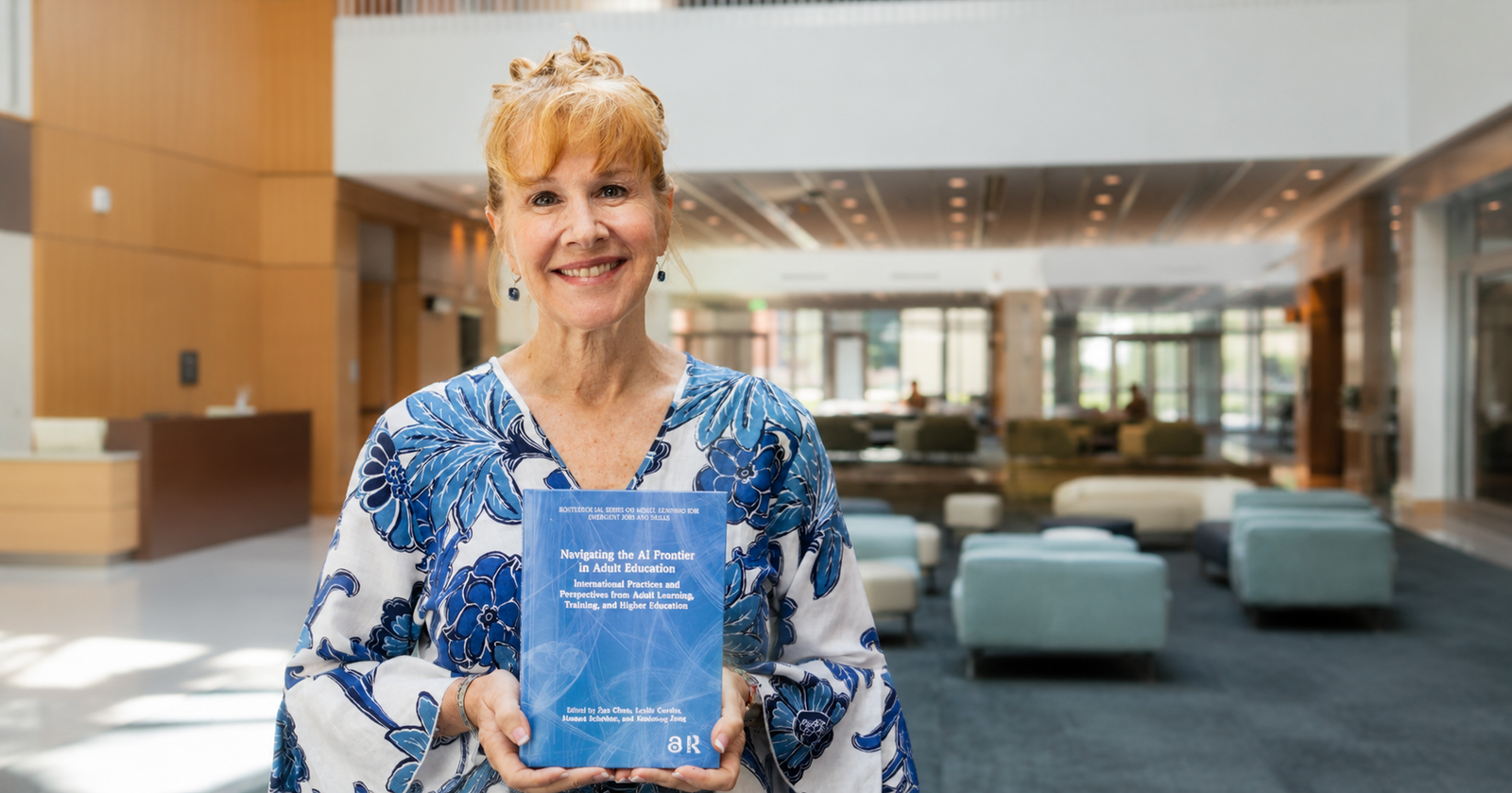

Leslie Cordie holds her new book, “Navigating the AI Frontier in Adult Education.”
If you ask anyone about artificial intelligence, you’ll probably hear one of two things: it’ll save the world or steal your job.
Leslie Cordie, associate professor of adult education in the Department of Educational Foundations, Leadership, and Technology, says both conversations miss the point.
“The real discussion is not whether AI is coming,” Cordie said. “It’s already there.”
For Cordie, AI is not something humans should fear or avoid; It is something they should learn to understand.
Whether she is leading discussions about workforce development, experiential learning, or comparative international education, Cordie encourages students to think beyond memorizing information. According to Cordie, learning happens through curiosity, conversation and experience.
“The students bring something to the table,” Cordie said. “I learn from them, just as they learn from me.”
This belief has naturally carried over into their approach to artificial intelligence. Instead of banning AI or seeing it as a shortcut, Cordie encourages students to experiment with it, question its answers, and think critically about what it produces. She wants them to understand not only what AI can do, but also what it cannot do.
“You have to use it,” she said. “You have to educate yourself.”
Cordie follows the same advice. She regularly uses AI to gather research ideas, redesign course materials, create assessment rubrics, and identify journals for future publication.
Rather than replacing her expertise, she said, technology gives her more time to focus on what matters most: meaningful conversations with students, collaboration and deeper learning.
“It makes me a better educator,” Cordie said.
This way of thinking ultimately led to an international research project.
Cordie was recently an associate editor “Navigating the AI frontier in adult education” An open access book based on a survey of 1,947 educators, trainers and consultants in 36 countries conducted by the Singapore Institute of Adult Education.
The purpose? Understand how AI is transforming teaching, learning and workforce development. The results? Surprising.
Instead of alarm, there was optimism.
Educators around the world largely viewed AI as a tool that could improve teaching, reduce repetitive tasks, and create new learning opportunities. Their biggest concern was not the adoption of the technology, but rather sufficient guidance and institutional support to put it to good use.
For Cordie, this realization confirmed something she had believed for years: that adult education is not limited to a classroom. This can happen through conversations, videos, new careers, unexpected challenges – and now artificial intelligence.
As workplaces continue to evolve, she believes the ability to continually learn may become more valuable than any individual skill. She already sees AI helping students prepare for interviews, organize research, strengthen presentations and develop ideas. If used wisely, it does not replace critical thinking. If anything, Cordie said, it creates more opportunities to practice it.
Looking to the future, she envisions classrooms becoming more interactive. Students could one day have conversations with AI-generated historical figures, create personalized learning experiences, or collaborate with technology in ways not yet possible.
But, Cordie says, even though technology changes, one thing won’t change.
“The learner will always bring something with them.”
https://wire.auburn.edu/content/ocm/2026/07/091316-leslie-cordie-ai.php?utm_sourceu003dauburn-todayu0026utm_mediumu003dweb
