Sid Pardeshi knew about the potential of artificial intelligence long before he joined the company MS/MBA Program co-directed by the Harvard John A. Paulson School of Engineering and Applied Sciences (SEAS) and Harvard Business School (HBS). He spent six years as a software engineer and architect at NVIDIA, where he designed and patented over 27 AI-related tools and products – at a time when terms like “large language model” (LLM), “chatbot” and “generative AI” were not yet part of the common lexicon. His experiences taught him how mechanical software design can be and how many of its most tedious, repetitive elements could be replaced by AI.
“Traditionally, software had to be written with a large number of people,” he said. “It’s kind of like an assembly line process where you have requirements, then you have developers implementing the solution. And then you go through code reviews and testing and all that work to finally gain the confidence to get something into production and customer-facing deployment.”
“We could see early on that the LLMs would eventually get better enough to be able to write a lot of code at once, validate the code autonomously and produce really high-quality results.”
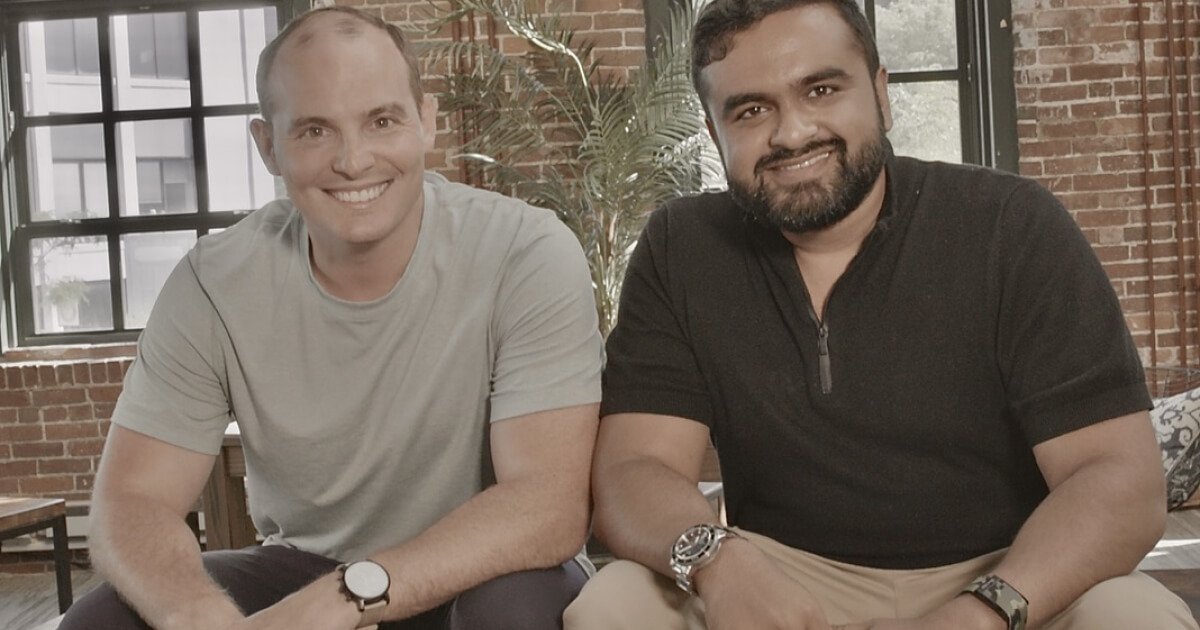
Pardeshi, MS/MBA ’24, made it clear in his Harvard application that he wanted to develop a more efficient approach to software development. During his stay, he met HBS student Brian Elliott and the two began working on their solution: an autonomous software development platform. They named the platform Blitzy, inspired by the term “blitzscaling,” an approach to extremely rapid business growth, that they studied while at Harvard.
The name turned out to be prophetic. In its first three years, the Cambridge-based startup has already grown to 80 employees and was named a local AI tech company to watch by the Boston Business Journal. The company recently announced a $200 million funding round at a $1.4 billion valuation. It is the second “unicorn” – company valued at over $1 billion – founded by an MS/MBA graduate. The first unicorn, Nominal, offers one AI-driven data analysis platform for aerospace, defense and industrial technology.
“It really feels like it’s just the beginning,” said Pardeshi, who serves as chief technology officer. “This is a once-in-a-lifetime opportunity to truly transform the field of software development. We are incredibly grateful to have had this opportunity and we want to do everything we can to make the most of it.”
Blitzy’s mission, as Pardeshi describes it, is “100% autonomy in software development.” Your platform writes code, tests it, finds security vulnerabilities, fixes bugs, and creates progress reports. When properly integrated into an organization, it frees human software developers to focus on the areas that Blitzy cannot automate, such as conceptualization, specification of programming requirements, and long-term software strategy.
“Assuming a project requires 100 hours of work, Blitzy can reliably complete at least 80 of those hours, allowing people to do much more and focus on much more complicated problems,” he said.
With this latest round of fundraising, Pardeshi plans to continue Blitzy’s rapid growth. He hopes to expand the company’s size to over 300 employees while expanding partnerships with labs and cloud service providers.
“A lot of the work that Blitzy does is related to the forward engineering movement, where we have engineers deployed to client companies and they help the company accelerate the impact of Blitzy,” he said. “We want to do this with a lot more enterprises. And from a product perspective, we have some really exciting features that we can now deliver much faster and more reliably, with enterprise-grade quality and reliability.”
Blitzy’s success is a success story for Harvard and also for the MS/MBA program. The company grew out of a class called “Launching Tech Ventures in the Age of AI” and later became Pardeshi’s capstone project. He and Elliott developed it at Harvard Innovation Labs. It was named a semifinalist in the 2024 Harvard President’s Innovation Challenge and the co-founders’ first customer was a company they learned about through their courses.
“This couldn’t have been a deeper Harvard story than it already is,” he said.
https://seas.harvard.edu/news/automating-software-and-success-msmba-alums-start-achieves-billion-dollar-valuation
