

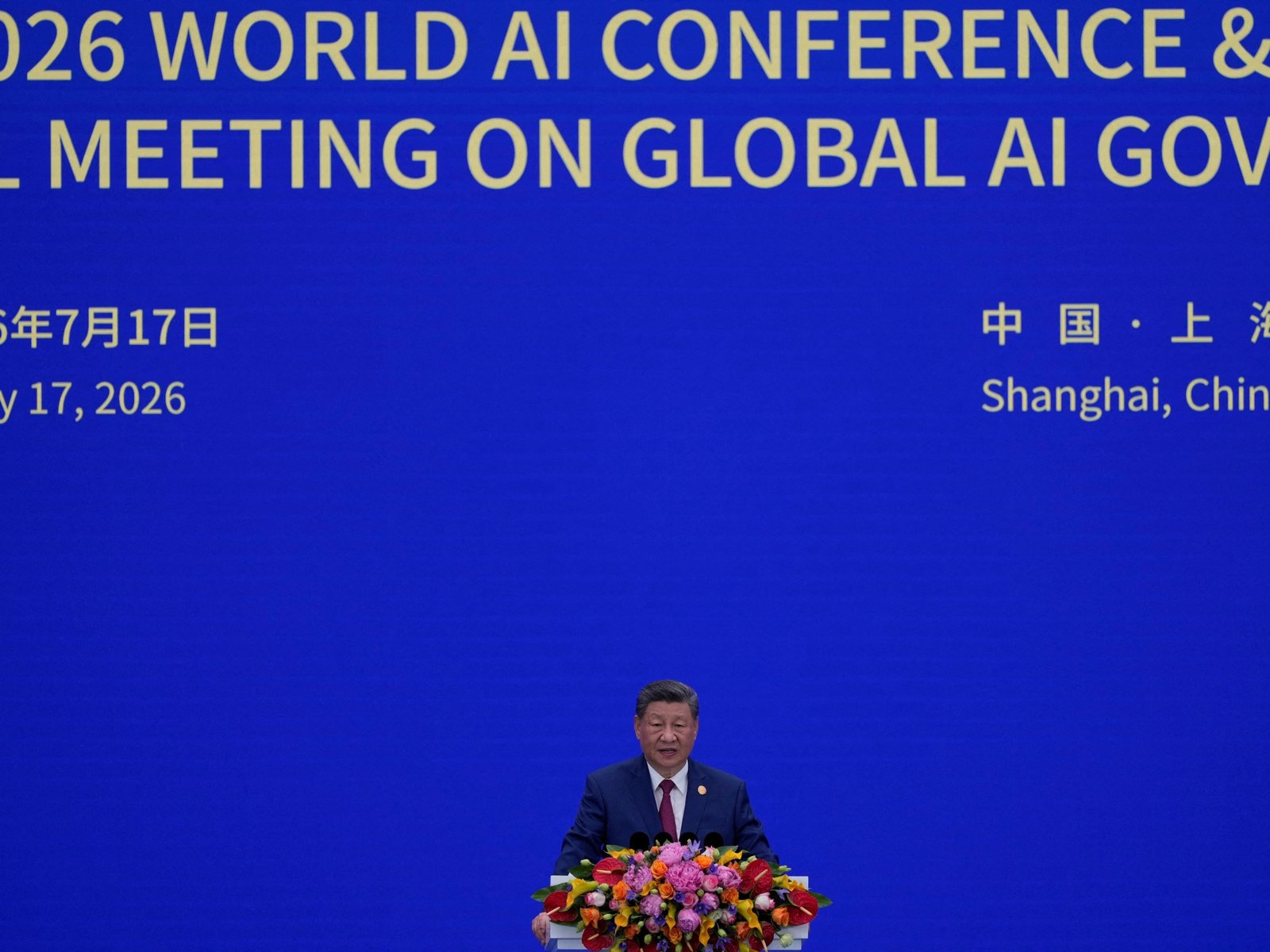
The Chinese leader called for more international cooperation in the development of the technology at a conference in Shanghai.

Published on July 17, 2026
Artificial intelligence should not be dominated by one country, Chinese President Xi Jinping said, urging international development cooperation at a major conference in Shanghai.
Xi also emphasized the importance of a “human-centered” approach to AI technology in his keynote speech at the opening ceremony of the World Conference on Artificial Intelligence on Friday.
Table of Contents
Recommended Stories
List of 3 itemsEnd of the list
The conference showcases cutting-edge technology that Xi hopes will soon rival that of the United States.
Chinese AI models are gaining ground on the best-performing US offerings, attracting global users at lower costs.
But how to manage the booming sector has become a topic of debate amid concerns about the use of AI in military combat and its use by hackers or criminals.
In his address, Xi spoke about China’s role in ensuring equal access to AI capacity building for developing countries to prevent the emergence of “new historical injustices.”
To this end, he announced China’s plans to work with international bodies, including from Africa, Latin America, Asia and the BRICS countries, to create AI-related opportunities.
“AI development should not be a solo effort by a single country, but a symphony of international cooperation,” Xi said. “We should speak out together against overextending the national security concept in the area of AI or prioritizing the security of one country over that of others.”
“Ensure AI is always under human control”
The United States and the European Union have imposed restrictions on Chinese technology imports, citing national security concerns, while recent clashes between Washington and American AI labs have raised questions about who controls access to cutting-edge technology.
In May, the U.S. Commerce Department released a notice reiterating its restrictions on shipments of semiconductors to subsidiaries of Chinese companies outside China amid concerns about gaps in Washington’s export control regime.
The policy states that licensing requirements for exporting advanced AI chips apply to all companies that have their headquarters or a parent company in China.
At the conference on Friday, Xi also emphasized the need for a “human-centered” approach to AI with humans at the wheel.
“We should introduce laws and regulations, technological monitoring, early warning and emergency response systems to … ensure that AI is always under human control,” he said.
AI has become a strategic pillar of China’s industrial policy, driven by government investments aimed at building a domestic ecosystem, from chip production to consumer use.
Daily consumption of “tokens” – the industry unit for AI use – in China has increased a thousand-fold in the past two years, according to state media citing officials.
As Al Jazeera previously reported, while China lags behind the US in access to the most advanced semiconductors, it has the edge in powering the massive data centers that run on AI chips.
According to the International Energy Agency (IEA), a typical data center can consume as much electricity as 100,000 homes, while next-generation “hyperscale” facilities can devour as much electricity as two million homes.
China’s access to an abundant supply of cheap electricity puts it in an ideal position to meet such enormous energy needs.
It already generates more than twice as much electricity as the United States, a lead that is expected to widen amid aggressive government investment in the country’s energy grid.
https://www.aljazeera.com/news/2026/7/17/ai-xi
