

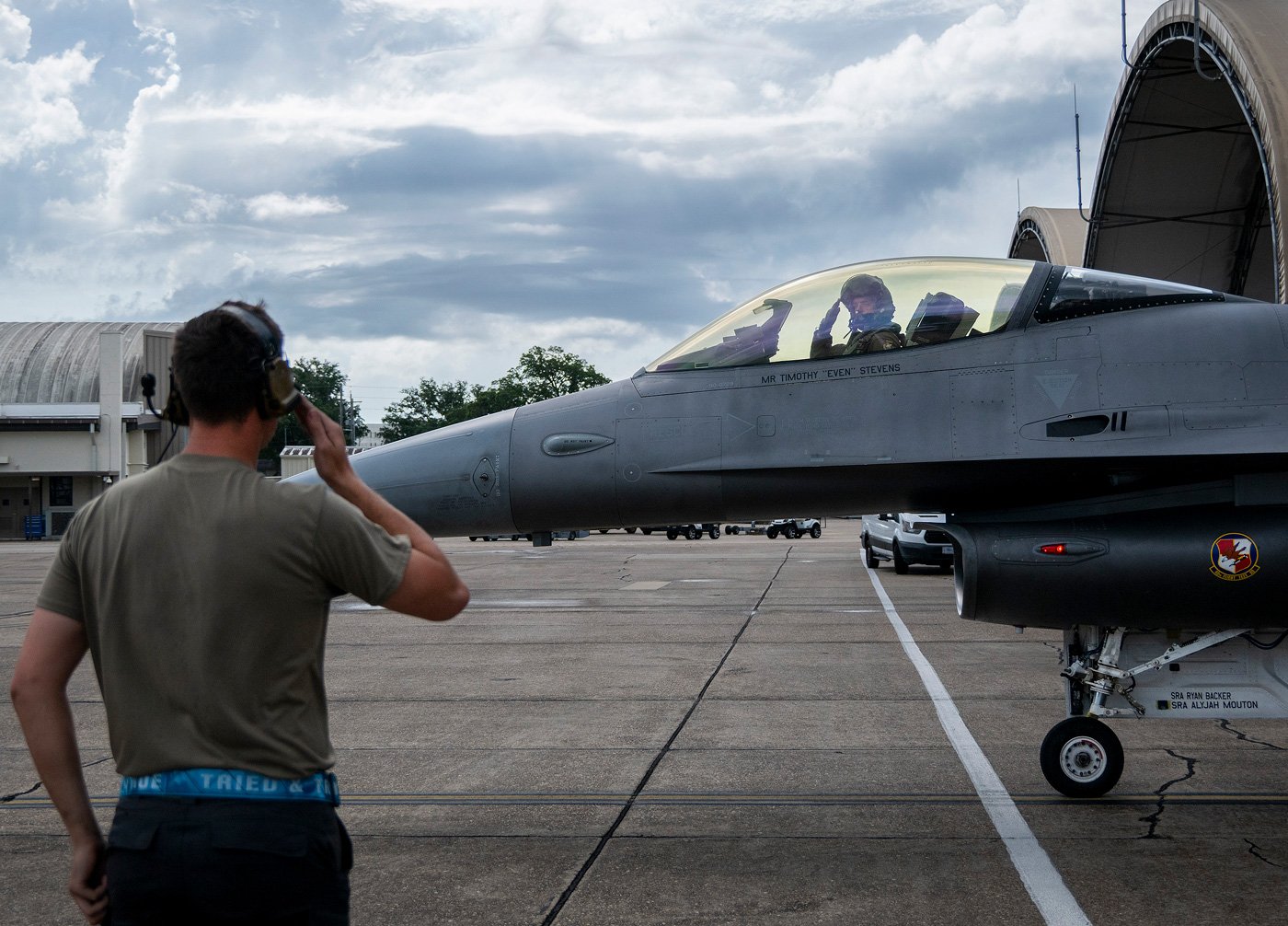
Eglin Air Force Base, Fla. – A U.S. Air Force F-16 fighter jet that was recently converted to serve as an autonomous flight test bed is currently undergoing air testing using an artificial intelligence (AI) agent to autonomously control the flight. This milestone advances state-of-the-art technological infrastructure designed to enable rapid, scalable development of combat AI across the joint force.
The aircraft is one of a group of F-16s converted into autonomously capable platforms as part of the Viper Experimentation and Next-Generation Operations Model (VENOM) program – a joint U.S. Air Force and DARPA initiative initiated under the Air Combat Evolution (ACE) program.
Building on previous ACE flights with the unique X-62A VISTA, which demonstrated that an AI agent can autonomously control a fighter aircraft in a dogfight, the flight of the VENOM aircraft demonstrates the United States’ ability to transform standard operational fleet aircraft to employ state-of-the-art AI.
“These groundbreaking flight tests of VENOM-modified F-16s advance the infrastructure necessary to develop reliable, autonomous air combat capabilities,” said Brigadier General. General James “Fangs” Valpiani, Ph.D., DARPA program manager. “The Air Force and DARPA team has automated flight controls and sensors on a standard F-16 without changing the jet’s core software. This enables an efficient pipeline for developing dominant AI for air combat and allows us to rapidly innovate for the fighter jet.”
The modification, known as the VENOM Autonomy Kit (VAK), was designed and integrated by several performers as part of the DARPA ACE program. The kit utilizes a novel interface with the aircraft’s flight controls and mission systems, allowing a pilot to switch between traditional human controls and AI controls with the push of a button. This ensures a safe and reliable environment for human-on-the-loop experiments.
Going forward, VENOM aircraft will serve as the cornerstone for the next phase of AI development under DARPA’s Artificial Intelligence Reinforcements (AIR) program. The AIR program will use the VENOM fleet to test multiple AI agents in live flight scenarios. These critical tests will pave the way for human pilots to seamlessly command and orchestrate teams of autonomous, unmanned aircraft. Ultimately, the capabilities developed under AIR will enable a variety of future joint force operations, including collaborative fighter aircraft programs.
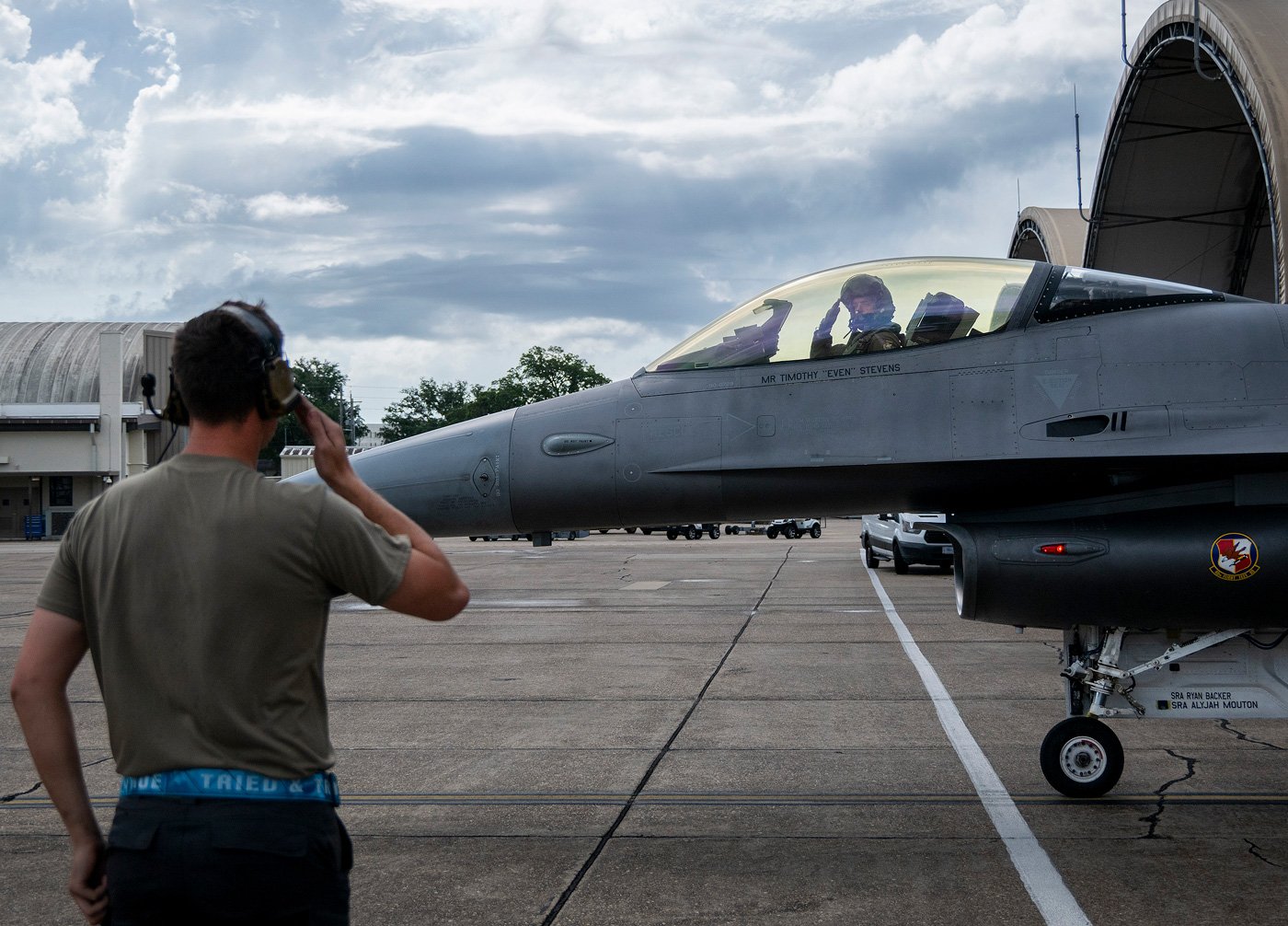
An F-16 Fighting Falcon modified for the Viper Experimentation and Next-Gen Operations Model – Autonomy Flying Testbed (VENOM) program conducts flight operations during autonomous systems testing in June 2026 at Eglin Air Force Base. The VENOM F-16s serve as modified flight test platforms equipped with specialized hardware, software and instrumentation, allowing artificial intelligence agents to control the aircraft while human pilots remain in the cockpit to monitor the AI agents and ensure flight and mission systems test objectives are met to rapidly advance autonomous capabilities. | Download US Air Force | Samuel King Jr., 96th Test Wing
“The emerging threat environment, particularly related to air combat, is becoming increasingly complex,” Valpiani added. “AI has tremendous potential to help humans address this complexity in beyond-visual-range combat, but many difficult questions remain regarding the performance and trustworthiness of combat AI in the extreme fog and friction of modern warfare. The AIR program aims to deploy cutting-edge combat assets in operationally relevant scenarios to answer these questions and provide our warfighters with war-deterrent and war-winning capabilities.”
Valpiani will end his term as DARPA program manager later this month. Lt. Col. Patrick “Dice” Highland, Ph.D., recently joined DARPA and is the new program manager for AIR.
“I am incredibly proud of the AIR program’s role in advancing our nation’s combat autonomy, demonstrated by this VENOM milestone,” Highland said. “We now have the opportunity to create dominant autonomy for multi-ship, beyond-visual-range combat. These flights give us our first glimpse of how AI agents can begin to actively transform air warfare.”
Terry Wilson, Ph.D., director of AI development and transition for the Air Force Research Laboratory’s Autonomy Capability Team (ACT3), remains in place as deputy program manager for VENOM and AIR. In this role, Wilson ensures continuity of key programs, technical and operational leadership, and provides essential stakeholder alignment across all shared organizations. This close, enduring partnership between DARPA and AFRL’s ACT3 team remains critical to ensuring the long-term operational success of the program.
“I share General Valpiani’s deep appreciation for the incredible efforts of our DARPA and industry teammates, joint engineers, the System Program Office, Eglin test and maintenance teams, and the entire AIR and VENOM ecosystem that made this milestone possible,” Wilson said. “I look forward to unleashing the VENOM platform and bringing these capabilities from simulation to the air.”
The AIR program will further improve the speed and predictability of model development and scale flight testing to multi-ship operations with increased complexity to enable novel and robust AI-driven autonomy.
###
Media representatives should contact DARPA Public Affairs with inquiries.
https://www.darpa.mil/news/2026/darpa-us-air-force-fly-ai-controlled-f-16
