

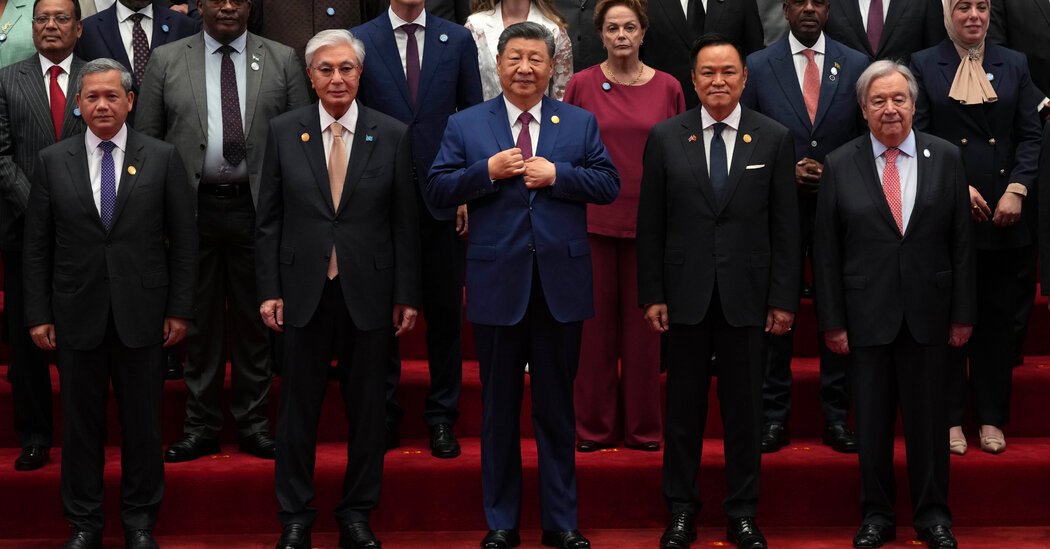
China’s leader on Friday laid out his country’s attempt to shape the path of artificial intelligence, calling China a champion of an open approach to the technology and a trustworthy ally of developing countries in advancing AI
Xi Jinping’s remarks underscored the importance that China’s top political and government leadership attaches to artificial intelligence. Mr. Xi’s speech did not mention the United States by name, but the message was clear: China plans to compete as the world’s other AI superpower.
At an AI conference in Shanghai, Mr. Xi said that “AI development should not be a solo effort by a single country, but a symphony of global cooperation.”
He described open source AI technology, where much of the software can be freely shared and modified, as a “rare and historic opportunity” to spread the benefits of AI worldwide. The technology, he said, must be shared by developing countries or risk “new historic injustices.”
Mr Xi’s vision is certainly also a vision of national self-interest. China is widely believed to be lagging behind the United States in AI, but it is catching up. This is particularly evident in the open source software developed by China’s leading AI software companies such as DeepSeek, Moonshot and Zhipu.
Their AI systems close the gap with America’s leading AI chatbots and question answerers, including OpenAI’s ChatGPT, Anthropic’s Claude, and Google’s Gemini.
On Friday, a Chinese company, Moonshot, unveiled a new model that it said worked just as well as American models from Anthropic and OpenAI. The announcement of the model Kimi K3 caused an uproar on the financial markets.
The US companies that have spent billions of dollars developing their top-of-the-line models are not freely sharing their technology. They have also accused the Chinese of stealing their technology. And China lags far behind in the most advanced AI chips, a market dominated by Nvidia.
Mr. Xi’s speech at the start of an AI conference in Shanghai came as China is building support for its World Organization for AI Cooperation. The group was founded a year ago, China said, in part to give developing countries a greater say in AI governance.
In his address, Mr. Xi also said that China intends to offer its AI technology and training to developing countries that are friendly to China. “We must maintain openness and win-win cooperation,” he said.
China’s international presence is intended to complement its AI ambitions at home. Mr. Xi has urged his country to “occupy the commanding heights” of technology, with AI at the forefront.
But depending on how far and quickly AI advances, it poses a dilemma for the ruling Communist Party. How should it deal with the rise of a technology that could one day be so disruptive that it could threaten its interests – and its grip on power?
The intensity of China’s regulation of AI has varied over the years, depending on where the country views its strengths and weaknesses.
When the Chinese government feared that it would fall behind the United States in 2022 after the launch of ChatGPT, it took a more cautious approach that ultimately helped companies like DeepSeek and others succeed.
At the same time, researchers have documented efforts by the Chinese government to monitor and manipulate public opinion in Hong Kong and Taiwan using companies with AI expertise. The Philippines on Friday condemned as racist an AI-generated video published by a Chinese state news site that portrayed the Southeast Asian country as a karaoke-singing monkey on behalf of the United States and Japan.
Xinyun Wu contributed reporting from Taiwan and Taipei.
https://www.nytimes.com/2026/07/17/business/xi-jinping-china-ai.html
