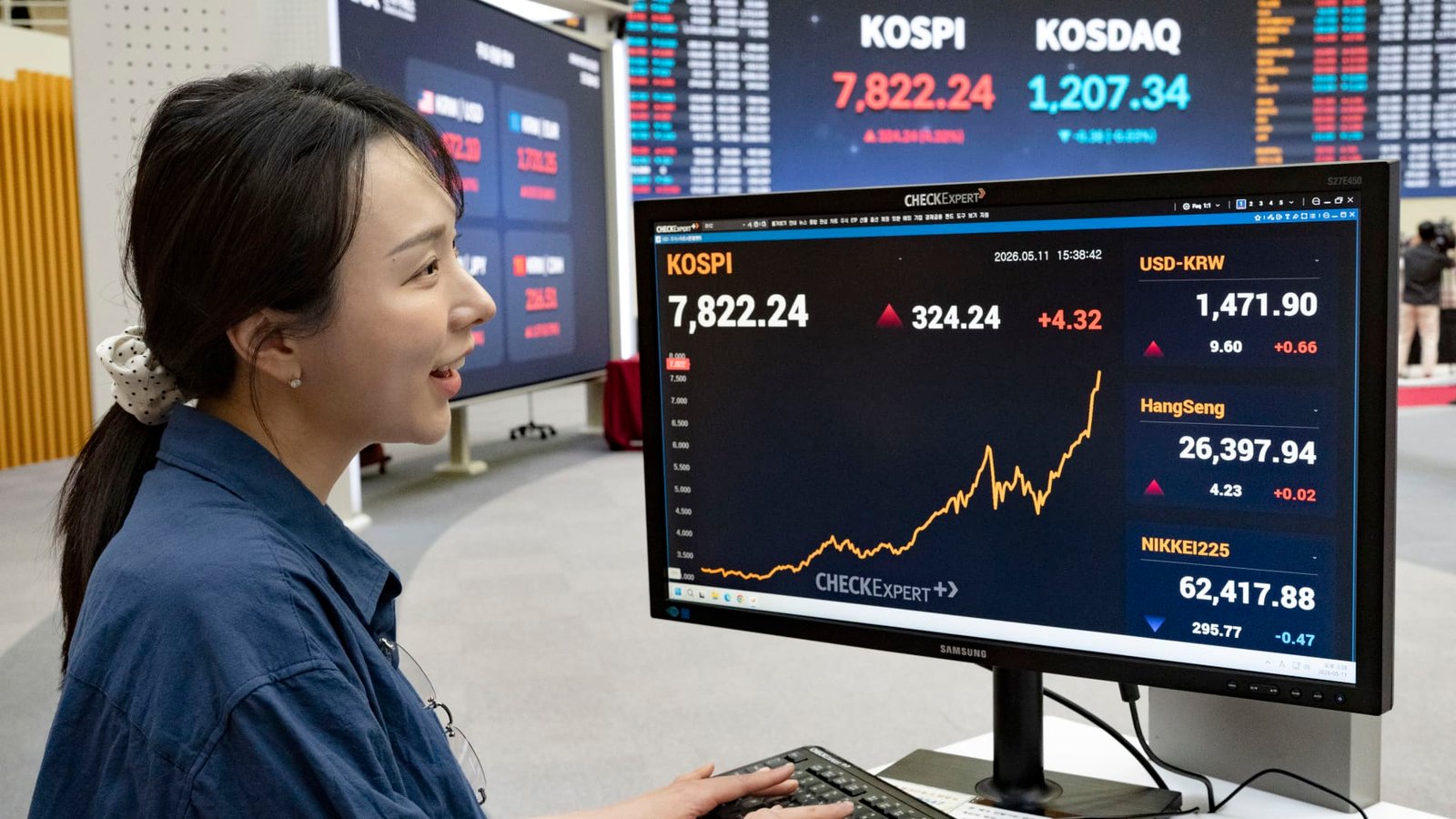
A Korea Exchange (KRX) employee monitors stock market data on computer screens in the Yeouido financial district in Seoul, South Korea on May 11, 2026.
Chris Jung | Photo only | Getty Images
South Korean retail investors who made leveraged bets on the country’s AI champions are suffering big losses after a sharp reversal, exposing the risks of the speculative trading boom that has helped fuel one of the world’s hottest stock markets.
The pain has been particularly acute for holders of single-stock exchange-traded funds tied to chip giants Samsung Electronics and SK Hynix, which had surged alongside the AI-driven semiconductor rally and have now plunged.
According to KB Financial Group, Korean retail investors have bought a net 14 trillion won ($9.4 billion) of single-stock leveraged ETFs since they were launched on May 27, compared with about 2 trillion won from foreign investors.
It’s not working so well for them at the moment. The KODEX SK Hynix Single Stock Leverage ETF – a product designed to deliver twice the daily movement of SK Hynix shares – is down about 70% from its record high reached in June and down about 50% since its debut, according to LSEG data.
South Korean online trading forums have been abuzz with complaints, especially after SK Hynix’s record plunge last week.
“I want to go back to before I started investing in stocks. Give me my money back,” one investor wrote.
“You are determined to kill me,” said another.
The losses underscore how South Korea’s retail investment culture has exacerbated volatility among the country’s technology heavyweights, even as analysts argue the long-term prospects for memory chip makers remain intact.
Table of Contents
Private investors are bearing the brunt
“The investors bearing the losses are predominantly domestic retail investors,” said Jung In Yun, founder of Fibonacci Asset Management.
The share of leveraged ETFs as a share of Korea-focused funds has also grown rapidly, with assets in the 25 largest leveraged Korea ETFs rising to about 30% as of June, up from about 15% at the start of 2026, according to data from Oxford Economics.
The economic consultancy downgraded South Korean stocks to neutral in late June, warning that leverage had increased significantly and that investment firms could become increasingly cautious about lending to retail investors.
The buyers, says Jung, are not simply inexperienced retailers chasing online hype. Many are investors in their 40s and 50s who have become increasingly comfortable with leverage and concentrated technology betting.
South Korea’s central bank warned in a report last month that leveraged equity investments by retail investors had risen to a record high, largely driven by margin lending and increasingly concentrated semiconductor positions.
While the BoK said the buildup was unlikely to pose a systemic threat to the financial system, it warned that leverage could increase volatility during market corrections, particularly when fear of missing out encourages investors to chase rallies with borrowed money.
Regulatory attention
The supervisory authorities have also taken note of this. South Korea on Thursday unveiled stricter rules for single-stock exchange-traded funds in a bid to curb speculative retail trading following sharp swings in Samsung Electronics and SK Hynix. Under the new measures, investors must deposit at least 30 million won in cash to trade the products, previously it was effectively at least 3 million won.
Peter Kim, head of global investment strategy at KB Financial Group, said the losses highlight how leveraged ETFs on individual stocks have become a vehicle for speculative trading rather than long-term investing.
“There are no signs of a massive rescue of the market by Korean retail investors, but if the overhang in ETFs continues and the decline and volatility continue, we could see a prolonged decline,” Kim told CNBC by email.
However, some market veterans say the settlement could take even longer.
Memory chip stocks have become the most crowded market in the market for both institutional and retail investors, said Thomas J. Hayes, chairman and managing member of Great Hill Capital.
“Semis and memory is the world’s busiest trade by institutional and retail positioning. It’s over,” Hayes said. One or more hyperscalers other than Meta should “moderate their investment commitments in the second quarter earnings guidance. They will see as aggressive a crowding out of our semi and storage capacity as a ‘crowding out’ in the coming months.”
Choose CNBC as your preferred source on Google and never miss a moment from the most trusted name in business news.
https://www.cnbc.com/2026/07/20/give-me-my-money-back-south-korean-traders-leveraged-bets-unravel.html
