

After hearing Tesla Inc.’s seemingly countless promises about artificial intelligence, autonomous driving and robotics, Wall Street wants the company to walk its talk.
Elon Musk’s electric vehicle maker has spent just $2.5 billion of its $25 billion in capital spending forecast for 2026 in April. The slow pace raises questions about whether Tesla’s spending is enough to deliver the progress AI-hungry investors expect.
“It’s a capital-intensive industry,” said Jay Van Sciver, partner and managing director at Hedgeye Risk Management. “There is no way to get from A to B with less money.”
That puts the company on a completely different path than most other tech giants, whose stocks are penalized when their AI spending is deemed too wasteful. For Tesla, however, a jump in capital spending in its earnings report Wednesday afternoon and a higher forecast from management for AI spending would likely give shares a boost as they signal the company’s product development is moving in the right direction.
“For a growth stock, capital spending is the best indicator of future growth,” said HSBC analyst Mike Tyndall, who rates the stock a “sell.” “If you don’t spend the money, you won’t get growth.”
Capex is a “credibility check” for companies like Tesla that sell long-term vision, according to Haris Khurshid, chief investment officer at Karobaar Capital, which owns Tesla shares through derivatives. But the reality is that Musk’s track record is littered with missed deadlines and abandoned projects. Investors know this and therefore want to see the first signs of noticeable progress.
“I’m less focused on a single number and more looking to see if the overall story becomes more internally consistent,” Khurshid said. “Are the capital expenditures, management commentary and timelines all pointing in the same direction? That’s what separates a compelling vision from a compelling investment.”
Four of Tesla’s Magnificent Seven competitors – Alphabet Inc., Amazon.com Inc., Meta Platforms Inc. and Microsoft Corp. – have forecast capital expenditure totaling $725 billion in 2026 alone. Its stocks took a hit every now and then due to spending concerns as investors wanted to see greater returns on these investments. By comparison, Tesla’s annual investment forecast of $25 billion looks conservative, but the company’s shares have not benefited, falling 18% in 2026, marking the worst performance among the group as of Monday’s close. Tesla shares rose 1.6% on Tuesday as the S&P 500 rose.
“I don’t have a big problem with the fact that they haven’t spent the money yet,” said Brian Mulberry of Zacks Investment Management, which owns Tesla shares. “But this is one of those input costs that could change the dynamics of overall earnings per share down the road if they don’t get it done soon and manage the cost structure properly.”
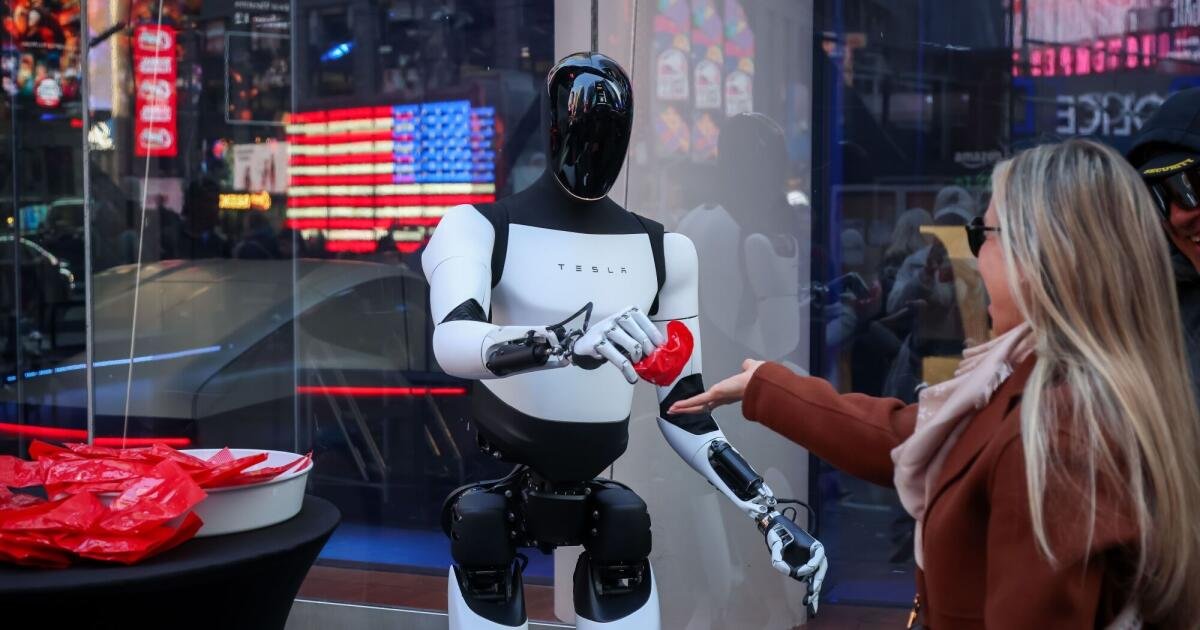
To be fair, the products Tesla develops are fundamentally different from those of other Big Tech companies. They mainly focus on expanding cloud computing capacity and building AI services. Tesla is focusing on the physical side of AI, envisioning a future with self-driving cars and robot butlers.
“The question is not who is spending more, but whether the spending will take the company into the bright future,” said Karobaar’s Khurshid.
The fact is that Tesla stock is valued as if that future is already here. At about 163 times earnings over the next 12 months, it is the second most expensive company in the S&P 500 index and by far the most expensive member of the Mag Seven, followed by Apple Inc. at about 34 times forward earnings. The S&P 500 is trading at about 20 times earnings as of Monday’s close.
Tesla is expected to report second-quarter net income of $1.2 billion, up 2.7% from a year earlier, on revenue of $26 billion, up 17% from the same period last year. Meanwhile, the overall environment for electric vehicles remains murky. Even though the company posted underwhelming vehicle deliveries in the second quarter, investors sold the news, sending shares plunging 7.5% on July 2, marking their worst day in a year.
“I think there are far fewer reasons to believe in Tesla today than ever before,” said David Trainer, chief executive of technology research firm New Constructs. “The core business is to compete in a highly capital-intensive space with supercompanies that were already profitable and are poised to become unprofitable.”
Pressure on Tesla to keep its promises has increased since Musk’s other company, Space Exploration Technologies Corp. or SpaceX, went public last month. If Tesla earnings fall short of high expectations, SpaceX’s ambitions to colonize Mars and operate orbital data centers may seem more exciting to Musk fans. SpaceX is expected to release its results on August 4th.
Speculation is already swirling about a merger between the two companies based on their existing points of connection — from Musk’s shared ownership to Tesla’s stake in the now SpaceX-owned xAI to the companies’ joint venture to make Terafab chips. SpaceX has big AI ambitions and is busy raising cash through its landmark $75 billion IPO and a subsequent $25 billion bond sale.
Tesla’s ability to work on robots and robotaxis could therefore determine whether the company will remain independent in the future.
A publicly traded SpaceX “forces Tesla to meet tighter timelines with real results,” said Max Gokhman of Franklin Templeton Investment Solutions. “I don’t think investors will be as patient with missed release dates or empty promises as they were before there was a clear opportunity to play the Elon Mars shot.”
Fitzgerald writes for Bloomberg.
https://www.latimes.com/business/story/2026-07-21/tesla-talked-up-ai-wall-street-wants-to-know-where-money-is
