

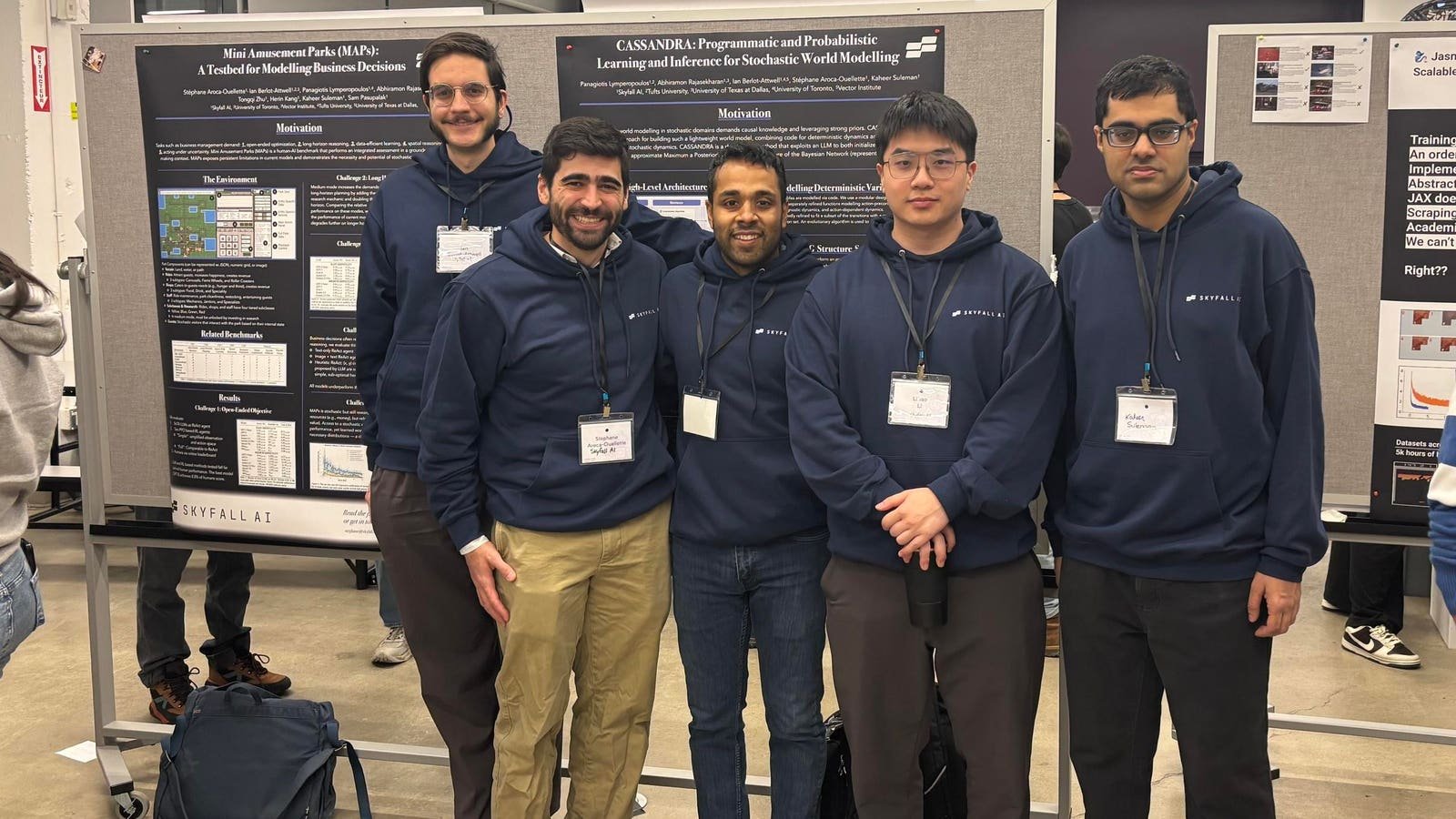
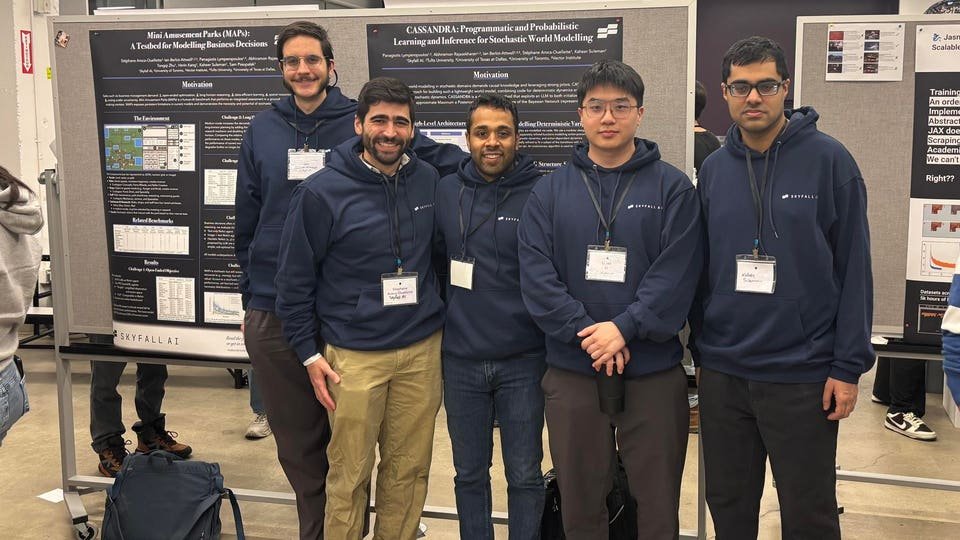
Skyfall AI, part of the team behind Microsoft’s $160 million acquisition of Maluuba, will buy a SaaS company and let AI run it as CEO. The founders claim that today’s LLMs and agent AI are not competent.
Skyfall AI
The biggest players in the AI industry are all pursuing the same goal: the autonomous workforce. OpenAI turns ChatGPT into a digital worker, Anthropic wants Claude to orchestrate corporate work, and Google continues to integrate Gemini into enterprise software. Their common bet is that companies will automate individual tasks little by little until humans oversee the work and no longer do it.
The founders of Skyfall AI believe that the enterprise AI industry is pursuing the wrong goal. Instead of validating its technology through controlled customer pilots, the startup plans to acquire a small B2B SaaS or e-commerce company for up to $1 million and try to run it with AI as CEO.
“We want to democratize the power of a CEO to all small businesses around the world, rather than creating another marketing or sales agent,” Skyfall co-founder and CEO Sam Pasupalak told me in an exclusive interview. “If you want a truly autonomous company, you have to buy a company and run the whole thing end-to-end. If you don’t run a company with minimal human intervention, you’ll never know if an autonomous company is actually possible.”
The system will oversee pricing, marketing, customer support, finances and operations while gradually reducing human involvement, with an ambitious goal: doubling the company’s revenue in six months while publicly documenting its successes and failures. It is an unusually public and expensive way to validate a research hypothesis.
Instead of building what Pasupalak calls the “next virtual software engineer,” Skyfall has set its sights on what it sees as a far more difficult challenge: a virtual CEO. Unlike software development, which he describes as largely logical and deterministic, running a business requires abstract thinking, long-term planning, and high-risk decisions made based on incomplete information.
“Many startups are building marketing or sales agents, which we think is a very narrow AI implementation – rather than the broader challenge of organizational decision-making,” says Pasupalak.
Table of Contents
Skyfall claims LLMs have reached their corporate limits
Pasupalak and co-founder and CTO Kaheer Suleman met nearly two decades ago while studying computer science at the University of Waterloo and pursued an ambitious goal: building intelligent machines during the so-called AI winter. After graduating in 2011, they co-founded Maluuba, one of the first deep learning startups, with Turing Award winners Yoshua Bengio and Richard Sutton.
The company’s early conversational AI systems reached hundreds of millions of devices through partnerships with Samsung, LG and BlackBerry. “Around 2016, one of the demos we created was able to answer questions about an entire Harry Potter book. Today, after the LLM, models do this on the internet. But ten years ago this was cutting-edge research,” remembers Pasupalak.
Microsoft acquired Maluuba in 2017 for around $160 million, making the lab the foundation of Microsoft AI in Canada. Nearly a decade later, the founders have reunited under Skyfall AI to pursue what they believe is the next frontier of AI and build the technology behind what they hope will become the world’s first autonomous company. They are joined by Chief Product Officer Sumit Pasupalak – Sam’s brother and a serial entrepreneur with several startup companies.
The founders believe that the direction of the industry will be determined by both economics and technology. With billions of dollars being invested in AI infrastructure and breakthrough LLMs, companies have a strong incentive to demonstrate that the current architecture continues to improve.
“If you think about the big players – whether OpenAI, Anthropic or Gemini – they are essentially LLMs,” he says. “All of their resources are based on LLMs. So they have to benchmark or work with companies that are doing benchmarks where LLMs are proven to have high accuracy. The result is that because so much money has been put into these, the entire research community is only betting on n-plus-one research improvements.”
Skyfall emerges from obscurity alongside Morpheus, a benchmark designed to test whether today’s cutting-edge AI models can continually adapt as enterprise environments evolve. According to the company’s latest research, models like GPT-5.5 and Gemini work well under usual business conditions, but deteriorate as competitors launch products, customer behavior changes, and market dynamics change – evidence, Skyfall argues, that while current systems excel at applying pre-trained knowledge, they struggle to continually learn from experience, and that scaling today’s architecture alone may not be enough to run a business.
The answer to this is what the founders call “Enterprise World Models” – AI systems designed to understand how an organization performs and simulate how decisions affect the entire company, from pricing and customer acquisition to hiring, operations and long-term revenue.
Ultimately, Pasupalak doesn’t expect AI to replace meaningful human work, but rather to remove the operational burden that prevents leaders from focusing on it. “We want all companies to be run autonomously because we believe people should spend their time on things they care about – not on operational tasks. We want to build the autonomous age.”
Why buying a real SaaS company is important
Skyfall wants to publicly test its ideas with real customers, revenue and operational consequences. The founders have spent years training their systems in increasingly sophisticated simulated business environments. However, they argue that they cannot capture the unpredictability of actual customers, competitors and markets, no matter how realistic they may be.
“We found that the gap between simulation and the real world is always a limit,” says Suleman. “The only way to solve this problem is to actually have real data. There’s no way around that if you want to solve the sim-to-real problem.”
But before they could put AI into the hands of a real company, they first had to determine whether it could run an entire company – even a simulated one. “Last year we started the video game RollerCoaster Tycoon,” Pasupalak explained. “Where you’re essentially running an entire theme park and trying to maximize revenue. The success of AI gave us confidence that we could operate in a simulated business. The next step is to buy a real business. After that, maybe next year, we’ll be looking at automating tens of millions of dollars worth of businesses.”
The founders claim that explicitly modeling a company’s evolving state makes AI better suited to long-term planning and high-risk decision-making than today’s prompt-driven agents.
“We’re building something we call a latent world model,” says Suleman. “Instead of predicting future states in token space, we predict them in a latent space. This allows us to focus only on the features that are actually important to the dynamics of the business.”
Skyfall is not the first, but perhaps the most ambitious
Skyfall doesn’t break new ground. The closest comparison is Anthropic’s Project Vend, developed with AI security startup Andon Labs, which gave a Claude-backed agent control of a real office sales business.
The first version floundered spectacularly when employees persuaded them to stock novel tungsten cubes and sell them at a loss, but later versions became considerably more competent. By mid-2026, the experiment had expanded to multiple locations in San Francisco, New York and London, with AI colleagues taking over oversight, and Andon Labs said operations had become “almost boring” because it was running so smoothly.
Previous attempts to appoint an AI CEO – NetDragon’s virtual executive Tang Yu or Dictador’s humanoid CEO Mika – never achieved the reality of true autonomy; both functioned largely as decision support experiments. What makes Skyfall different is less the ambition than the willingness to make the hypothesis falsifiable: buy a truly revenue-generating company, publicly measure whether AI can grow it while reducing human intervention, and document the failures alongside the successes.
Can AI really become the CEO?
Even Pasupalak doesn’t believe AI should replace every aspect of leadership. At least for now, he draws the line between human relationships.
“I spend more than half of my time on operations – meetings, budgeting, coordinating teams, campaigns. Imagine if AI took over all of these operational tasks. Then I could spend a lot more time on strategy,” he says. “When it comes to motivating employees and building relationships with people, that is still very difficult for AI to replicate.”
Even if AI eventually takes over a majority of a company’s operational workload, Suleman doesn’t believe humans will disappear from the equation. Instead, he envisions their role evolving from carrying out day-to-day tasks to providing oversight and accountability. “Trust is still important, and you probably don’t want to hand over actual responsibility to an AI. Humans should always remain responsible in some way.”
Skyfall’s first experiment is intentionally modest compared to its long-term goal: to automate as many business processes as possible and measure not only performance but also whether human intervention is steadily decreasing over time. Whether it will succeed remains an open question. Anthropic has already shown that AI can run a relatively limited retail business autonomously. Skyfall is testing a far more challenging proposition: whether AI can fully manage an organization where strategy, competition, customer behavior and market conditions are constantly evolving.
https://www.forbes.com/sites/victordey/2026/07/20/former-microsoft-ai-leaders-are-spending-1m-to-prove-ai-can-replace-ceos/
