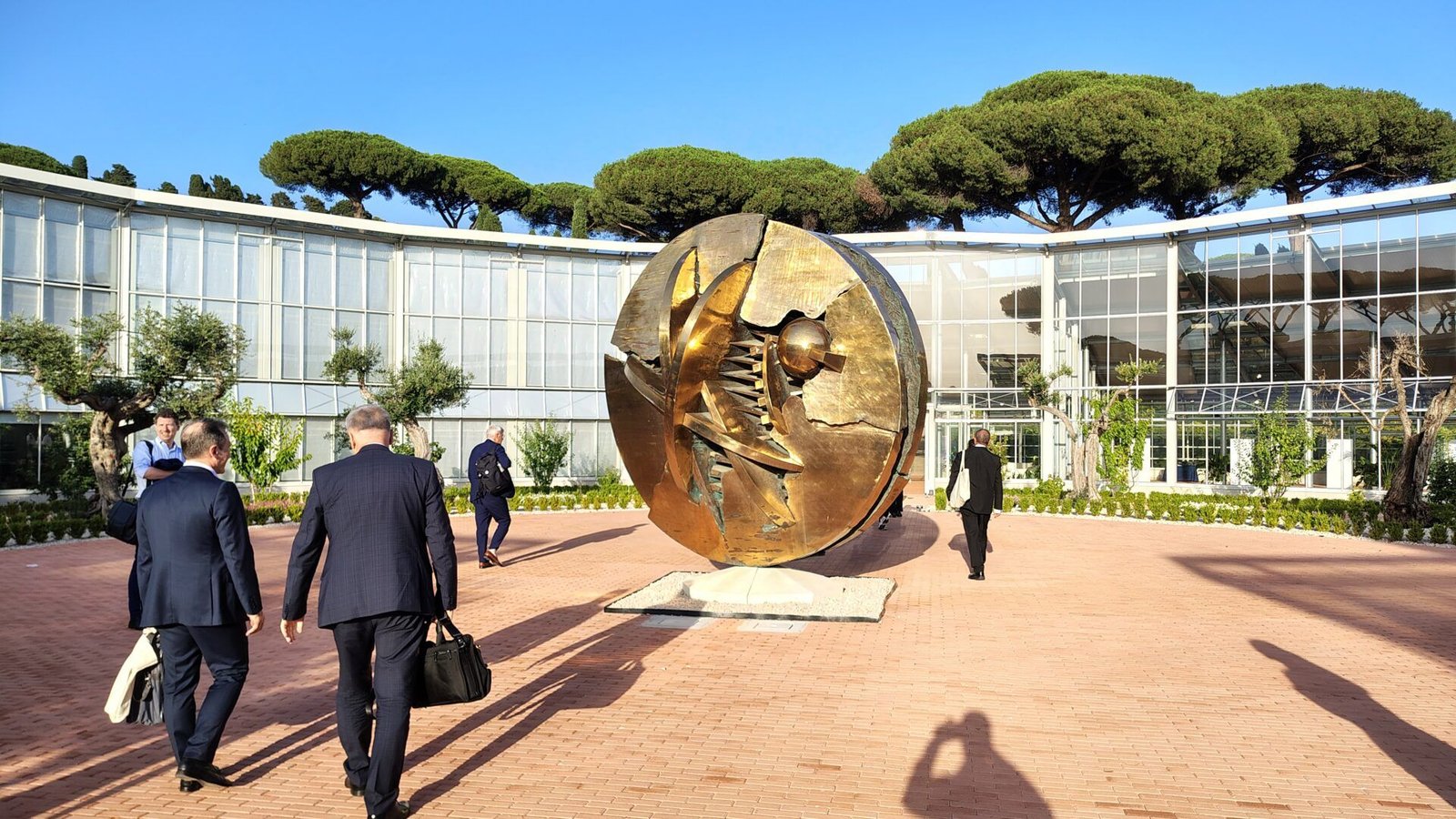
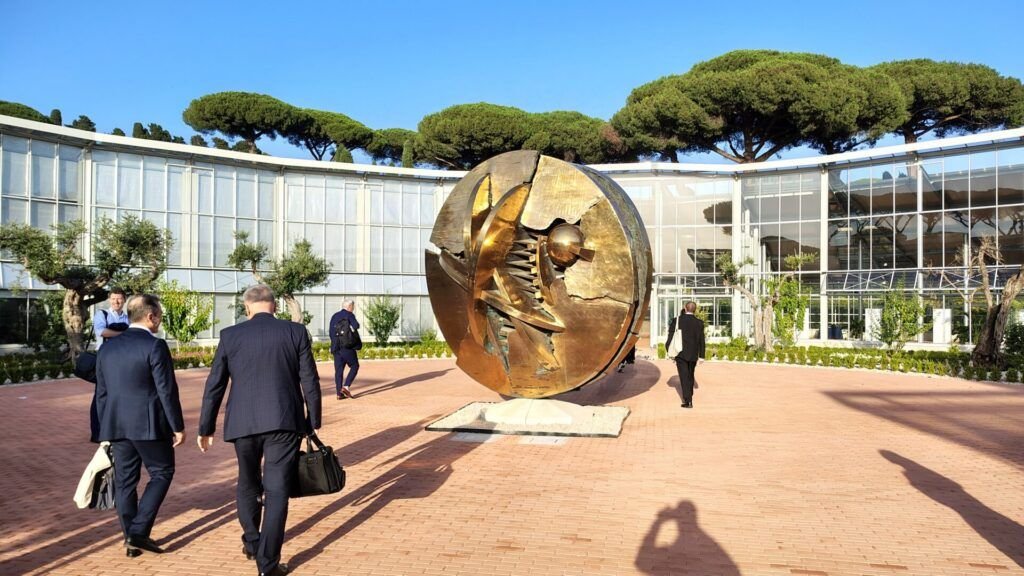
 Participants arrive at the Global Nobel Laureates Assembly on Artificial Intelligence and Nuclear War, which took place at Borgo Laudato si’ in Castel Gandolfo, southeast of Rome. (Photo by François Diaz-Maurin)
ROME — In a future nuclear crisis, the speed of artificial intelligence may leave little room for human judgment or decision-making. Other impacts of AI – its potential to enable destabilizing cyberattacks or enable the near-instantaneous generation of disinformation – increase the likelihood that such a crisis will even occur. An international group of Nobel laureates addressed these and other issues Thursday, warning urgently about emerging nuclear risks at a time of rapidly evolving AI technology.
The group’s statement titled Humanity on the Threshold: A Statement on Artificial Intelligence and Nuclear Weaponsfollowed two days of meetings between Nobel laureates, leading scientists and policy experts, and religious leaders at the Papal Villas of Castel Gandolfo, a summer residence for popes since the 17th century.
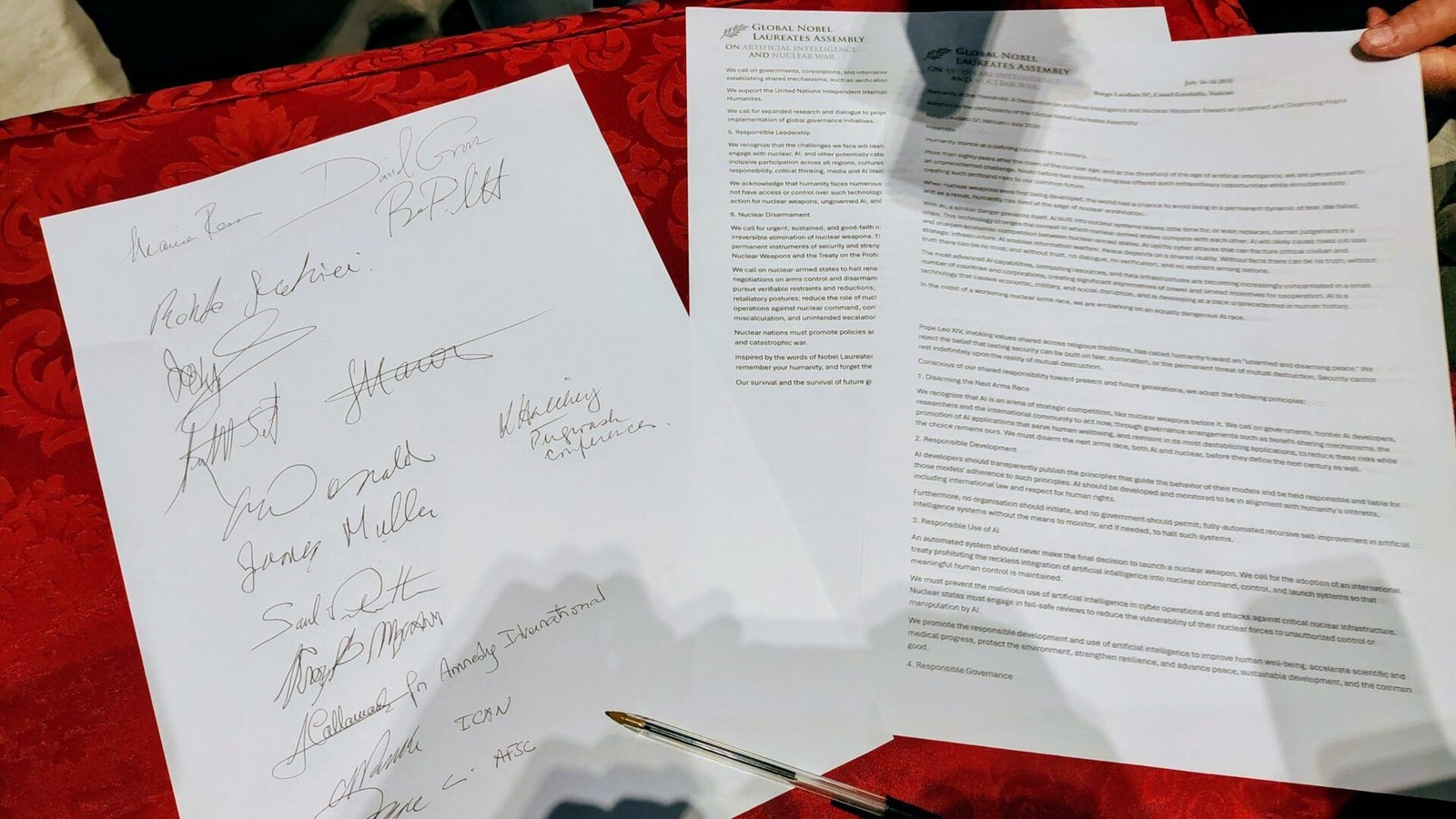 Over a dozen Nobel Prize winners signed the Rome Declaration on Artificial Intelligence and Nuclear Weapons at the Capitol in Rome on July 16, 2026. (Photo by François Diaz-Maurin)
Synchronized The Global Nobel Laureate Meeting on Artificial Intelligence and Nuclear WarThe meetings included expert presentations on eight topics related to the rapid advancement of AI models, their use in military systems that include the command and control of nuclear weapons, and the practical and ethical challenges associated with efforts to reduce the dangers that the AI-nuclear nexus poses to humanity.
The gathering followed recent efforts to highlight the risks posed by the ongoing AI and nuclear arms race. Last year, the Nobel Prize Laureate Meeting on the Prevention of Nuclear War met at the University of Chicago and issued a statement calling on policymakers and leaders to reduce the threat of nuclear war. And earlier this month, the United Nations published its first scientific assessment report on the opportunities, risks and impacts of AI; The assessment explains how technology could exacerbate global inequality.
But this week marked the first time that such a large and diverse gathering of scientists, experts, activists and religious leaders came together to address the risks of AI and nuclear weapons.
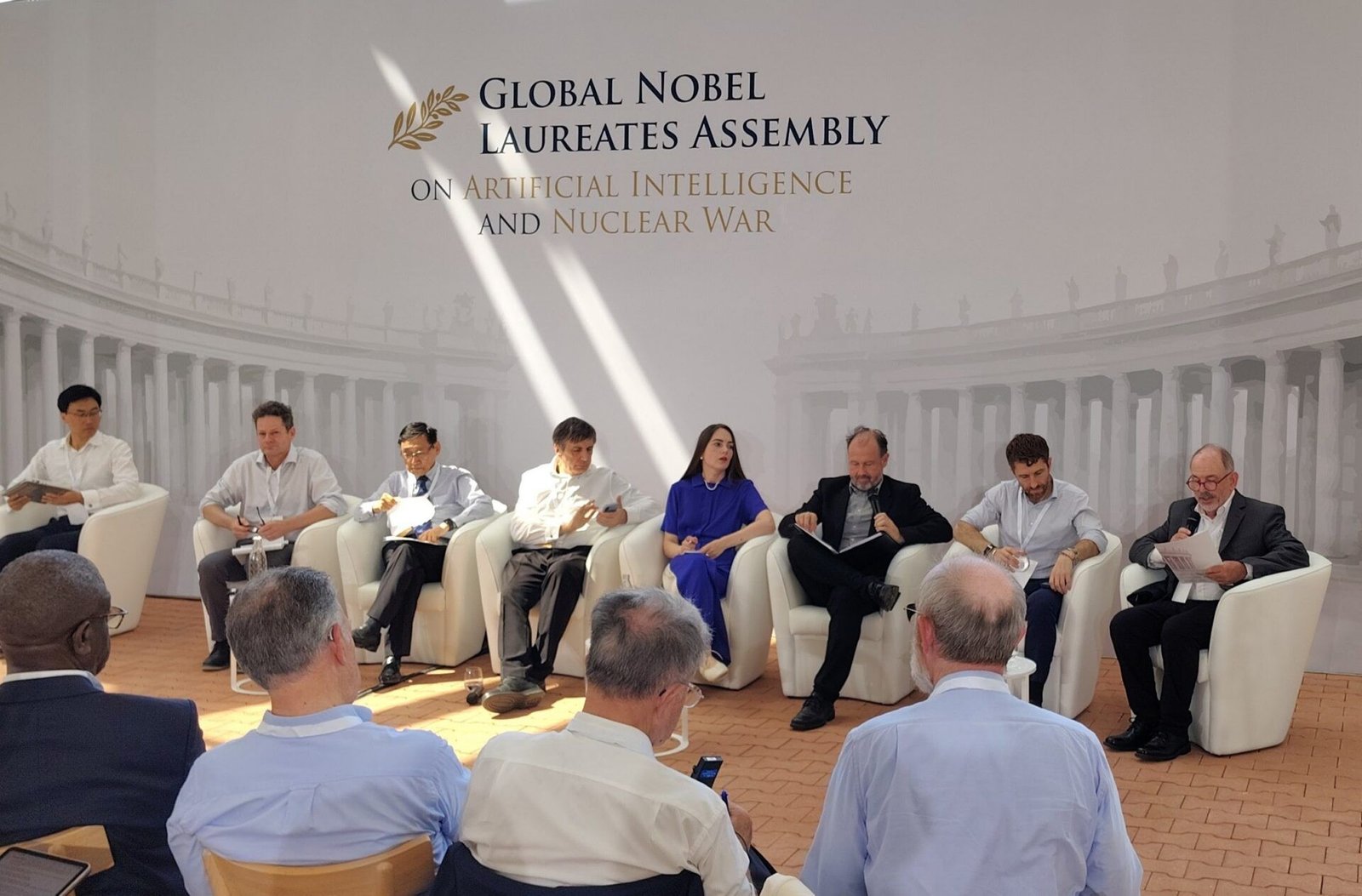 Panelists during a session on Technology in the Service of Humanity, moderated by bulletin Editor-in-Chief John Mecklin on July 14, 2026. From left to right: Tong Zhao (Carnegie Endowment), Jason Pruet (OpenAI), Tatsujiro Suzuki (Nagasaki University), Andre Konstantin Geim (2010 Nobel Prize in Physics), Oleksandra Matviichuk (2022 Nobel Peace Prize), Daryl Kimball (Arms Control Association), Tristan Harris (Center for Humane Technology) and John Mecklin. (Photo by François Diaz-Maurin)
The Rome Declaration contained a shocking description of the problem:
AI integrated into nuclear systems leaves little time for, or even replaces, human judgment in a crisis. This technology is changing the context in which nuclear-armed states compete with one another. … AI promotes cyberattacks that can destroy critical civil and strategic infrastructure. AI enables information warfare: Peace depends on a shared reality. Without facts there can be no truth; without truth there can be no trust; and without trust, there can be no dialogue, no verification and no restraint between nations.
The most advanced AI capabilities, computing resources and data infrastructures are increasingly concentrated in a small number of countries and companies, leading to significant power asymmetries and limited incentives for collaboration. AI is a technology that is causing economic, military and social disruption and is evolving at a pace unprecedented in human history.
Amid an intensifying nuclear arms race, we are embarking on an equally dangerous AI race.
The subtitle of the statement:Towards a weaponless and disarming peace– reflected the religious underpinnings of the gathering by referencing the language used by Pope Leo XIV in his May encyclical Magnifica Humanitas: protecting the human person in the age of artificial intelligence. The Vatican was able to bring together a diverse group of thought leaders in a way that probably would not have been possible otherwise. It’s a group that could have real impact.
“I could reach a million people,” said Brian Schmidt, winner of the Nobel Prize in Physics in 2011. “But the Pope can reach 2 billion. That’s 2,000 times more than me.”
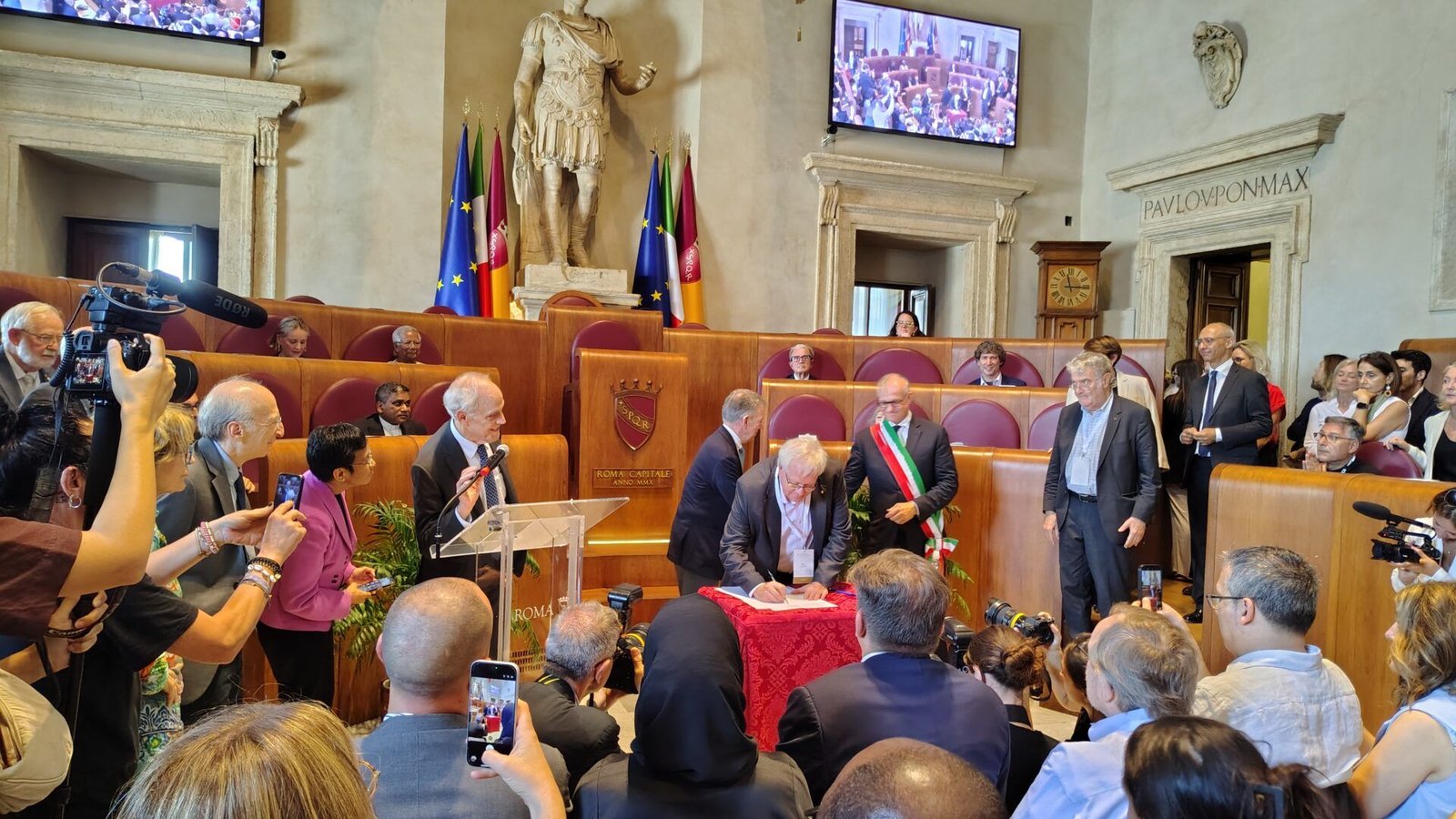 Nobel Prize winner in physics Brian Schmidt signs the Rome Declaration on July 16, 2026. (Photo by François Diaz-Maurin)
Part of the effort this week, Schmidt said, was aimed at convincing the Vatican that the combined risk of AI and nuclear war is an issue important enough for the Vatican and other churches.
Participants at the meeting called for urgent action to address the threat. For Maria Ressa, 2021 Nobel Peace Prize winner and co-rapporteur of the declaration, the world has already experienced its Trinity Test moment with AI, alluding to the first nuclear weapons test 81 years ago this week. “A nuclear bomb exploded silently in our information ecosystem. Now crises can be created in minutes.”
Muhammad Yunus, winner of the 2006 Nobel Peace Prize, said bulletin that the statement was important given the growing nuclear tensions and the threatening possibilities that AI brings with it. For Yunus, “artificial intelligence is just the beginning of the horror story. It can become a terrible thing because we let the genie out of the bottle. So this is a good time to take a stand.”
Many participants noted that given the speed at which AI is evolving, it is difficult to assess the risk. “AI is a technology we don’t understand, and it’s evolving faster than humans can comprehend,” says Daniel Holz, an astrophysicist at the University of Chicago and chairman of the Bulletin of Atomic Scientists“Science and Security Council said during the public ceremony. Wood played an important role in organizing the gathering; The bulletin was a sponsor of the campaign. “Many of those developing AI technology are afraid of this technology,” Holz added. An expert who works at a large AI company said this bulletin that until three months ago the expert was not worried that AI could become an existential threat. Now the developer is worried. Deep.
“I felt uncomfortable. Now I’m really worried,” said Schmidt, the 2011 physics prize winner. “It’s because I learned more.”
Did the meeting find the right time? “I think we’ve done it,” Schmidt said, adding: “It’s a very complicated new space. I think bringing the groups together has clarified the risk.”
The meeting may have brought clarity to the problem, but formulating solutions will be difficult. The statement makes six recommendations, including ending the AI and nuclear arms race and ensuring responsible development and governance of AI models so that they are consistent with “the interests of humanity, including international law and respect for human rights.”
Actress and humanitarian activist Sharon Stone, who took part in the assembly’s deliberations, called on leaders to “pursue the common good and peace for every human being,” adding: “Our children must be given the opportunity to continue to love one another.”
Juan Manuel Santos, a 2016 Nobel Peace Prize winner and former president of Colombia, noted that in the 1980s and 90s, people took to the streets in massive demonstrations against nuclear weapons and the threat of nuclear war.
“Today, 40 years later, the risk of nuclear war has increased dramatically [including because of AI]“There is virtually no demonstration, no public response to this existential threat,” Santos said bulletin. “I hope that a meeting of this kind will provide the impetus for such a response from public opinion to push world leaders to make more concrete decisions to reduce the risk to the poor.”
During the press conference, Holz called the declaration “a productive first step” at a time of unprecedented danger. The Nobel laureates said they now had to spread their message far beyond Castel Gandolfo.
“This is the beginning,” said Yunus. “The whole world should come together, not just a few people. This is very important.”
David Gross, 2004 Nobel Prize winner in physics and co-rapporteur of the statement, agreed. “The next fight will be on the streets.”
https://thebulletin.org/2026/07/ai-for-peace-in-rome-nobel-laureates-call-for-disarming-ai-and-nuclear-weapons/
