

Landshut. The BMW Group is expanding its expertise in the area of physical AI: The BMW Group plant in Landshut is taking on central software development tasks for AI-supported robotics in component production. The focus is on open software platforms, the generation, provision and processing of training data, simulation and movement planning as well as the training of robotic systems. These activities complement the pilot projects already underway on the use of humanoid robotics in the Leipzig and Spartanburg plants.
Landshut uses its role as a competence center for its own component production. The wide range of products and manufacturing processes offers ideal conditions for developing and evaluating new approaches using AI-supported robotics under real production conditions. The focus of these activities is the question of which tasks are suitable for humanoid robot systems in the future – especially where flexibility, fine motor skills and understanding of the working environment are required. For this purpose, the Landshut plant is developing software that enables robots to perceive their surroundings, evaluate situations and independently derive appropriate actions from them.
“At the BMW Group plant in Landshut, we combine software know-how with industrial practice in component production. This allows us to test new technologies at an early stage and carefully evaluate their benefits for production,” he says Dr. Wolfgang Blümlhuber, head of driving dynamics and in-house component production.
Technological foundations for AI-supported robot systems
The starting point is the further development of the software architecture. At the Landshut location, the BMW Group relies on open platforms that enable flexible and scalable training of robots by combining traditional (deterministic) programming with modern AI models (Vision-Language-Action (VLA) models), integrating visual information, language understanding and robot actions. The goal is a modular robotics ecosystem in which different systems work together. This creates a technical basis for new functionalities and diverse industrial applications.
This requires reliable data. At the Landshut plant, the project team collects data from real production environments and test setups and integrates them into robot simulations in which movement patterns and movement planning are modeled virtually. This allows processes to be tested in advance and learning processes to be accelerated. New approaches are first tested outside of ongoing production, implemented in pilot projects and then scaled.
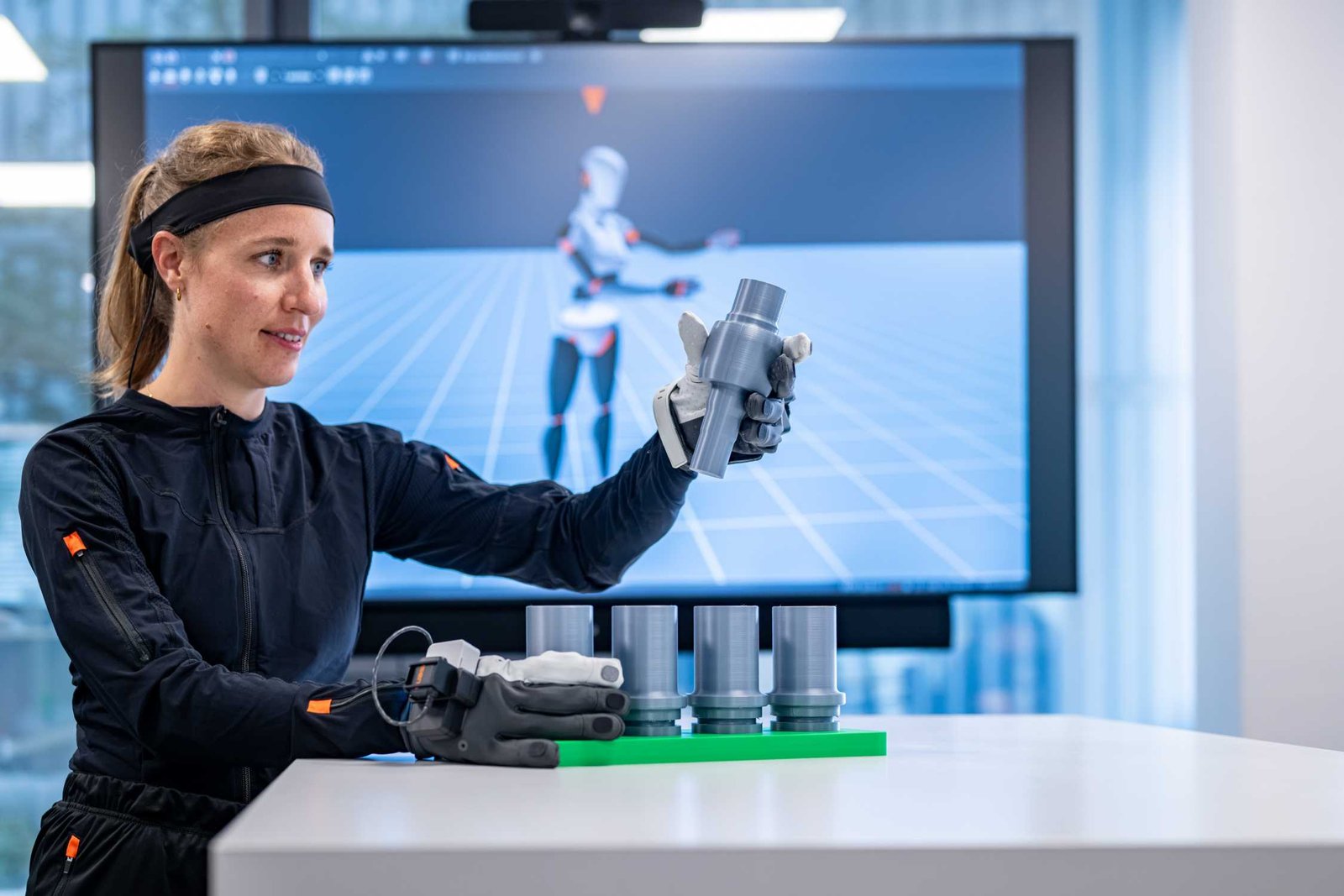
In parallel, humanoid robot systems acquire new skills through demonstration-based learning. Movement patterns and work processes are first demonstrated by the project team. The data generated in this way is captured by camera systems, motion capture suits and data gloves. They are then converted into generalizable behavioral models – called policies – that can be applied to different tasks and use cases.
“It is crucial for us to develop the technology very closely to real-world requirements. We not only test what is technically possible, but also where humanoid robotics can deliver truly reliable advantages in component production. This gradually creates a clear picture of which applications are suitable for industrial use,” he says Christoph Jagoda, project manager for physical AI at the BMW Group plant in Landshut.
Possible uses in component production
On this basis, the Landshut plant is working on applications for humanoid robotics in component production. The focus is on tasks that require a high level of flexibility, fine motor skills and a good understanding of objects and work environments. This includes recognizing and interpreting environments, determining position and status, planning efficient movements, and precisely gripping and moving components.
To further develop the basic technology, the BMW Group works closely with partners from industry and science at the Landshut location. This includes, in particular, direct collaboration with Athenyx Robotics, a startup founded specifically for this technology area, which has its origins at the Machine Tool Laboratory (WZL) at RWTH Aachen University and is located in the immediate vicinity of the BMW Group plant in Landshut.
The technology company is developing AI-based software for intelligent robot systems together with specialists from the BMW Group. The main aim is to create a so-called “intelligence stack” that integrates perception, learning, simulation and decision-making. The aim is to enable humanoid robots to independently carry out complex tasks in industrial environments. The prerequisite for this is that the systems are able to perceive their environment, evaluate situations and derive appropriate measures from them. The platform-based approach means that acquired skills can be transferred to different robotic systems and use cases in the future.
In addition, the Landshut plant works with specialists from Landshut University – for example in data generation, simulation and the development and testing of specific use cases.
https://www.press.bmwgroup.com/global/article/detail/T0459467EN/bmw-group-plant-landshut-develops-software-for-humanoid-robotics-in-component-production?languageu003den
