After a decade-long comeback, chip giant Advanced Micro Devices is preparing to ship its first artificial intelligence rack system called Helios to a growing customer list that now includes Microsoft.
It’s the first competitor to Nvidia’s wildly popular Grace Blackwell and Vera Rubin systems, and aims to give the world’s most valuable chipmaker its first real competition in years.
Microsoft announced on Monday that it would use the Helios system in its data centers and joined Meta, OpenAIOracle and others in the race for as much computing power as possible.
AMD will begin shipping to customers, including Microsoft, later this year.
Details about the financial terms or the amount of computing capacity were not disclosed.
“We are expanding the Azure infrastructure portfolio with AMD Helios to give customers the performance, scalability and choice they need to build and run the next generation of AI applications,” Microsoft CEO Satya Nadella wrote in a press release.
The new Helios system will enable frontier model inference for Microsoft and its AI customers and support Azure AI services. Microsoft will also add two new compute instances running on AMD’s latest “Venice” central processing units, or CPUs, one for agentic AI and data pipelines and another for semiconductor design.
It’s the continuation of a long-standing partnership that has seen AMD chips power Microsoft’s Surface PCs and Xbox gaming consoles for many years. In 2023, Microsoft also became the first company to introduce AMD’s MI300X graphics processing unit (GPU), which competed with Nvidia’s AI chips. Microsoft also uses its own Maia chips in its data centers.
Like its competitors, Microsoft needs as much computing power as possible, especially as it advances its own model development and dedicates more computing capacity to research and development. Seven home-built models were announced in June. Microsoft’s AI efforts have yielded mixed results so far, from the 365 Copilot AI assistant to the GitHub Copilot coding agent. It is the “Magnificent Seven” share with the worst performance so far this year.
Microsoft is among a growing number of large companies turning to AMD for AI acceleration. According to AMD, eight of the top 10 AI companies run workloads on its Instinct GPUs, including OpenAI, Cohere and Elon Musk’s SpaceXAI, which is part of SpaceX.
An AMD employee installs the first rack-scale Helios AI system at a data center lab in Rockdale, Texas, on June 24, 2026. Helios is available in four customizable configurations, and Meta will be making these available later this year.
Andrew Evers | CNBC
In February, Meta announced plans to use up to 6 gigawatts of AMD GPUs over time, starting with 1 gigawatts deployed on Helios racks later this year. OpenAI and Oracle have also made big commitments to using Helios this year, with India’s largest IT company, Tata Consultancy Services, also pledging to use it.
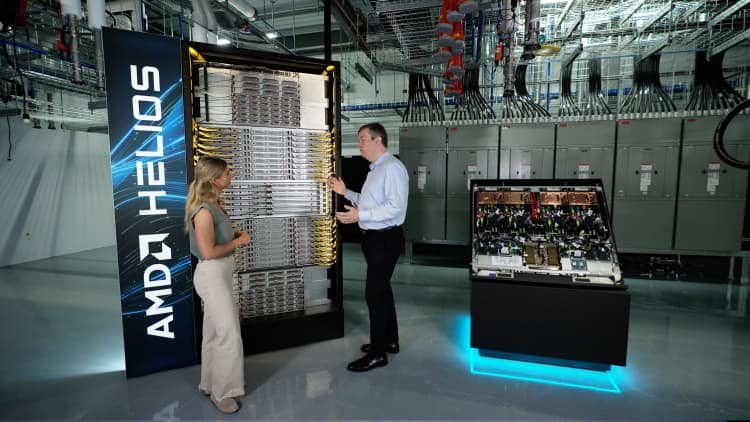
CNBC got the world’s first detailed look inside a Helios system from the Texas data center lab where it is being developed and tested.
Table of Contents
“Lowest cost per token”
Named after an ancient Greek god who uses four horses to pull the sun across the sky, Helios brings together four things that AMD does internally: GPUs, CPUs, networking and software.
“We’re very focused on providing the best total cost of ownership and the lowest cost per token,” data center head Forrest Norrod told CNBC of AMD’s first-generation system. “And our customers tell us that we achieve this.”
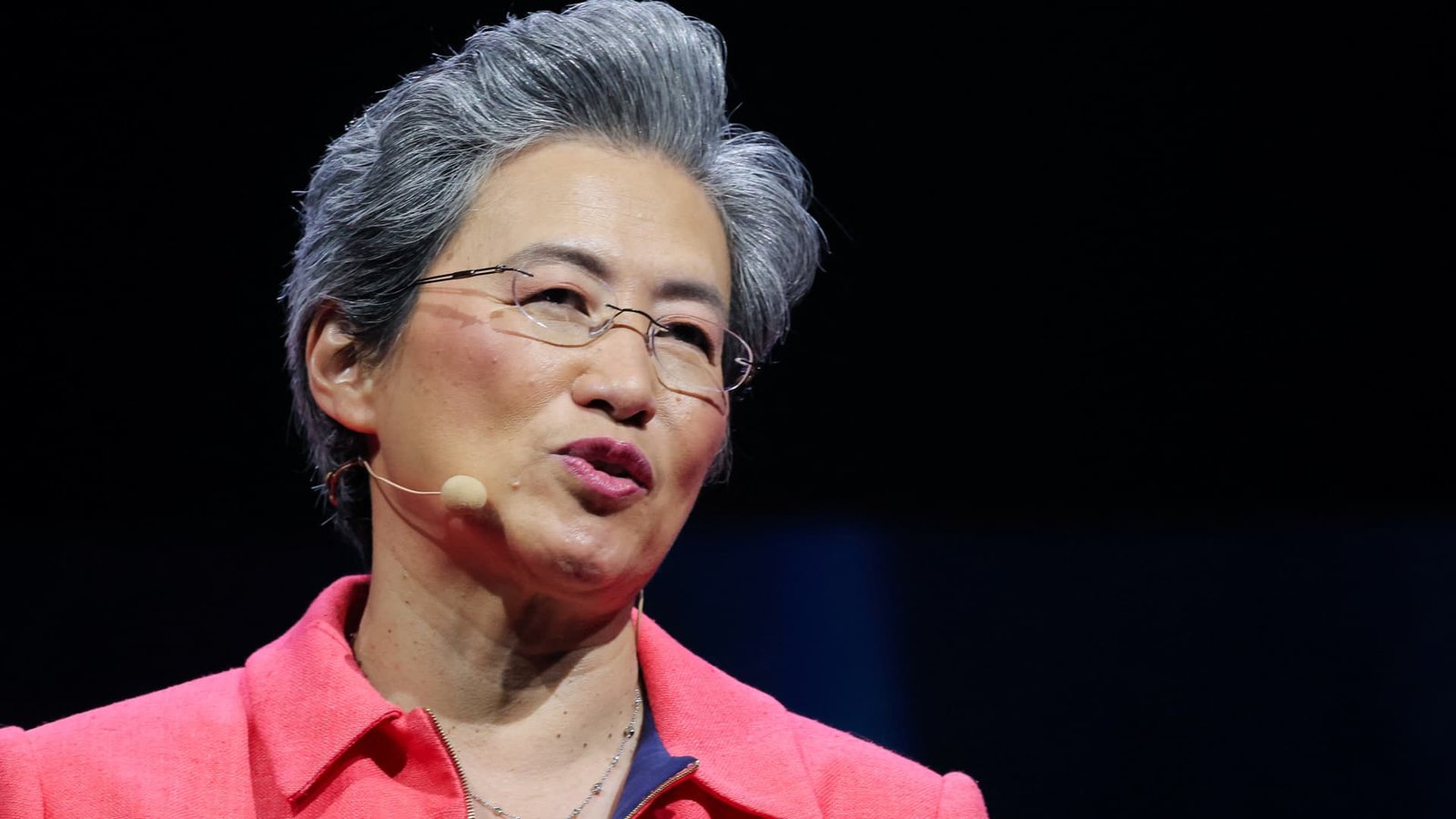
In May, AMD CEO Lisa Su told CNBC’s Jim Cramer that Helios had “significant advantages” over Nvidia’s rack-scale systems “when it comes to inference and when it comes to memory bandwidth and storage capacities.”
While AMD isn’t commenting on cost, Futurum Group estimates Helios will cost between $5 million and $5.5 million. That compares with Futurum estimates of $3.5 million to $4 million for Nvidia’s second-generation Vera Rubin rack-scale system.
At up to 7,000 pounds, Helios is also wider and heavier than Nvidia’s Vera Rubin.
According to Futurum Group, Nvidia controls more than 95% of the data center GPU market. AMD only has about 4.5% of the market, but Helios could change that.
“I think there’s a serious case where AMD does great and can get to 20% and 25%. And that’s hundreds of billions of dollars in revenue, by the way,” said Daniel Newman, analyst and CEO of Futurum Group.
In the first quarter of 2026, data centers accounted for the majority of AMD revenue, up 57% year-over-year. AMD told CNBC that it plans to generate tens of billions of dollars in data center AI revenue starting in 2027, with the majority coming from Helios.
In terms of CPU market share in the data center Intel remains the clear leader, but AMD has steadily gained ground. This CPU leadership distinguishes AMD from Nvidia, which launched its first server CPU in 2021 and changed its strategies this year to return the focus to chips.
“A completely different AMD”
Norrod called Helios “our baby” as he showed CNBC the system’s core chips. Each of its 18 computing compartments has four Instinct GPUs powered by a single EPYC central processing unit.
It was these EPYC data center CPUs that helped AMD regain a decade of lost leadership in the data center market.
In 2003, AMD had a breakthrough data center CPU that helped the company quickly capture nearly a quarter of the market. But that share dwindled after a series of delays and missteps that led to large layoffs and declining sales when Su took the helm.
“It’s been a very different AMD under Lisa’s leadership over the last 12 years,” Norrod said.
The turning point came after the company introduced the first EPYC server CPU on stage in 2017.
“One of the things we did is detail our roadmap for three generations, which is very unusual,” he said. “And we delivered exactly what we said we would.”
Part of AMD’s roadmap included plans to launch Helios with the current MI400 series of GPUs.
Each Helios tray also features up to 12 networking chips made with technology AMD acquired when it purchased Pensando in 2022.
It was one of several acquisitions that contributed to Helios’ development in recent years.
AMD’s largest purchase to date was programmable chip maker Xilinx for nearly $50 billion in 2022. AMD also acquired server maker ZT Systems for nearly $5 billion in 2025, as well as a number of software companies that helped the company develop ROCm, its open source alternative to Nvidia’s widely used CUDA software ecosystem.
Neil Shah, an analyst at Counterpoint Research, said AMD’s Helios chips are “on par” with Nvidia’s GPUs and CPUs, but the “secret lies in the software and optimization.”
“I think Nvidia has a larger ecosystem with CUDA and is well ahead of AMD,” he said.
With Helios, AMD has the opportunity to make significant progress depending on how well the initial deployments perform.
“The question will be: Does AMD win because they are technologically superior? Or does AMD win because the capacity is so limited that if they can build it, someone will buy it?” Newman said.
REGARD: First, look at Vera Rubin, Nvidia’s AI system, which is 10 times more efficient than Grace Blackwell
— CNBC’s Jordan Novet contributed to this report.
Choose CNBC as your preferred source on Google and never miss a moment from the most trusted name in business news.
https://www.cnbc.com/2026/07/20/amd-helios-microsoft-ai-nvidia.html
