

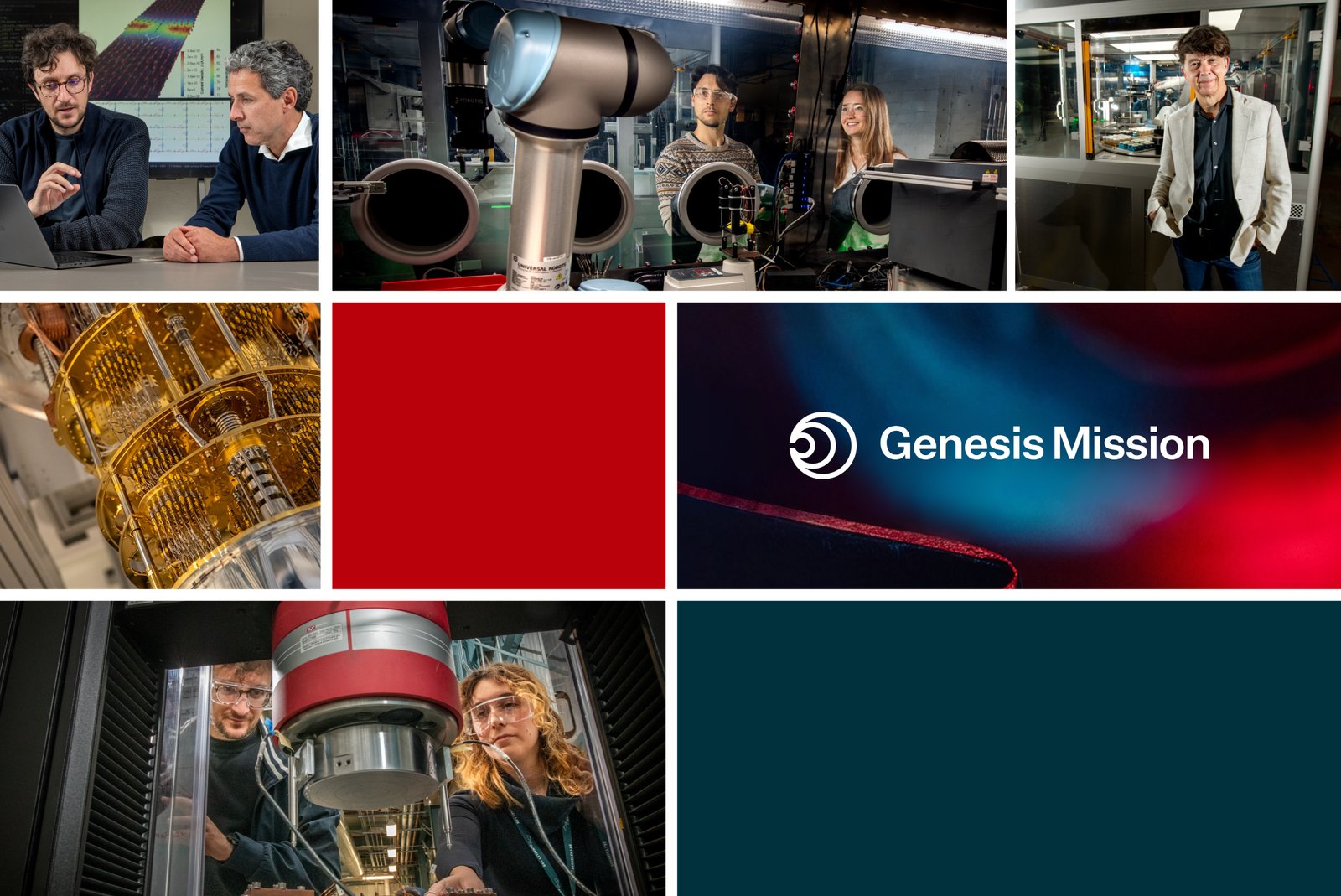
Today the US Department of Energy announced Funding new projects that use artificial intelligence to accelerate discoveries. Lawrence Berkeley National Laboratory (Berkeley Lab) will lead 13 projects and partner on more than 30 others.
The projects are part of DOEs Genesis Missiona historic national initiative aimed at building the world’s most powerful integrated platform for scientific discovery. Bringing together government, industry, academia and philanthropy, it aims to accelerate breakthroughs in energy, scientific discovery and national security through a new platform that combines AI, supercomputing, quantum systems and advanced scientific instruments.
Contributions from Berkeley Lab The Genesis mission builds on decades of research in high-performance computing, big data management, and groundbreaking AI models. Researchers will lead new projects across multiple disciplines, advancing areas such as critical minerals, materials, manufacturing, fusion and energy.
“By developing advanced AI tools and combining them with high-quality datasets and high-performance computing, our researchers maximize their scientific impact and accelerate discovery,” said Kathy Yelick, director of Berkeley Lab. “In addition, the Genesis mission is also an opportunity to develop better AI tools and approaches for all of science that will pay dividends for generations to come.”
The goal of Genesis Mission Phase 1 projects is to identify promising pathways to transformative scientific capabilities and provide a foundation for future investment and scale. Project teams will design and demonstrate research workflows that integrate AI with scientific inquiry, rigorously assessing whether these approaches can accelerate discoveries, improve predictive capabilities, improve experiments, or generate new scientific knowledge.
The Projects The leaders of Berkeley Lab are:
- AI decrypts DOE data to protect hydropower and US grid: ASPIRE will create an AI-driven workflow that leverages Department of Energy data to improve precipitation forecasting, secure U.S. hydroelectric power generation, and protect critical grid infrastructure.
- AI-driven autonomous laboratories for accelerated material discovery: Researchers will develop AI systems that work with autonomous laboratories to design, conduct and learn from experiments, dramatically accelerating materials discovery and scientific innovation.
- AI-powered discovery of quantum and optoelectronic materials: AI based on physics simulations will model excited states to identify promising quantum and optoelectronic materials, accelerating research into future computing, sensing and energy technologies.
- AI to predict water supply for energy with novel precision: Scientists will develop an artificial intelligence framework to collaboratively predict surface and groundwater dynamics nationwide to support energy and water security.
- AI workflows for running DOE code in the cloud: The Agentic HPC Pipeline Initiative (AHPI) will develop AI workflows that enable U.S. manufacturers to run high-performance DOE research code on commercial cloud platforms.
- Breaking down silos: AI for designing final repositories for nuclear waste: AI will enable an optimized environment to analyze nuclear waste repository design and break down existing silos through a digital twin approach.
- Closing the loop: AI-accelerated alloy development: Researchers will combine AI structure prediction, high-throughput synthesis and advanced microscopy to accelerate the optimization and design of complex concentrated alloys for extreme environmental applications.
- HERALD: AI to unlock nuclear archives: The HERALD Project will build an AI platform to review decades of secure government research and release it to commercial industry to accelerate nuclear innovation.
- Meeting water-energy demand with local, actionable forecasts: To predict water resources for energy infrastructure, scientists will use AI to develop a high-precision water availability forecasting system.
- Novel AI workflow for critical minerals in geosystems: The team will use AI to optimize the extraction of critical minerals from copper, molybdenum, platinum, chromium and nickel mineral deposits.
- Physics-informed digital twins for fusion magnet systems: AI-powered digital twins will pave a credible path for the reliable operation of high-temperature superconducting magnets and support future compact magnetic confinement fusion power plants.
- Predicting underground fractures with AI for energy: Scientists will combine artificial intelligence and geophysical observations to improve prediction of underground fractures and advance geothermal and other energy technologies.
- Store nuclear waste safely with advanced 3D models: Researchers will develop AI-powered 3D geological models that can effectively identify suitable locations for underground storage of nuclear waste.
###
Lawrence Berkeley National Laboratory (Berkeley Lab) is committed to groundbreaking research focused on discovery science and solutions for abundant and reliable energy supplies. The laboratory’s expertise includes materials, chemistry, physics, biology, earth and environmental sciences, mathematics and computer science. Researchers from around the world rely on the laboratory’s world-class scientific facilities for their own groundbreaking research. Founded in 1931 with the belief that the biggest problems are best solved by teams, Berkeley Lab and its scientists have been awarded 17 Nobel Prizes. Berkeley Lab is a national multiprogram laboratory managed by the University of California for the U.S. Department of Energy’s Office of Science.
DOE’s Office of Science is the single largest supporter of basic research in the physical sciences in the United States and is working to address some of the most pressing challenges of our time. For more information, visit energy.gov/science.
https://newscenter.lbl.gov/2026/07/22/berkeley-lab-to-lead-13-new-genesis-mission-ai-projects/
