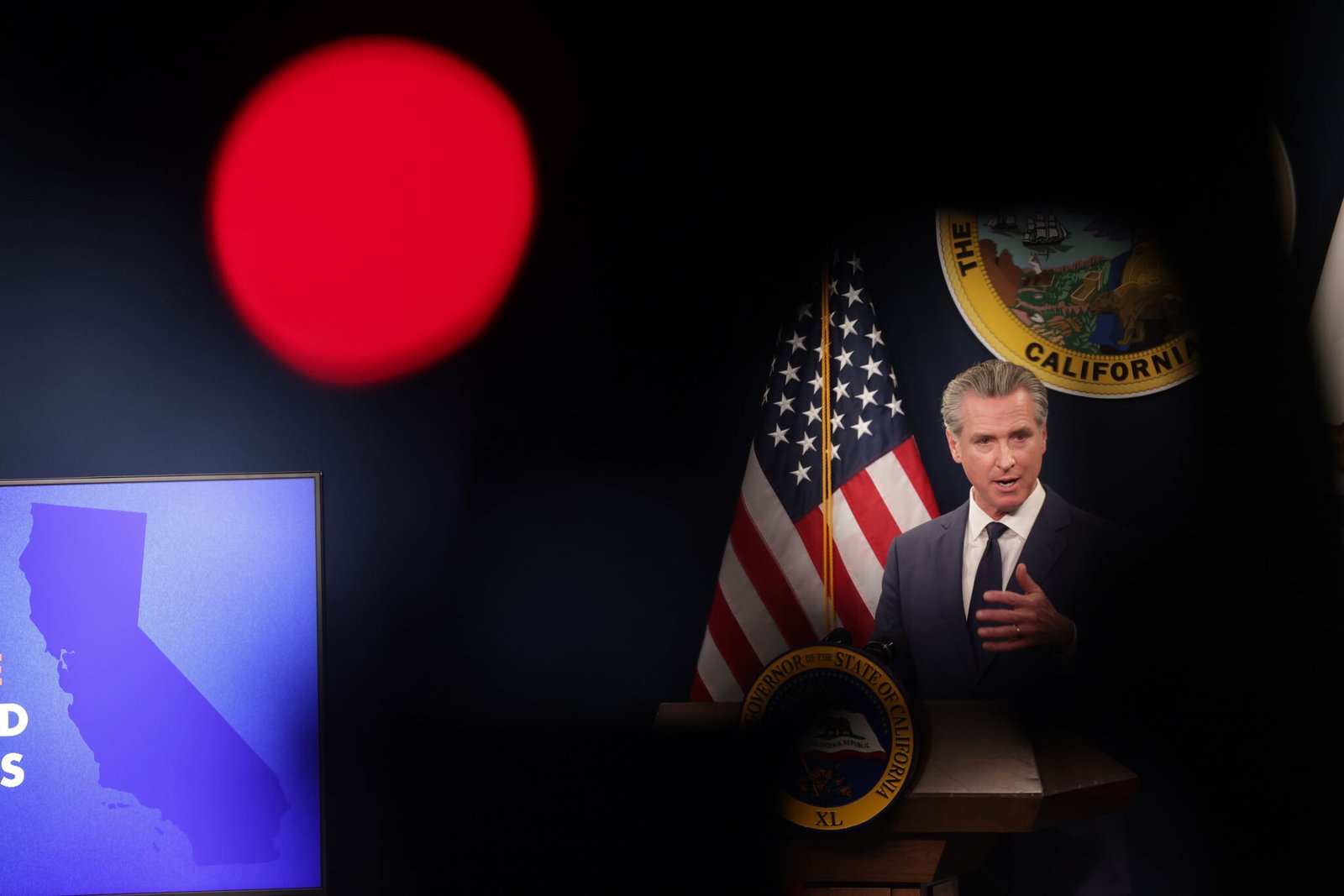
Gov. Gavin Newsom unveils his final state budget plan on May 14 at the Capitol in Sacramento. The budget he signed Monday includes several new taxes.
Gabrielle Lurie/SF Chronicle
A flood of biblical proportions is coming to California, and no, I’m not talking about the weather.
I’m talking about taxes.
Yes, there is the infamous billionaire wealth tax that Californians will officially vote on in November after Gov. Gavin Newsom and state lawmakers failed to reach a deal with the measure’s supporters last week to keep it off the ballot.
The article continues below this ad
But a flood of further tax increases is also planned.
Rich or poor, California is looking for your money.
San Francisco Chronicle logo
Make us your preferred source to find out more about our news in your search.
Add preferred source
Let’s start with the nearly $352 billion state budget Newsom signed Monday. Although Newsom smugly described it as “timely, balanced and structurally sound,” the reality is far less rosy.
For years, California has been spending more money than it makes, leading to a structural deficit even as it rakes in record revenue thanks to the artificial intelligence frenzy. To balance things out on paper, Newsom and lawmakers have relied on a variety of accounting tricks, drawing billions of dollars from reserves.
The article continues below this ad
You don’t have to be an accountant to understand that sacrificing your savings at a time of rising income is not smart tax policy.
“These measures should be reserved for addressing revenue shortfalls during downturns and not for balancing the budget during a revenue boom,” the nonpartisan Legislative Analyst’s Office warned in a recent report.
Still, in their budget agreement, Newsom and lawmakers decided to squeeze even more money from Californians through several new taxes that are set to take effect in 2027.
One charges you state and local sales taxes on digital downloads and remote cloud access for software programs like Microsoft 365, Google Workspace, QuickBooks, Zoom and Salesforce. This is expected to raise $900 million annually for the state and $1.1 billion for local governments.
Another measure, which requires federal approval to take effect, would increase an existing tax on private health insurance to bring about $1.5 billion annually into state coffers.
The article continues below this ad
Yes, you read that correctly. Health care costs are skyrocketing, but California is making health insurance more expensive.
The California Association of Health Plans, which represents health insurers, estimates annual premiums will rise by $100 for an individual and $400 for a family of four.
“Significantly increasing health care premiums for hard-working Californians to replenish the state’s general fund … is particularly concerning as state leaders continue to say affordability is a top priority,” the association said diplomatically in a statement.
I’ll put it more clearly:
In their relentless fight for more money, Newsom and lawmakers would rather pay everyday Californians five cents than do the hard, politically sensitive work of making the state more affordable.
The article continues below this ad
For example, Democratic lawmakers have long expressed their desire to stop subsidizing large companies with a disproportionate share of workers under Medi-Cal, the government’s low-income health insurance program. Why should taxpayers foot the bill for companies that don’t want to pay their workers enough to survive?
But the budget agreement they reached with Newsom scuttles a decision by weakly directing the governor to “present fully viable options to the Legislature to hold large corporations accountable for their employees’ health care costs by April 1, 2027.”
There are two ways leaders could bring the budget under control. You might – gasp! – live within their already generous means. Or they could pursue systemic reforms to simplify California’s incredibly complex tangle of spending rules and regulations and stabilize its notoriously turbulent tax revenues. (Because the budget relies heavily on the wealthiest taxpayers, revenue varies greatly depending on the stock market.)
But until now, state policymakers have largely lacked the courage to do both.
It’s no wonder that interest groups are trying to close the leadership gap with their own actions.
The article continues below this ad
There’s the billionaire tax, Proposition 40, which would impose a one-time, legally dubious 5% wealth tax on billionaires to mitigate the impact of the Trump administration’s health care cuts. Prop 3, on the other hand, would make permanent an existing tax set to expire in 2031 that targets individuals making at least $360,000 and joint filers making at least $721,000 to fund kindergarten through 12th grade and community colleges.
Then there are the anti-tax measures that are explicitly aimed at abolishing the billionaire tax. Prop 41 would, among other things, prevent a new state tax from circumventing voter-approved spending limits. The so-called Gann limit caps the state’s per-capita spending and generally requires excess funds to be split between tax refunds and schools. The billionaire tax was written to get around the rule.
Prop 42, on the other hand, would ban new state taxes on things like retirement accounts, financial assets, business interests and intellectual property, while also banning certain retroactive state taxes. The billionaire tax would apply retroactively to everyone living in California starting January 1, 2026.
The Gann limit also features prominently in Prop 2, which was placed on the ballot by state lawmakers. This measure would allow the state to double the amount of money it can keep in reserves while exempting those funds from the spending cap — meaning the state could keep more tax money without having to send some of it back.
Then there’s Prop 43, which would require approval from two-thirds of voters to pass local special taxes on citizen initiative, instead of the current simple majority requirement. State lawmakers have also placed the measure on the ballot — although many, including its sponsor, Democratic Assemblywoman Buffy Wicks of Oakland, plan to actively fight it.
Lawmakers put the measure before voters to persuade the Howard Jarvis Taxpayers Association — the anti-tax group behind Prop 13’s 1978 property tax cap — to withdraw its own ballot measure sharply limiting property transfer taxes retroactively Citizen-led local special taxes require a two-thirds majority, which would have left a huge hole in the budgets of many local governments.
“Politics doesn’t always give you good decisions,” Wicks tweeted. “Sometimes you have the choice between bad – and much worse.”
TRUE. But Newsom and lawmakers have arguably created the conditions for such bad decisions to thrive by consistently failing to create responsible and fair budgets.
Guest opinions in Open forum and insight are written by authors with expertise, personal experience or original insights on a topic of interest to our readers. Your views do not necessarily reflect the opinion of The Chronicle Editorial Board, committed to providing a diversity of ideas to our readership.
We see the consequences on our ballots and feel them in our wallets.
Here’s another one for you on the go: The state’s gas tax increased by 2 cents per gallon on Wednesday, bringing it to over 63 cents per gallon.
Emily Hoeven is a columnist and editorial writer for the Opinion section.
https://www.sfchronicle.com/opinion/article/tax-money-state-california-22325976.php
