North Carolina’s most exclusive and expensive private schools receive little or no money from the Opportunity Scholarship voucher program, while the program’s largest recipients are overwhelmingly lower-cost religious schools, according to a Carolina Journal analysis of state disbursement data.
Of the 703 schools that received grant money in the 2025-26 school year, some of the state’s best-known private academies don’t appear at all. Ravenscroft in Raleigh, Cary Academy, Charlotte Latin, Providence Day School in Charlotte, Durham Academy, Greensboro Day, Charlotte Country Day, Carolina Day School in Asheville and Asheville School did not receive voucher money.
These schools are among the most expensive in the state. For example, Durham Academy’s tuition is $37,500, while Ravenscroft charges $34,190, Charlotte Latin charges $36,500, Providence Day charges $36,325, and Cary Academy charges $35,700.
For at least one of these schools, staying outside is a conscious decision. Ravenscroft says on its website that it is not participating because the program “imposes a number of rules and regulations” that “have the potential for the state to dictate future policies and programs.” This oversight, the Raleigh school said, would jeopardize its independence as a private institution.
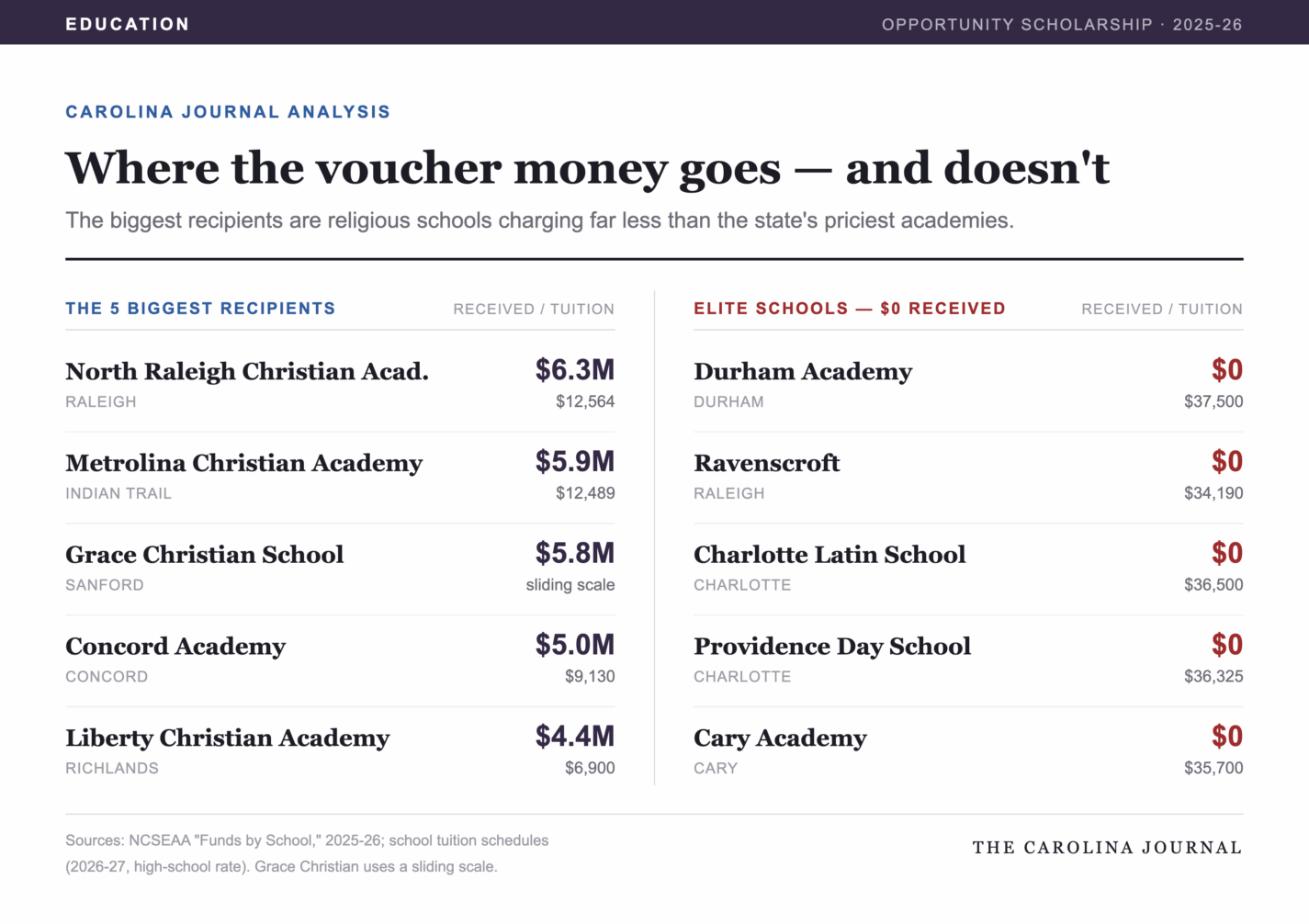
The pattern complicates a common criticism. Senate Minority Leader Sydney Batch, D-Wake, argued in June in a profanity-laced satirical video posted to social media that Republicans “donate $250 million a year to private schools so rich kids can learn ‘history’ with our damn tax dollars.” Payout data shows the state’s most expensive academies receive none of that money. The data does not capture the income of families at participating schools.
The Opportunity Scholarship program awarded approximately $589 million to nearly 107,000 students this year, according to the NC State Education Assistance Authority (NCSEAA), which administers it. Enrollment roughly tripled after the General Assembly eliminated the program’s income limits in 2023. The maximum grant is $7,686 for students from lower-income households.
Table of Contents
The biggest recipients
The Carolina Journal listed the 100 schools that received the most scholarship money in the 2025-26 school year and reviewed each school’s religious affiliation and published tuition rates.
More than 80 of the 100 are religious schools. Most of the rest are campuses of Thales Academy, a secular chain that charges about $7,000 a year. The others are primarily college preparatory day schools and schools for students with disabilities.
The Carolina Journal found published tuition rates for 89 of the 100 schools. Among these 89, the average tuition is about $7,900 per year. About two-thirds ask for less than the $11,569 North Carolina spends per student in state and local funds in the 2024-25 school year, according to the state Department of Public Instruction (DPI), and about three-quarters ask for less than the $13,068 it spends per student when federal money is also included. At around 40 schools, a full scholarship covers the entire tuition fees.
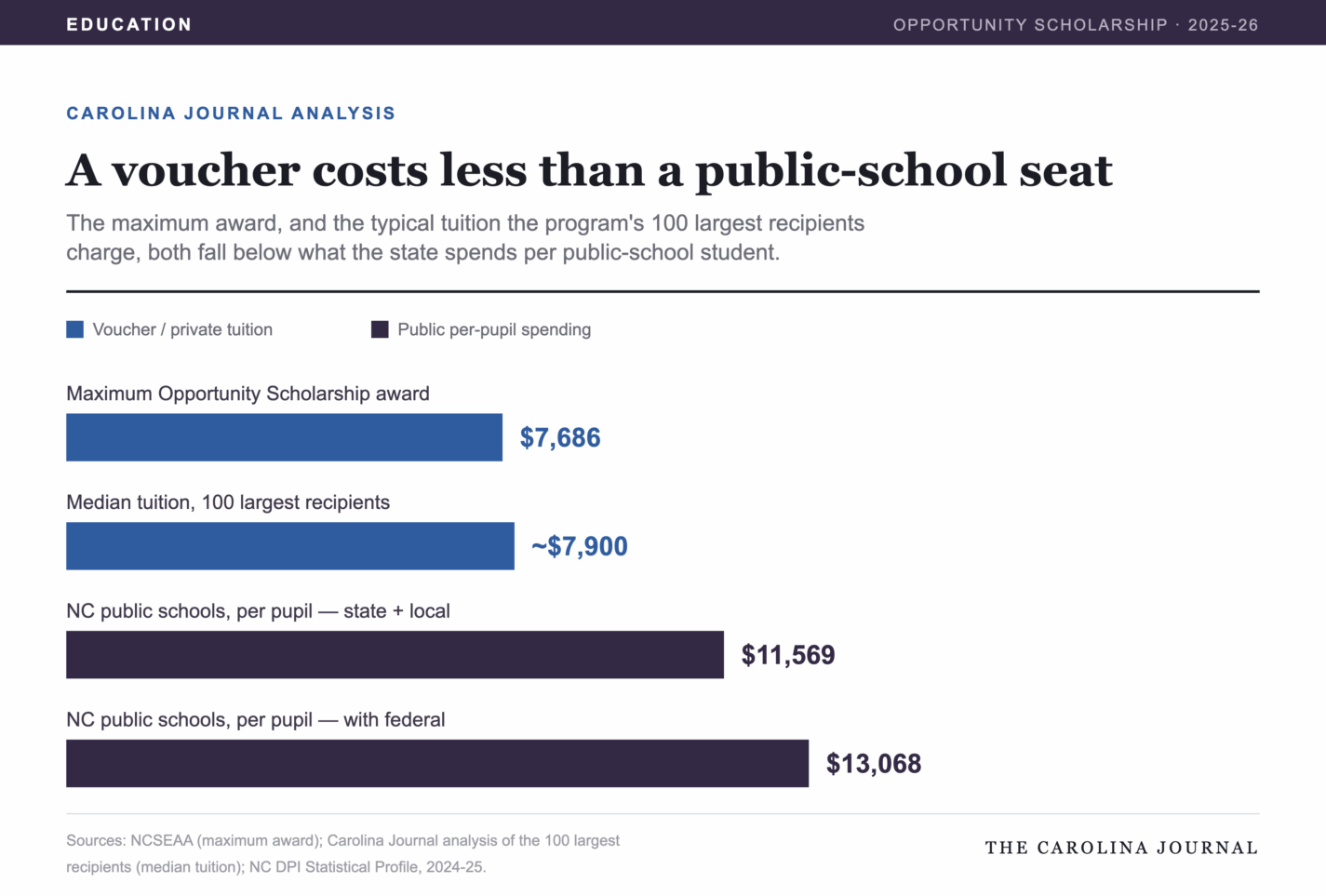
Tuition figures reflect each school’s published rate for its highest grade level and are derived from the schools’ websites when available and from third-party listings otherwise.
The higher priced schools that participate tend to rank lower on the list. Cannon School in Concord ranks 118th in scholarships received and Forsyth Country Day School near Winston-Salem ranks 131st. The two highest-cost secular academies in the top 100 — Cape Fear Academy in Wilmington and Fayetteville Academy — rank 88th and 99th.
A consistent pattern
The pattern applies to the entire program, not just the largest recipients.
Of all scholarship money awarded in 2025-2026, about 78% of the money went to religious schools, a Carolina Journal classification of disbursement data found. Protestant Christian schools alone accounted for at least 64% of the funds, while Catholic schools accounted for a further 11%.
The secular minority’s schools are also largely not elite academies. The largest are the Thales Academy chain’s 11 locations in North Carolina – nine of which are among the program’s top 100 recipients – followed by Montessori, Waldorf, nature and microschool programs; and schools for students with disabilities, such as John Crosland School in Charlotte and Hill Learning Center in Durham.
Of the established college-preparatory day schools that participated — including Cannon School, Forsyth Country Day and Cape Fear Academy — they received less than $1.9 million each.
The concentration of public money on religious schools is settled law. In Carson v. In 2022, the U.S. Supreme Court ruled that states offering tuition assistance programs cannot exclude schools simply because they are religious, building on its 2020 decision in Espinoza v. Montana Department of Revenue.
Growth after income caps are lifted
The composition of the program has changed since the income limits were removed. Among the top 100 schools, total scholarship money increased about fivefold between 2022-23, the last year before the program became available to all families, and between 2025-26, according to a Carolina Journal analysis.
Several Catholic schools and secondary schools grew faster. St. Gabriel Catholic School in Charlotte went from receiving about $36,000 in scholarship money in 2022-23 to $1.9 million this year. Charlotte Catholic High School’s total population grew approximately 24-fold.
Five schools that did not receive any grant money in 2022-23 are now among the top 100 recipients. These include some of the more expensive schools on the list, such as Charlotte Christian School, where tuition exceeds $27,000, and Caldwell Academy in Greensboro, which costs nearly $19,000.
The lower-cost schools still receive most of the money. Schools that charge less than the $11,569 the state spends per student received about 55% of all grant money in 2025-26 and about the same share of the growth since 2022-23, in part because they make up most of the recipients.
Heather Koons, research and communications director for Public Schools First NC, which opposes expanding the program, argues that the move will benefit wealthier families. “I think our state is now subsidizing wealthy families to attend private school,” she told CBS 17. “Some private schools have increased their tuition significantly as vouchers have become more available.”
According to the NCSEAA, families in the lowest two of four income levels received about two-thirds of the scholarship money this year, the Carolina Journal reported earlier this month. The highest income level, for which there is no income limit, accounted for approximately 17% of recipients and 11% of funds.
The budget and future of the program
The state budget passed by the Legislature in early July further expands the Opportunity Scholarship program and rejects a push by Gov. Josh Stein and Democratic lawmakers to freeze or shrink it.
The Republican-led General Assembly refused to adopt any of the Democratic approaches. Stein’s proposed moratorium would have placed an income cap of about $90,000 on a family of four, eliminating an estimated 60,000 recipients, according to the Carolina Journal. Another bill introduced by four House Democrats would have cut nearly $400 million over two years and redirected it to child care.
Instead, the final spending plan maintains the statutory timeline, which increases the program’s annual funding to $825 million by 2032.
The budget also reinvests nearly $36 million in public schools, an amount that matches the savings the state made over the past two years as students transferred from public schools to private schools using vouchers worth less than what the state spends per student in public schools.
A DPI report found the state spent about $34.3 million on scholarships for students leaving public schools in 2024-25 — about $10.1 million less than it would have spent on public school education.
https://www.carolinajournal.com/nc-elite-private-schools-take-little-opportunity-scholarship-money/
