

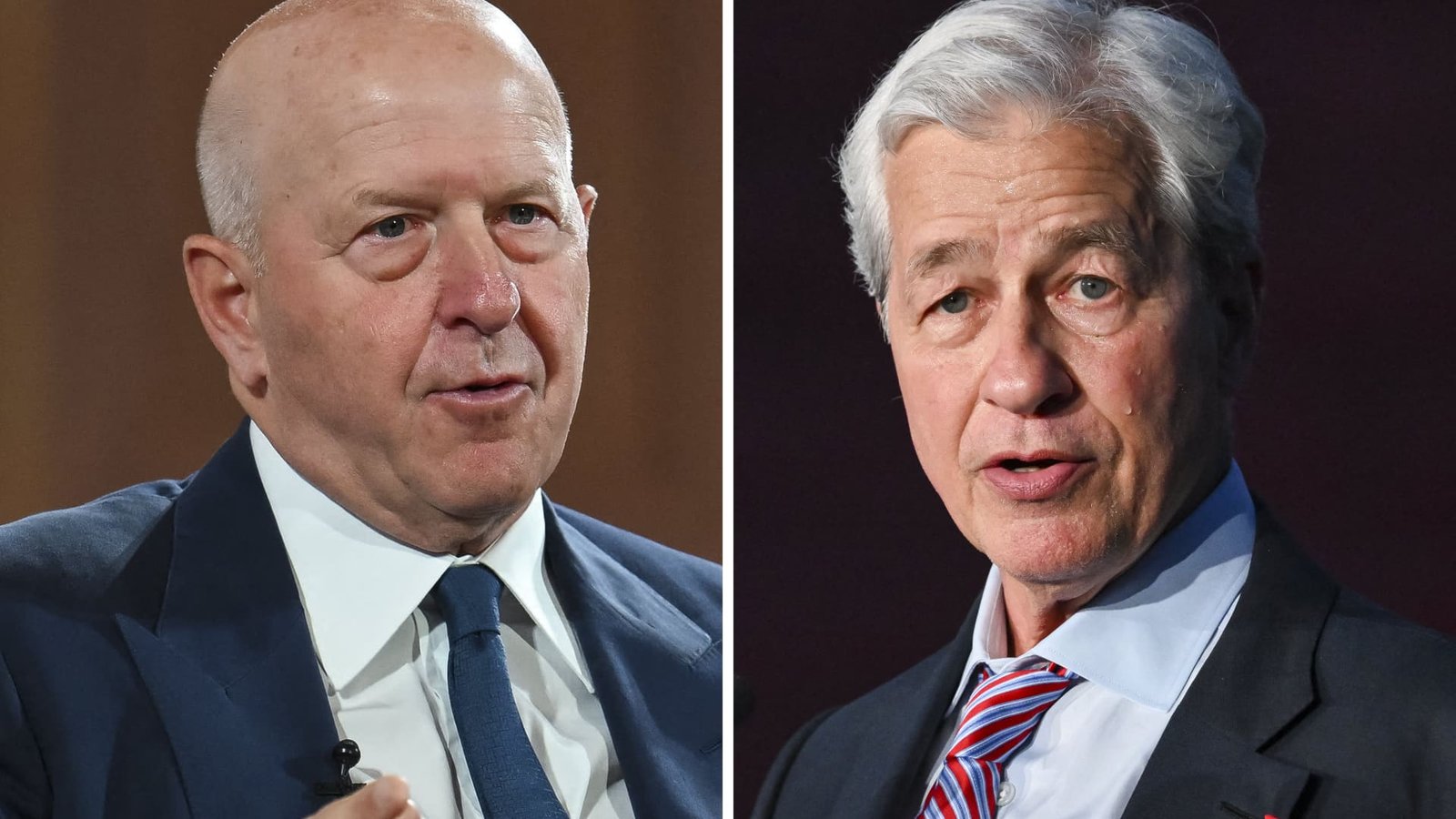
JPMorgan Chase & Co. Chairman and CEO Jamie Dimon and Goldman Sachs Chairman and CEO David Solomon.
Angela Weiss | AFP | Getty Images
American megabanks proved on Tuesday that the global boom in artificial intelligence is not just benefiting tech giants and chipmakers.
Goldman Sachs And JPMorgan Chase Both posted record quarterly revenue gains, driven by massive gains in equity trading and investment banking.
Behind the surge in activity – Goldman’s revenue rose 39% to $20.3 billion, while JPMorgan posted a 27% increase to $58 billion – is the fact that AI is “everywhere in financial markets,” JPMorgan CFO Jeremy Barnum told reporters.
“These are booming environments with a lot of activity, big IPOs, big index rebalancing and a lot of activity in Asia,” Barnum said Tuesday. “A lot of this is downstream from the AI issue and is big on a global scale. It’s just a very, very, very active environment.”
The quarter showed that the AI boom is producing winners far beyond Silicon Valley. While Nvidia and hyperscalers including alphabet have made many headlines, Goldman, JPMorgan and other banks are benefiting from the massive capital flows into AI.
They advise on AI-related deals, finance data centers and energy infrastructure, underwrite debt and equity offerings, and facilitate the surge in trading that comes with the global race to deploy the technology.
This is creating a “ripple effect” across the American economy, giving banks a flood of new opportunities to offer financing and trading solutions in public and private markets, Goldman CEO David Solomon told analysts on Tuesday.
“We are in the middle of an AI investment supercycle where there are funding requirements for every single funding vehicle, in every region of the world and in every single industry,” Solomon said. Capex is short for capital expenditures or investments that a company makes in physical assets such as factories.
Goldman is preparing for a three- to five-year investment cycle that is still in its early stages, he told analysts.
Goldman shares rose 8% in afternoon trading, while JPMorgan rose 2%.
Table of Contents
AI “tipping point”
While AI expansion is nothing new, what has changed is that it has expanded beyond chips and software to include utilities and infrastructure players.
The biggest beneficiaries of this trend are the three largest Wall Street firms: Goldman Sachs, JPMorgan and Morgan Stanleysaid Mike Mayo, banking analyst at Wells Fargo.
The AI investment boom “reached a tipping point” in the second quarter, Mayo said.
Mayo raised his price targets on Goldman and JPMorgan following underwhelming results on Tuesday. Morgan Stanley is expected to report its results on Wednesday.
GE Vernova gas turbines at the on-site natural gas plant under construction during a media tour of the Stargate AI data center in Abilene, Texas, USA, on Wednesday, September 24, 2025.
Kyle Grillot | Bloomberg | Getty Images
The clearest evidence of AI’s impact came in equities trading, where global capital flows and blockbuster transactions contributed to some of the quarter’s biggest revenue surprises.
Stock trading revenue rose 86% to $6 billion at JPMorgan and 72% to $7.42 billion at Goldman. Combined, that was a whopping $4.4 billion more than analysts had expected.
Other major banks also benefited. Bank of Americathe second-largest U.S. lender by assets, reported a 70% increase in stock trading revenue to $3.6 billion.
To support the quarter, investors expanded their search for AI beneficiaries and poured money into Asian markets, including South Korea, Taiwan and Japan, Soofian Zuberi, president and co-head of global markets at Bank of America, told CNBC.
“People looked at AI trading and asked themselves, ‘What are the best outcomes of this outside the U.S.?'” Zuberi said. “You have American clients who are diversifying and putting more money into Asia, including foundations, foundations and family offices.”
SpaceX, Alphabet
The impact of AI was also reflected in the banks’ high consulting income in the second quarter.
Investment banking revenue rose 55% to $3.4 billion at Goldman and 30% to $3.3 billion at JPMorgan Chase. That’s a total of $1 billion more than analysts had expected.
Goldman served as lead advisor during the quarter SpaceX IPO and Alphabet’s $90 billion stock offering, as well as advising Dominion Energy on its sale to NextEra Energy, all moves driven by the AI cycle.
At Bank of America, investment banking fees rose 50% to $2.1 billion.
As they rake in record fees thanks to AI, banks are starting to benefit from implementing the technology internally. This should help them increase their revenue while keeping headcount and other expenses under control.
“AI is driving banking forward by helping to streamline processes,” Zubieri said. “And banking is driving AI, because without banking you can’t finance all of these data centers.”
Choose CNBC as your preferred source on Google and never miss a moment from the most trusted name in business news.
https://www.cnbc.com/2026/07/14/goldman-sachs-and-jpmorgan-chase-are-emerging-as-ai-winners.html
