

DoorDash shared the architecture behind Ask DoorDash, its conversational AI assistant that helps consumers discover restaurants, plan meals and build shopping carts via natural language interactions. During a three-part engineering deep dive, the company described how it built the system using large language models, specialized AI agents, Model Context Protocol (MCP)-based tools, consumer persistent storage, and automated evaluation infrastructure to enable AI-driven experiences in production.
DoorDash reported early production results showing that calculated consumer memory improved grocery checkout conversion rates by approximately 24%, increased cart size by 17%, and reduced conversation turns by 7% during a seven-day evaluation. When searching for restaurants, the assistant achieved a 15% higher conversion rate for open search queries. The company also reported improvements in AI agent quality measurement through automated evaluation, enabling faster validation of model and system changes.
As Raghav Saboo, RecSys and search lead at DoorDash, noted in a post,
It is difficult to develop a useful AI agent. It’s even harder to know if it’s actually good.
To validate AI agent behavior in production, DoorDash developed an automated assessment framework that simulates stateful customer conversations using LLM-generated users and recorded tool setups. The framework mirrors production runtime to independently evaluate orchestration, guardrails, and domain agents. According to DoorDash, the platform scaled quality measurement to more than 2,000 automated reviews per day, improved quality scores by eight points, reduced regression testing from six hours to twenty minutes, and validated a model migration that reduced latency by 35% while maintaining quality.
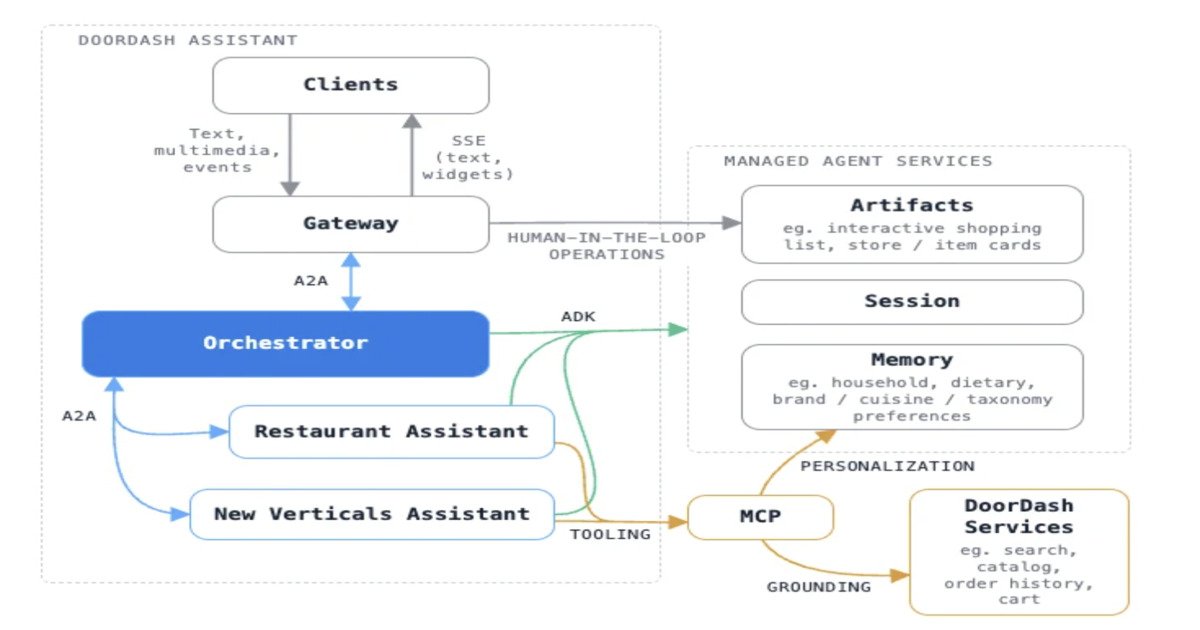
The architecture behind Ask DoorDash separates orchestration from business functions. An assistant runtime coordinates interactions between specialized agents, while a common MCP layer provides business functions including catalog search, recommendations, shopping carts, checkout, order history, and consumer storage. Instead of embedding business logic directly into prompts, the assistant invokes reusable tools powered by existing DoorDash services, allowing multiple AI experiences to share integrations while backend functions evolve independently.

DoorDash Assistant Runtime Architecture (Source: DoorDash blog post)
In a LinkedIn post announcing the feature, the company highlights a key challenge:
Agents don’t just need access to user data. You need the right context for the right task at the right moment.
DoorDash has introduced an intelligence layer that manages personalization across three storage systems. Long-term memory is generated offline from historical consumer behavior to capture preferences such as favorite cuisines and dietary restrictions. Session memory maintains conversational context during an interaction, while agent memory stores explicit facts provided by consumers. Relevant memories are retrieved, ordered, and integrated into prompts through semantic vector search, separating memory management from model inference.

Storage architecture across generation, tooling layer, storage, policy, and agents (Source: DoorDash blog post)
In a LinkedIn post announcing the feature, DoorDash co-founder Andy Fang said:
Ask DoorDash lets you create a cart about 5 times faster than manually, and requires a single prompt to complete your cart in under 2 minutes.
DoorDash emphasized that the platform improves latency and reliability through operational optimizations, including deterministic actions that update versioned artifacts without calling the language model, and confirmation workflows for recommendations and generated shopping carts. The architecture follows DoorDash’s engineering model, where domain teams build specialized agents while platform teams provide orchestration, MCP tools, storage, evaluation, and common components.
DoorDash notes that production AI agents introduce complexity through orchestration, retrieval, and tool coordination, but these investments enable reusable infrastructure, improved reliability, and independent evolution of domain capabilities.
https://www.infoq.com/news/2026/07/doordash-ai-ask-assistant/
