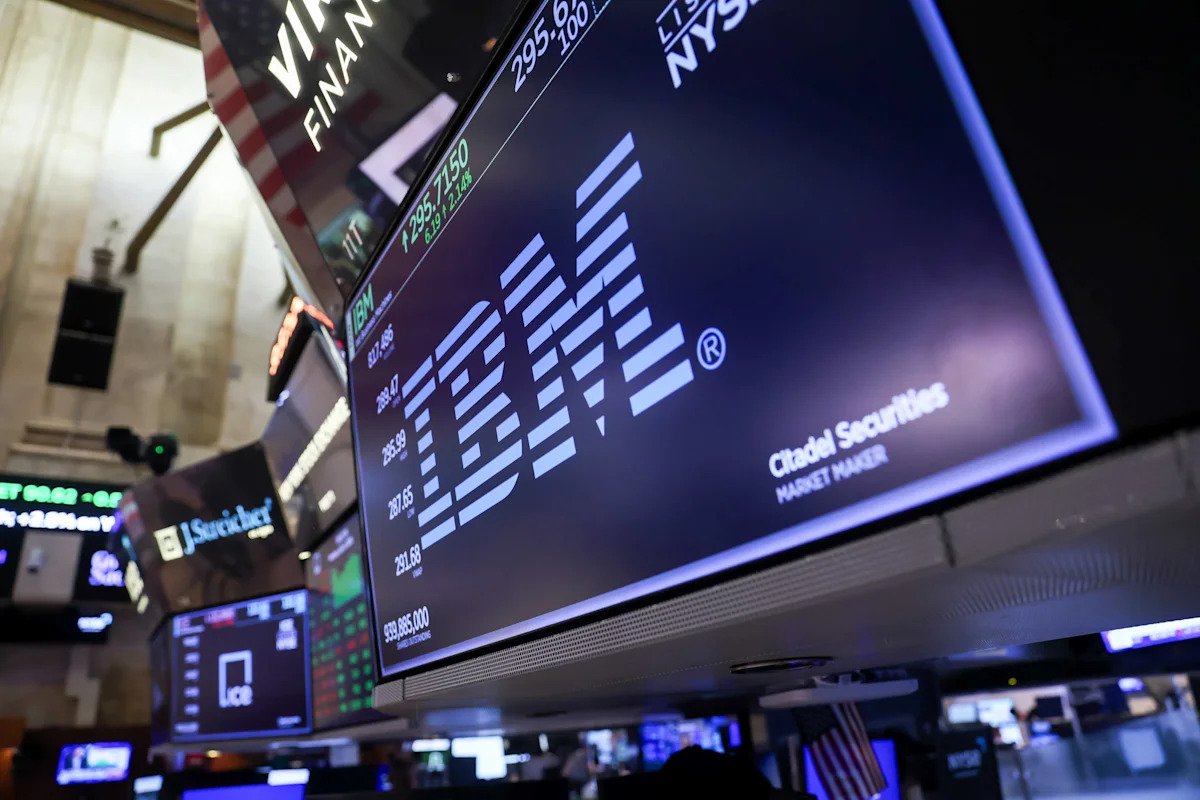
IBM shares plunged toward their worst trading day in nearly four decades on Tuesday, July 14, after CEO Arvind Krishna told investors that the company’s second quarter fell short of Wall Street’s expectations.
Just hours after that warning, a bank lowered its price target and told its clients to consider buying a basket of IBM competitors instead. Another bank raised its target that same morning.
This split reaction is the real story here, and it says more about what actually went wrong than the stock chart.
According to CNN, IBM shares fell as much as 23% in premarket trading, putting the stock on track for its biggest single-day decline since Black Monday in October 1987.
According to CNBC, preliminary second-quarter revenue was $17.2 billion, below analysts’ expectations of $17.85 billion. Adjusted earnings of $2.93 per share missed the consensus of $3.01, according to CNBC.
Table of Contents
IBM’s mainframe wasn’t the problem
Investors initially assumed that IBM’s latest mainframe, the Z17, was having trouble finding buyers. That’s not quite what happened.
In a letter to investors published in IBM’s newsroom, Krishna said customers shifted their quarterly capital budgets to servers, storage and memory in late June instead and rushed to secure limited-supply hardware before prices rise further.
As a result, infrastructure revenue fell 7%, while software growth of 5% and flat consulting revenue failed to make up the shortfall.
This timing detail is important. The memory shortage causing this behavior comes as Samsung, SK Hynix and Micron shifted production capacity toward the specialized chips that power AI data centers, effectively selling out standard enterprise memory, CNN reported.
IBM’s own customers are being squeezed by the same AI expansion that is supposed to be their growth catalyst.
 IBM shares plunged as much as 23% on Tuesday after CEO Arvind Krishna cited a shift by customers toward hardware spending ahead of expected price hikes. Alex Wong/Getty Images
Competitors with no connection to IBM’s supply chain were dragged into the abyss anyway
The sell-off remained uncontrollable for IBM. According to a report from Seeking Alpha, ServiceNow (NOW) fell nearly 7%, Salesforce (CRM) fell 5%, and Accenture (ACN) and Cognizant Technology Solutions (CTSH) fell 8% and 7%, respectively.
None of these companies share IBM’s mainframe risk or Z17 supply chain problem.
What they have in common is that the customer base is now prioritizing hardware contracts over software contracts, and investors saw this as reason enough to sell first and ask questions later.
Related: IBM just answered a $5 billion cybersecurity question
Beyond the immediate software decline, several key market indicators illustrate the extent of the pressure on Tuesday:
According to Seeking Alpha, Adobe (ADBE), Workday (WDAY), HubSpot (HUBS), Datadog (DDOG) and Microsoft all fell 3% or more in sympathy trading, although none of them reported results this morning.
IBM’s GAAP earnings per share were $2.27, down 2% year-over-year, with pretax margins declining 90 basis points, according to IBM’s letter to investors.
The stock’s premarket decline wiped out tens of billions of dollars in market value in just a few hours, a magnitude that TheStreet described as one of the biggest single stock moves of the day.
Wall Street’s price targets don’t match the panic
If it were a simple drop in demand, analysts would be lining up to collectively lower targets. They are not.
HSBC downgraded IBM to Reduce and lowered its target to $191 from $231. According to Investing.com, clients could build a “synthetic IBM” of SAP, Accenture, HP and IonQ stocks for less money and a better presence.
According to Tipranks, that same morning, Oppenheimer went in the opposite direction, raising his target from $320 to $350, while Morgan Stanley raised his target from $267 to $293.
This divergence suggests that the majority of the public views this as a timing issue related to a volatile quarter, rather than a structural break in IBM’s software business. Red Hat, IBM’s fastest-growing unit, was not even cited as a vulnerability.
More IBM:
Storage shortage is becoming a technology story for businesses
IBM’s warning is a preview of something bigger than a company’s mainframe cycle.
When storage and server prices rise fast enough, enterprise buyers begin to push hardware purchases at the expense of software renewals and consulting contracts.
This redistribution can affect any provider whose revenue depends on the same IT budgets.
Investors should keep an eye on IBM’s full earnings release on July 22 to find out whether Krishna can quantify how much of the deficit has been delayed rather than lost, and whether other enterprise software and consulting companies will report the same shift in spending in late June when their turn comes.
If the pattern repeats itself across the sector, Tuesday’s selloff would not have been an overreaction. It must have been early.
Related: IBM’s latest call to Wall Street hides bigger changes
This story was originally published by The street on July 15, 2026, where it first appeared in Invest Section. Add TheStreet as Click here to find your preferred source.
https://finance.yahoo.com/markets/stocks/articles/ibm-warning-sends-software-consulting-170700828.html
