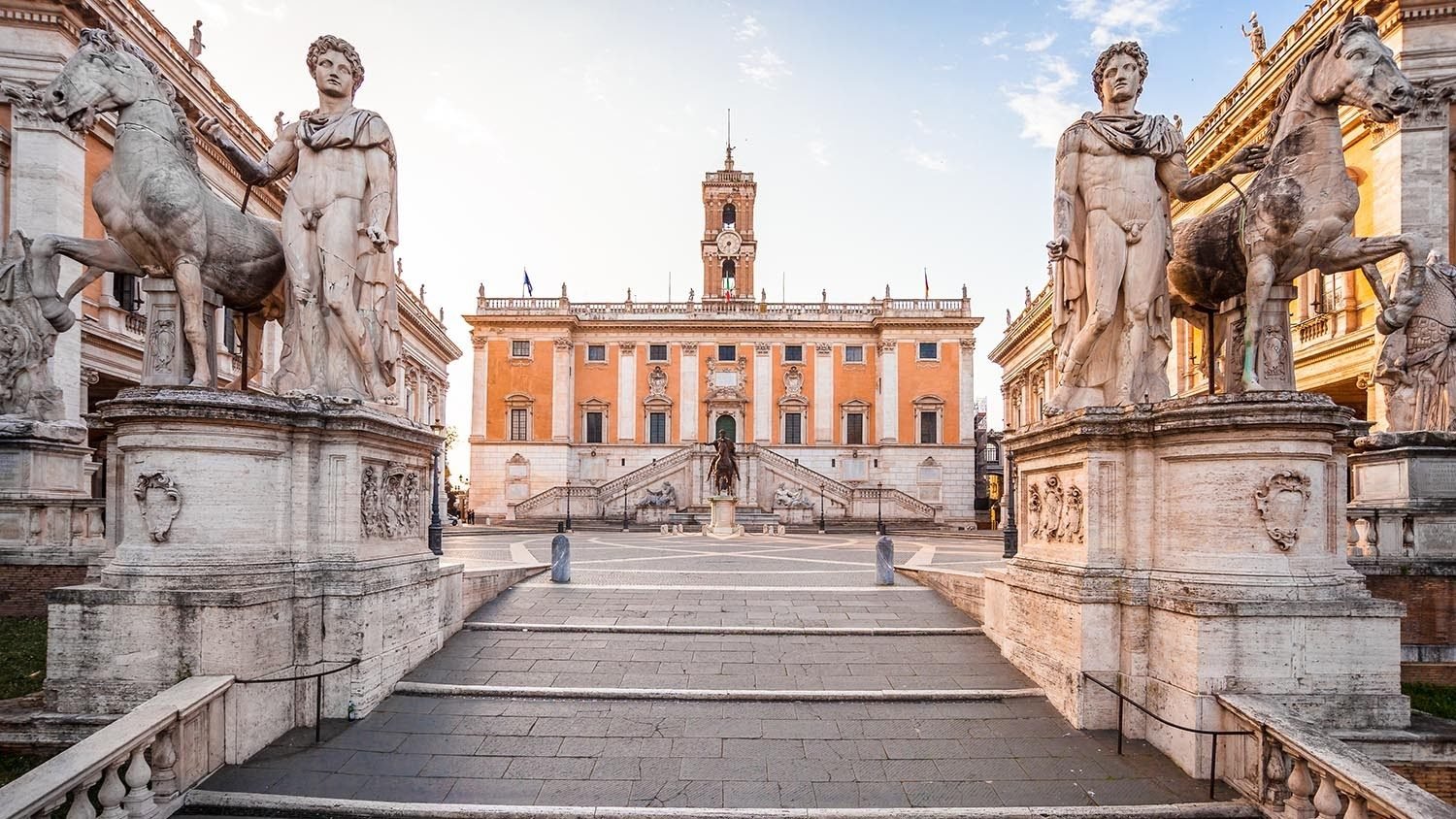
Nobel Prize winners, international experts and scientists, religious leaders and former heads of state and government meet at the Capitol in Rome to sign the “Rome Declaration for an unarmed and disarmed peace” in the age of artificial intelligence and nuclear weapons. The joint appeal calls for renewed international cooperation in view of the immense challenges posed by nuclear weapons and AI.
By Deborah Castellano Lubov
The groundbreaking “Rome Declaration for an Unarmed and Disarming Peace in the Age of Artificial Intelligence, Nuclear and Autonomous Weapons, New Digital Protocols and New Models of Digital Development” was signed at the Capitol in Rome on Thursday, July 16, marking the culmination of the Global Nobel Laureate Assembly on Artificial Intelligence and Nuclear War.
The gathering, attended by more than 200 of the world’s most eminent personalities and representatives of leading international research institutions in the fields of peace and artificial intelligence, was inspired by Pope Leo XIV’s encyclical Great humanitydedicated to protecting the human person in the age of artificial intelligence.
The Vatican hosted the event at the Borgo Laudato si’ in the Pontifical Gardens of Castel Gandolfo from July 14th to 15th and it ends today, July 16th, with the ceremonial session at Rome’s Town Hall on the Capitoline Hill. The morning began with an institutional welcome by the Mayor of Rome, Roberto Gualtieri.
Next, University of Chicago Professor Daniel Holz, founding director of the Existential Risk Lab (X Lab), candidly reminded those in attendance that “the bad news” is that “it is a time of unprecedented danger,” but “the good news is that there are many things we can do to make ourselves safer from nuclear weapons and safer from AI.”
Table of Contents
Cardinal Reina: No machine or algorithm can decide on existential questions
The Vicar General of Rome, Cardinal Baldo Reina, said the Rome Declaration was of particular importance today. “It comes at a time of rapid change and profound risks: artificial intelligence, nuclear weapons, geopolitical instability, the crisis of multilateralism and the temptation to trust security to fear, deterrence and mutual threats.”
Cardinal Reina emphasized that we are at a “decisive moment” in history. “Scientific and technological progress offers extraordinary opportunities for health care, education, public health, environmental protection, poverty reduction and peace-building. But that same progress, when divorced from ethics, responsibility and respect for human dignity, can become an instrument of domination, exclusion and even destruction.”
“Today’s statement reminds us with great clarity that no machine, no algorithm and no autonomous system can be placed at the center of decisions on which the survival of humanity depends.”
He said that “decisions about life and death, peace and war, and the future of future peoples and generations must remain under full, responsible and meaningful human control.”
AI can make people build or destroy
Meanwhile, Father Andrea Ciucci, chancellor of the Pontifical Academy for Life, reflected on human ingenuity. He noted that, on the one hand, humans are capable of creating incredible masterpieces, but on the other hand, human ingenuity can also wreak great havoc.
He said that AI and nuclear power are no exception, pointing out that “AI can make people build or destroy.”
Cardinal Silvano Maria Tomasi and Nobel Peace Prize laureate Professor Maria Ressa of Columbia University also addressed those present with powerful words about the arms race and the need for a moral compass in these times of unprecedented risk.
Our survival is at stake
Professor David Gross, Nobel laureate in physics and Chancellor’s Chair Professor of Theoretical Physics at the University of California, said he has a much better understanding of the danger of nuclear weapons today than he did 30 years ago.
He complained that arms control treaties had disappeared and that nine nations were now nuclear powers. “We are in the middle of an accelerated arms race.” The people of the world, he said, could no longer ignore how these threats could impact not only their own lives, but certainly those of their children and grandchildren.
Regarding the statement, Professor Gross emphasized that her suggestions were simple and that we had heard them before.
He emphasized: “We call on nuclear states to promote policies that reduce the risk of war, nuclear war and annihilation.”
He said those present, inspired by the words of the Pope, the Church and anyone with a moral sense, must act.
“Remember your humanity and forget the rest,” the Nobel laureate reiterated, warning that our survival and that of future generations is clearly at stake.
Ambassador of Peace Sharon Stone also spoke, saying that, united in the goal of the common good and respect for every human being, as the capacity of machines expands, so must the moral effort of those who build them. “Human dignity,” she said, “is not an algorithm.”
https://www.vaticannews.va/en/world/news/2026-07/global-nobel-laureates-assembly-sign-declaration-on-peace-ai.html
