

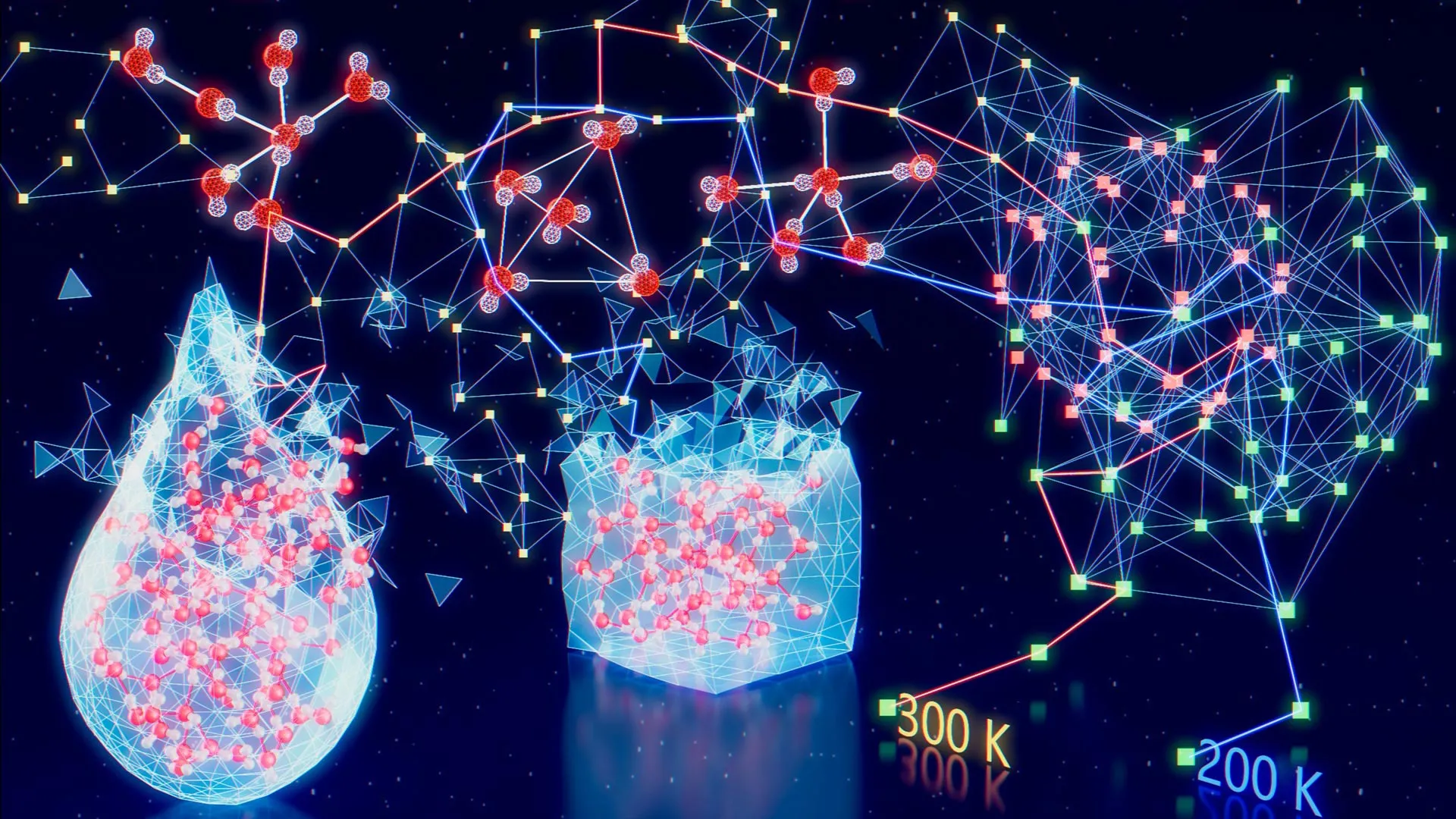
Water covers most of the Earth’s surface, but it behaves in ways that distinguish it from almost any other liquid. One of its most unusual properties is that it expands instead of contracting when it freezes. Scientists have long linked these strange behaviors to changes in the microscopic structure of water with fluctuations in temperature and pressure, but have lacked a consistent way to describe and compare these structural changes.
Now researchers at Osaka University have turned to artificial intelligence (AI) to address this challenge. Their AI system provides a unified way to compare different methods of describing the structure of supercooled water to determine which captures the most important features. The research was published in Communication chemistry.
Why supercooled water behaves so strangely
For liquid water to turn into ice, its molecules must arrange themselves in an ordered crystal lattice. This process begins at a nucleation site, a surface where ice crystals can form. Tiny impurities in the water or even microscopic scratches inside a container can provide such clues.
If these nucleation sites are missing, water can remain liquid even after it has cooled below its normal freezing point. This unusual condition is called supercooled water.
Under these conditions, the unusual properties of the water become even more apparent. Scientists believe this behavior is related to a balance between two competing forms of liquid water: a high-density liquid (HDL) and a low-density liquid (LDL). At the molecular level, water molecules constantly form and break networks of hydrogen bonds. As the temperature increases, the more compact HDL structures increasingly dominate the more open LDL arrangements.
AI compares competing water models
Over the years, researchers have proposed many different methods for describing the local arrangement of water molecules, including measurements such as tetrahedral bond order and local density. Because these structural descriptors were developed independently, they use different scales, dimensions, and types of information. This has made it difficult to compare them directly and determine which are most useful.
“Previous studies have shown that using machine learning to classify and understand structural data is effective,” explains corresponding author Kang Kim. “We specifically wanted to integrate a neural network model into this study to evaluate how accurately the descriptors capture important structural information in a way similar to human perception.”
To train the AI, the researchers fed the neural network with structural data generated from molecular dynamics simulations of supercooled water. Through repeated trial and error, the system learned to recognize meaningful patterns in the molecular structures.
New clues to the hidden structure of water
“The network used its findings to compare how 16 descriptors distinguished between LDL and HDL structures at different temperatures,” reports Nobuyuki Matubayasi, lead author. “In this way, we identified the most efficient descriptors.”
The researchers say their framework could improve scientists’ understanding of how microscopic structural changes are related to the thermodynamic behavior of water. The results may also help explain the origin of water’s unusual properties while spurring the development of even better tools to study its complex molecular structure.
https://www.sciencedaily.com/releases/2026/07/260707025047.htm
