

Space security
July 8, 2026
612 Views
16 likes
The control team of ESA’s Hera mission, which operates across 140 million kilometers of space, has managed to update the spacecraft’s software so that it is ready to explore the distant asteroids Dimorphos and Didymos in the autumn.
Overseeing Hera from ESOC’s interplanetary control room
Imagine having to install new software on a multi-million dollar computer without being seen. One is not allowed to touch the hardware in question because it is already busy monitoring a spacecraft in space that is moving forward at more than 12 km per second.
Instead, you send instructions via text message, which are relayed through communications antennas 35m in diameter aimed at exactly the right point in the sky, with a signal delay of almost eight minutes in one direction due to the inherent distance.
ESOC Mission Control
After the software has been successfully uploaded, comes the crucial phase in which the entire spaceship must be restarted – twice!
Hera’s onboard computer, which monitors all of its instruments and subsystems, runs on parallel processor streams for redundancy. With two restarts, each could be evaluated one after the other. The seven-member Hera core team stood ready in its control room in case the spacecraft didn’t return a signal as planned, but fortunately it restarted nominally on time each time.
CubeSat Deep Space Deployers in the Hera spacecraft
“The success of this more than two-week operation makes Hera finally ready for what we call its ‘asteroid phase,'” says Anna Schiavo, operations engineer for the Hera spacecraft. “The update will allow us to bring all of the spacecraft’s remaining instruments into operation and utilize the autonomous functionality that Hera will rely on to navigate around its target asteroids – along with the intersatellite links that Hera will use to communicate with the two CubeSats it will deploy early next year.”
Before the software was used in flight, it underwent one of the most complex test campaigns ever carried out at ESA’s ESOC Mission Control Center in Darmstadt. This took more than a year and a half and required a total of 50 days of testing on the ground. This included testing Hera’s full autonomous functionality around its two target asteroids as well as interacting with its CubeSats.
The Hera avionics test bench from OHB
Sylvain Lodiot, Head of ESA’s Outer Solar System and Planetary Defense Operations, explains: “During the tests, the software was run on a working replica of Hera located at the mission’s prime contractor, OHB in Bremen, called ‘Bench’, flying around simulated models of the asteroids and communicating with actual CubeSat replicas via the intersatellite links.”
Caglayan Guerbuez, Hera Spacecraft Operations Manager: “It is not that unusual for a space mission to launch without the final software on board, but Hera was truly a mission in a hurry: it had to launch on time in October 2024 to benefit from a Mars flyby the following spring, otherwise the mission would have taken years longer to reach Dimorphos.”
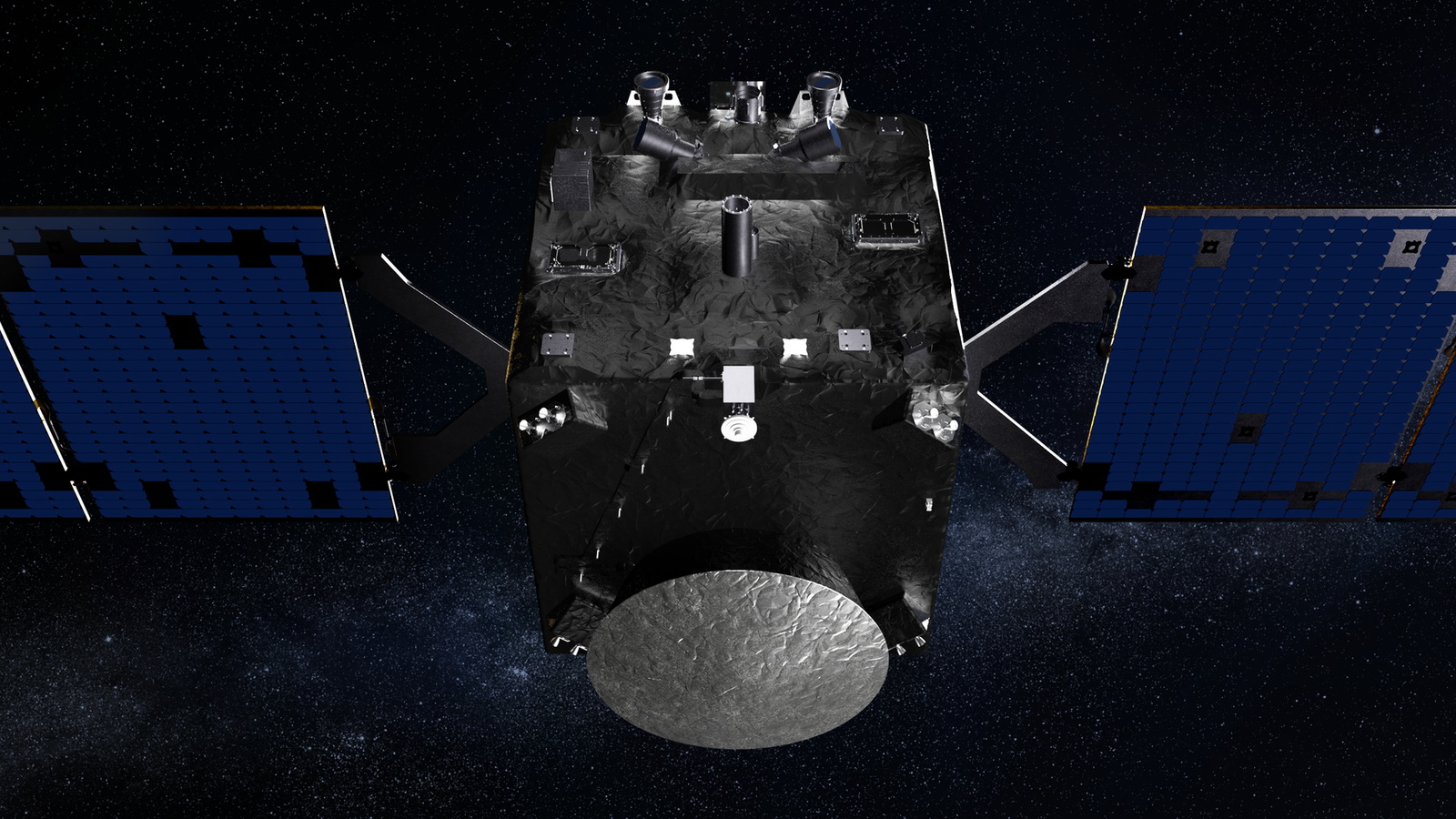
Hera, her CubeSats and her rocky target
“That’s why we were busy catching up during the cruise phase, with the valued support of software provider Spacebel and OHB.”
Hera is ESA’s first planetary defense mission. The van-sized spacecraft is on its way to the asteroid Dimorphos, which in turn orbits the larger asteroid Didymos. Dimorphos is already historic as it was the first object in the solar system to have its orbit altered by human intervention – when NASA’s DART spacecraft hit in September 2022.
Hera’s large-gain antenna connects it to Earth
The DART impact caused a brightening that was visible to distant Earth telescopes, but no one knows what it did to Dimorphos itself. Hera will go there to conduct a close-up survey of the crash site to help convert DART’s kinetic impact experiment into a well-understood planetary defense that can be tailored to incoming objects if necessary.
Humans have altered an asteroid. Now we find out how
How
https://www.esa.int/Space_Safety/Hera/Deep_space_software_upgrade_for_Hera_s_asteroid_visit
