

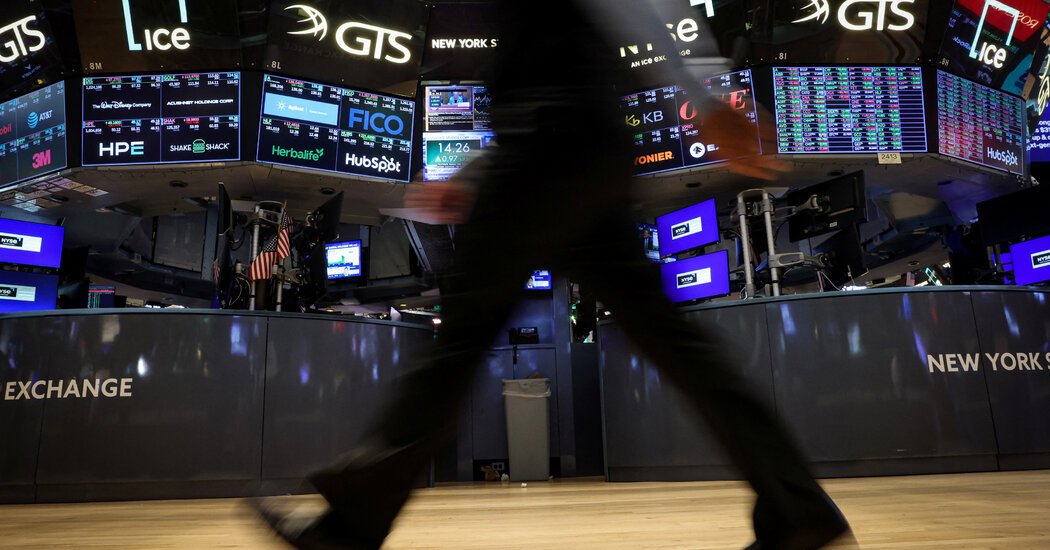
Stocks around the world tumbled on Friday, hit by a selloff in major technology companies developing artificial intelligence, after signs of increasing competition from China added to investors’ unease over staggering spending on AI
The S&P 500 fell 1 percent and posted a loss of 1.6 percent for the week, led by the largest technology companies. The technology-heavy Nasdaq Composite Index fell 1.4 percent. The stock markets in China, Japan and across Europe also fell.
Signs of investor concern were most evident in the Philadelphia Semiconductor Index, a benchmark for the computer industry that includes AI titans such as Nvidia and Micron, which fell 1.6 percent on Friday, adding to losses over the past month. The index has fallen more than 20 percent since its peak in June and has crossed the threshold for a so-called bear market – an indicator of deep investor concern.
Nvidia, the giant chipmaker, fell 1.9 percent on Friday, briefly slipping below Apple’s market valuation as the two battle for the spot as the world’s most valuable company. Alphabet, Google’s parent company, lost 2.5 percent and Meta lost 3 percent. SpaceX, Elon Musk’s rocket and AI company, fell 5.5 percent after falling below $135, the stock market price set last month, earlier this week.
“It’s more of a reset of a very frothy dynamic rather than a judgment on the sustainability of AI or anything like that,” said Adam Turnquist, chief technical strategist at LPL Financial.
In some ways this was to be expected. After a long, parabolic rally, investors were already concerned about high valuations in the stock market, supported by a rosy, AI-powered future expectation that has not yet been realized.
A long-standing concern about whether the AI juggernaut can continue to grow at this pace is whether China — or other competitors — can develop AI models that are as effective or even more desirable but cost less, which would raise questions about the billions spent by U.S. tech giants.
On Friday, Moonshot AI, a Chinese AI company, stoked those fears when it released a new model, Kimi K3, that it said worked just as well as AI models from American giants like Anthropic and OpenAI, but at a significantly lower cost.
Kimi K3 is even more powerful than GLM-5.2, a Chinese AI model released just two weeks ago by startup Z.ai, which also offered comparable performance to US models but at a cheaper cost, according to Vals AI’s ranking, which assesses the performance of the latest AI technologies.
“I think it makes sense that there needs to be some sort of pause while investors digest the situation,” said Kristina Hooper, chief market strategist at Man Group. “For a long time it seemed like there was an insatiable appetite for anything AI-related, but now there is quite a bit of saturation.”
In stark contrast to China, the Trump administration is leaning toward regulating its domestic AI technology. The United States remains dominant in the emerging industry, but government oversight could give foreign competitors an advantage. Some Silicon Valley executives support such regulation, raising concerns that the leading technologies can fuel malicious cyberattacks and help build biological weapons.
China has chosen to make even its most powerful systems “open source,” meaning anyone can freely use and modify the models. Moonshot plans to make the new Kimi K3 model available to the public later this month.
By providing open source models, Chinese developers are increasing competitive pressure on U.S. companies that have developed models that can be expensive to use.
“AI development should not be a solo effort by a single country, but a symphony of global cooperation,” Xi Jinping, China’s leader, said on Friday at an AI conference in Shanghai. He described open source AI as a “rare and historic opportunity” to spread the benefits of the technology worldwide.
On Friday, renewed strikes between the United States and Iran added to market concerns. The passage of ships through the Strait of Hormuz, a key waterway for trade in energy and related products, pushed oil prices higher again and sparked worries about rising inflation. Brent crude, the global oil benchmark, was trading at around $88 a barrel on Friday.
“A protracted conflagration in the Middle East would also threaten AI spending if it disrupts natural gas and helium supplies from the region, which are key inputs for semiconductor and other electronics production in Asia,” Bernard Yaros, senior U.S. economist at Oxford Economics, wrote in a research note.
In Asia, market losses were sharper on Friday. Taiwan’s Taiex index fell 6.5 percent, a day after chipmaker Taiwan Semiconductor Manufacturing Company announced an additional $100 billion investment in its operations in the United States. TSMC shares fell more than 7 percent on Friday.
Analysts at New York bank BNY said in a report that Taiwanese stocks saw record levels of selling by foreign investors on Friday. They cited a reassessment of valuations of the biggest tech companies by investors and “tougher” competition from Chinese companies, but stopped short of projecting a deeper gloom.
“This is not the collapse of the AI or semiconductor growth story,” they wrote.
Cade Metz contributed reporting.
https://www.nytimes.com/2026/07/17/business/stocks-ai-tech-wall-street.html
