

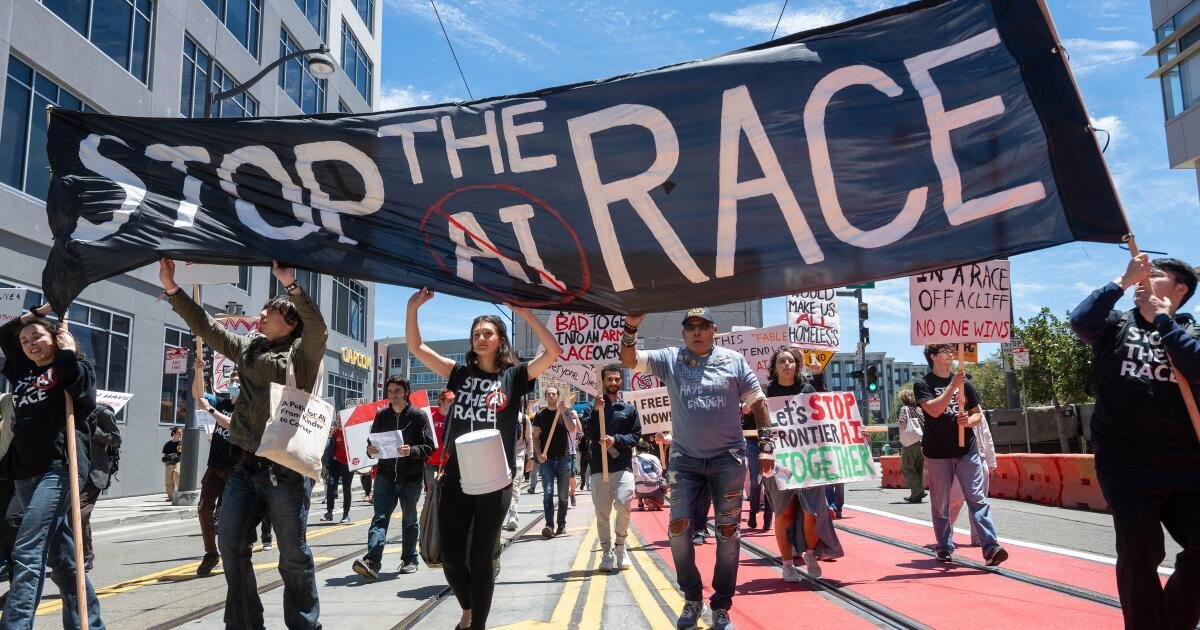
Silicon Valley residents are increasingly trying to halt the progress of artificial intelligence, even as the region attracts hundreds of billions of dollars in investment to expand the technology’s reach.
Companies and workers around the San Francisco Bay Area sparked the global AI explosion. Now the country’s tech hub is also at the center of an intense and growing revolt against its ability to do harm and replace people.
Hunter Glenn joined a group of protesters outside the San Francisco headquarters of AI pioneer Anthropic on Monday because he fears that AI poses a threat not only to jobs but also to humanity.
Shortly after his company began using AI tools, he was laid off as a copywriter.
“You didn’t tell me we were replacing you with AI, but that’s the impression I had,” he said.
Tech workers and activists have staged protests across the region this month, raising alarms that the more powerful AI becomes, the harder it will become to control.
Prominent economists, technology leaders and researchers have warned that AI could transform the economy for better or worse and lead to large-scale job displacement. And people are resisting new data centers in their communities.
The public outcry comes as AI becomes increasingly embedded in people’s daily lives, sparking such fears as human extinction. Companies are pushing their employees to use AI tools to do more with fewer people. Teens are increasingly socializing with AI chatbots, raising concerns about the technology’s impact on mental health. Still, tech companies show no signs of slowing down as they bring more powerful AI tools to market and win new customers in government, healthcare and other industries.
Glenn took part in a protest organized by Stop the AI Race. In a city full of AI billboards, a large black flag bearing the group’s name waved in the wind as workers entered and exited the office and self-driving cars drove by.
This month, Glenn was also among the hundreds of protesters who marched to OpenAI, Anthropic and Google DeepMind, calling on companies to stop the AI race, a competition that is heating up between the U.S. and China.
The group, which plans to be at Anthropic headquarters every day until its demands are met, and others have pushed for companies to stop training new AI models. They want governments to sign an international treaty to respond to the “potentially catastrophic risks” of AI, such as human extinction.
Although the threat to jobs from AI is “very real,” Glenn said he is more concerned about AI’s threat to civilization and people’s quality of life.
“We could win the AI race to give humanity second place,” he said.
Michael Trazzi, founder and leader of the Stop the AI Race movement, attracted attention last year when he went on hunger strike outside Google DeepMind’s London office. The former AI researcher and filmmaker has called on Google DeepMind CEO Demis Hassabis to advocate for an end to the AI race.
“The problem is not that the companies themselves are evil and trying to kill everyone, but more importantly that if this market risk continues, we will end up with AI that is smarter than humans and will be difficult to control,” he said.
Various groups expanded in the Bay Area and beyond. Some focused more on job displacement, others pushed for measures like abandoning OpenAI’s ChatGPT and banning the development of new AI technologies.
The push to use more AI tools in the workplace has also raised concerns among engineers who fear their work could be automated in the future. Tech companies like Meta, Amazon, Oracle and others have shed their global workforces.
Many of the layoffs are taking place in California. Laid-off technicians say it’s becoming increasingly difficult to find their next job.
Tech companies have marketed AI as a tool to help workers rather than replace them. Still, some technology executives have admitted that they believe the overall workforce will shrink, while others say AI will create new jobs. Anthropic, OpenAI, Google and Meta did not respond to a request for comment.
Hassabis has called on the US to set up an AI monitor to mitigate potential risks.
“No one in the world knows exactly what will happen from here, and even the experts disagree. When there is a high degree of uncertainty and the stakes are so high, the sensible and correct strategy is to proceed with cautious optimism,” he wrote in a July 14 online post.
Also last week, Google employees demonstrated outside the company’s headquarters in Mountain View, demanding stronger protections against layoffs. More than 4,500 Google employees have signed a petition calling for protections such as voluntary exit packages and guaranteed severance packages.
“As AI is added to my job requirements, I also have to worry about whether I am using it enough, or whether I have the time to check what it does, or whether it will become good enough at my job to replace me,” Dan Freedman, a staff software engineer at Google and a member of the Alphabet Workers Union-Communications Workers of America, said in a statement.
According to a 2026 report published by the Stanford Institute for Human-Centered AI, a third of companies expect AI to shrink their workforce, with the largest cuts expected in service operations, supply chain and software engineering. AI is impacting early career professionals, including software developers, the report says.
AI chatbots can quickly generate text, code and other content, potentially revolutionizing the creative industries in Hollywood and elsewhere.
Jenny Lin, a senior product designer who lives in San Francisco, said AI content still needs to be reviewed by humans.
“AI is fast at execution, but execution has never been the hard part of the job,” she said. “I hope the industry doesn’t use AI as a reason to stop investing in and hiring the next generation of designers.”
Sonny D, an AI researcher who declined to provide his last name for surveillance reasons, is involved in a group called AI Action, which focuses on issues such as job relocation.
The activist said he has seen how AI impacts drivers, therapists, architects, designers and other professions. He fears that this could worsen working conditions.
The emerging AI technology elite, he said, wants to “push for these technological changes to surpass regulation, unions and democracy.”
In California, lawmakers and politicians are working toward more guardrails to mitigate AI risks, even as they face pressure from tech companies to change or weaken laws.
California Gov. Gavin Newsom signed an executive order directing the state to review policies and practices supporting laid-off workers as well as efforts to improve training for unemployed workers. Newsom has also proposed creating a national public equity fund so Americans can have a stake in the future of AI.
Holly Elmore, founder and executive director of PauseAI US, said activists are trying to connect the public with lawmakers.
The group is urging a pause in the “development of the most dangerous AI systems” until their builders can prove they are safe.
“There is so much pressure to be an advocate for innovation, and there is a lot of fear of falling behind,” she said. “It’s just something that people have to deal with with AI.”
https://www.latimes.com/business/story/2026-07-22/they-built-ai-now-silicon-valley-workers-protest-its-threat-to-jobs-humanity
