

By Maya C. Miller, CalMatters
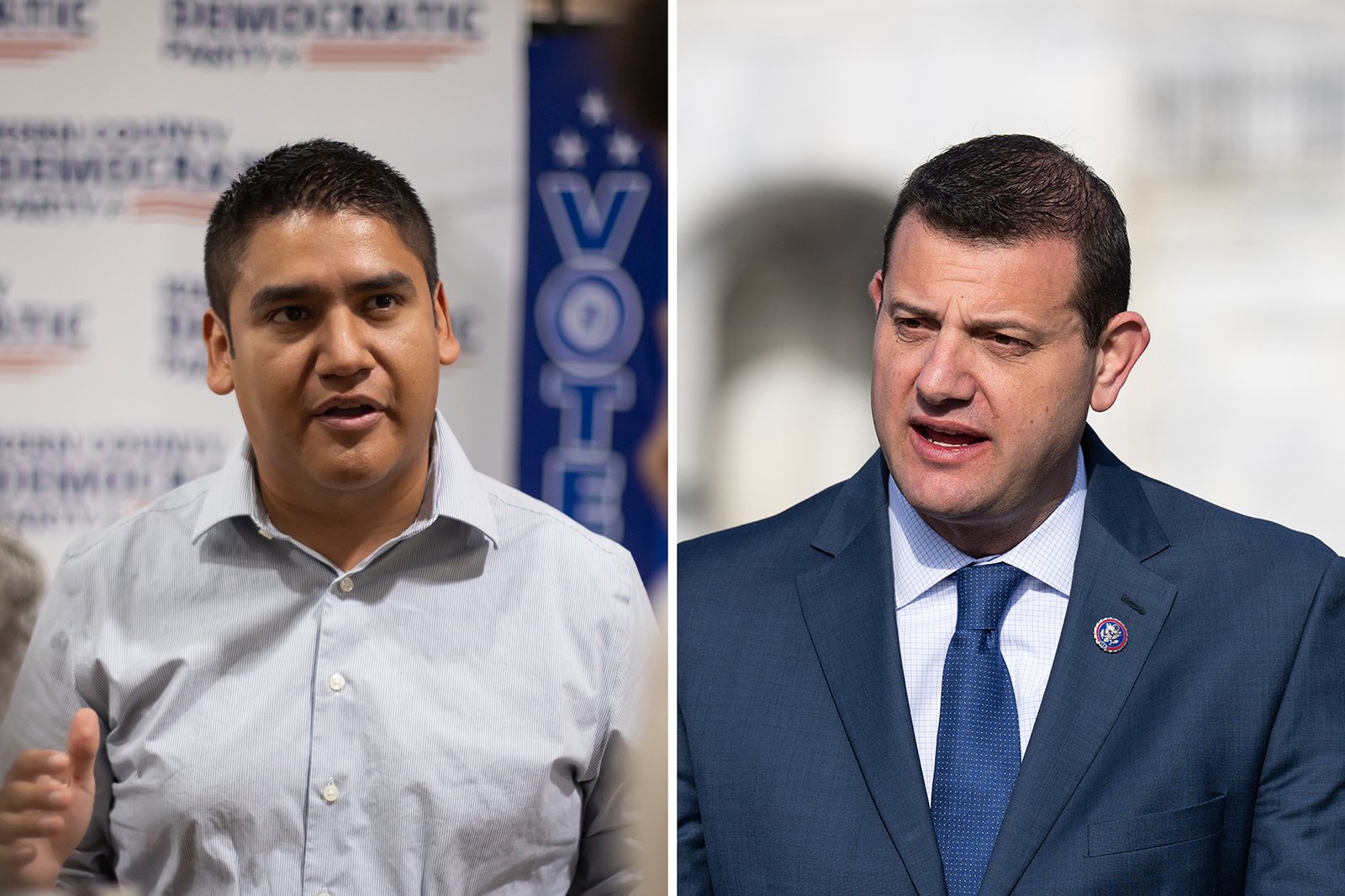
From left, Randy Villegas and U.S. Representative David Valadao, candidates for California’s 22nd Congressional District. Photos by Larry Valenzuela, CalMatters and Bill Clark, via Getty Images
This story was originally published by CalMatters. Sign up for their newsletter.
It’s a tough year to run for Congress as a Republican, especially in California, where voters approved new plans aimed at ousting five Republican incumbents in favor of Democrats.
Three were doomed after being drawn into heavily Democratic districts. But there is a bright spot for Republicans: campaign money.
In the state’s two remaining battleground districts, whose seats Democrats have flipped in their favor and are now seen as must-win to win the House, bloody and costly primary contests have put Democratic candidates at a financial disadvantage as campaigns prepare for the sprint to Election Day.
In the Central Valley, Republican Rep. David Valadao has a cash hoard of more than $3.3 million, according to the latest federal report filed Wednesday. His Democratic opponent, progressive professor and school board trustee Randy Villegas, has only a fraction of that — about $571,000 in cash.
Unlike Valadao, Villegas had to win an intraparty battle against Rep. Jasmeet Bains, the establishment-backed candidate and strong favorite. His campaign spent more than $1.45 million in the two months leading up to the June 2 primary. Valadao’s team spent less than $280,000 during the same period.
Further south in the 48th District, San Diego Republican County Executive Jim Desmond is sitting on more than $1.2 million in cash, federal records show. His Democratic opponent, San Diego City Councilwoman Marni von Wilpert, is further behind with $825,000 after defeating fellow Democrat Amar Campa-Najjar in the primary.
And in the Sacramento suburbs, the $2.1 million in Republican-turned-Independent Rep. Kevin Kiley’s account dwarfs the $359,000 available to former Democratic Sen. Richard Pan.
The GOP’s financial lead is bolstered by a U.S. Supreme Court ruling last month that struck down decades-old restrictions on how much political parties can spend in direct coordination with the candidates they support.
Federal law requires broadcasters to offer candidates the lowest rate available. But political bodies such as parties or super PACs had to pay much more for the same advertising time. This primarily benefited Democrats, whose candidates tend to be stronger fundraisers thanks to vast smaller-dollar donor networks.
The new ruling essentially grants political parties access to this lower TV advertising rate as well — and the Republican National Committee is flush with cash this year.
It had more than $125 million on hand at the end of May, according to most recent federal filings, compared with the Democratic National Committee, whose records show it has more than $3 million in debt. Likewise, the House Republicans’ campaign arm, the National Republican Congressional Committee, has more than $81 million, more than twice as much as its Democratic counterpart.
Although Republicans are grappling with an unpopular president and an unpopular war that has raised the cost of living, they are optimistic that the court’s decision will help enough of their nominees in swing districts to maintain the party’s control of Congress.
“This is another arrow in the Republicans’ quiver heading into November,” Nick Poche, an RNC spokesman, said in an emailed statement.
Table of Contents
The verdict will force election campaign decisions
The Democrats are not ringing the alarm bells yet.
“I don’t think it’s the greatest relief,” Paul Mitchell, the Democratic vice president of a California political data firm and an expert on redistricting, said of the Supreme Court’s ruling. “That money would have found its way to the right candidates that Republicans wanted to spend money on.”
Mitchell argued that the ruling will force Democrats to evaluate what money is best spent by which parts of the campaign — the candidate, the parties, super PACs or other outside groups. For example, instead of the candidate reserving television advertising, the party could focus on buying ads and the candidate could work on building a strong team of local volunteers.
Democratic candidates in swing congressional districts still held a significant fundraising advantage in the final quarter before the June primary.
In the 22nd District, Villegas outspent Republican incumbent Valadao by a nearly 2-1 margin in the most recent filing period that ended June 30, according to campaign reports filed Wednesday. In the 48th District, von Wilpert lapped Desmond by more than 3 to 1, collecting $871,000 compared to his roughly $272,000.
However, it is still unclear whether the Republican Party’s national committees will spend their winnings in California. While national Republican committees could theoretically stretch their money by spending more in districts across the country, they may not choose to prioritize California, with its more expensive media markets. The nonpartisan Cook Political Report classifies only 18 of the 435 seats in the U.S. House of Representatives as “toss-ups.” Another 10 races are leaning toward Democrats winning, while nine races are leaning toward Republicans winning.
“They want to play where they can win seats,” said Rob Stutzman, a longtime California Republican consultant. “Money doesn’t solve everything, and in many places they are on the defensive.”
This article was originally published on CalMatters and republished under the Creative Commons Attribution-NonCommercial-NoDerivatives License.
https://calmatters.org/politics/2026/07/california-congressional-races-republican-fundraising/
