

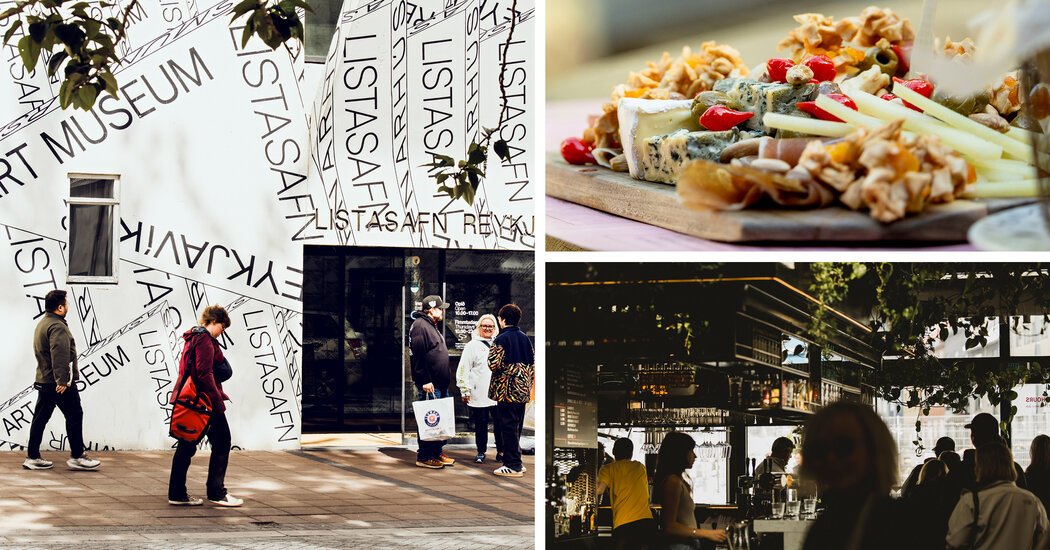
Of the approximately 394,000 people who live in Iceland, almost 252,000 live in and around Reykjavik, the capital. There are active volcanoes in the suburbs, but what attracts visitors is the sparsely populated area with its glaciers, waterfalls, basalt rocks and other geological wonders.
In contrast, Reykjavik is the place to experience Icelandic creativity, history and humor. There, you can spend three days visiting museums, meeting locals and visitors at the legendary Kaffibarinn bar and, for cheap eats, trying grocery chain Kronan’s rye flatbread flatkaka – things I did during a free stopover in Reykjavik on an Islandair flight to continental Europe.
The program, which allows passengers to stay in Iceland for up to a week, is a potentially attractive way for eclipse chasers to view the solar eclipse that will pass over Iceland on August 12. The overall path includes Reykjavik as well as Westfjords and the Snæfellsnes Peninsula in the north and the Reykjanes Peninsula near the airport in Keflavik. (Because heavy traffic is expected, the Icelandic Tourism Authority recommends eclipse watchers take one of the many tours available.)
Here are four money-saving strategies and a few tips for small luxuries in the populous part of Iceland. Note that most prices are in Icelandic kroner and are currently trading at around 125.40 kroner per dollar. However, travelers can see prices in euros and dollars.
Table of Contents
Cheap accommodation
Saving on overnight stays is a challenge in both hotels and short-term rentals (to combat the housing shortage, rentals in Iceland are strictly regulated). AirDNA, a service that analyzes the short-term rental industry, places Iceland vacation rentals second on its list of the most expensive European destinations (behind Monaco), with an average daily rate of around $240 per night.
I opted for the cheapest accommodation I could find on Airbnb, a single room in a guesthouse about two blocks from the central Hallgrimskirkja Church ($104 per night, before taxes and fees).
A shared bathroom was at the end of the hallway, a cozy library was right outside my door, and the downstairs kitchen offered a refrigerator and cooking facilities. In the middle of a week in April, I only had a few roommates (several reviews recommend bringing earplugs).
A budget alternative is the Kex Hostel, which has a bar, laundry facilities, a terrace, and a breakfast buffet for 2,700 kronor (about $21). This summer, private rooms start at about $151 a night and a bed in a dorm starts at about $58. Nearby, City Hub Reykjavik offers pod-style accommodation with king-size beds, shared bathrooms, and a rooftop hot tub (from around 128 euros this summer).
Reykjavik has an impressive number of museums for a city of its size, and the cheapest way to see them is with the Reykjavik City Card.
The card, available in 24-, 48- and 72-hour increments (from 34 euros or $39), allows entry to 17 museums and attractions as well as eight swimming pools. There are also discounts on other activities, including a 10 percent discount on a whale watching tour. If you visit the Icelandic National Museum (entrance fee 3,300 kr) and a swimming pool in one day, the ticket will almost pay for itself.
I did much more in the long days of subarctic spring. I learned about Iceland’s Viking origins at the fascinating National Museum, enjoyed fairy tale illustrations at the Icelandic National Gallery, and visited exhibitions on botanical photography and the futuristic use of lava in architecture at the contemporary Reykjavik art museum Hafnarhus.
The card also covers local bus transport (but not the Flybus, which runs between Keflavik airport and Reykjavik, from 3,999 krone each way).
Immerse yourself like a local
In Iceland’s many geothermally heated basins, volcanic activity meets an abundant water supply. There are around 200 public swimming pools across the country, and swimming pool culture – as a health practice and social environment – was added to UNESCO’s list of intangible cultural heritage last year.
However, don’t confuse these pools with hot springs like the Blue Lagoon in Grindavik, which offer both nature and water immersion. Public pools are located closer to community swimming facilities and have lap lanes, wading pools, and warm water pools that are often kept at different temperatures.
While entry to the Blue Lagoon starts at $95, public swimming pools in Reykjavik, including the central Sundholl swimming pool, cost 1,500 krone (included in the Reykjavik City Card).
I also used the card to visit Vesturbæjarlaug swimming pool, which last year offers five hot tubs and three saunas.
Self-service meals
Food prices underscore Iceland’s remote location and dependence on shipping. Skipping full-service restaurants sounds like skipping a vacation, but there are dining alternatives that are a step above the take-and-go fare at 10-11 convenience stores.
Reykjavik offers several food halls – or matholl – including the Grandi Matholl on the harbor and the Posthus Food Hall & Bar in a former post office.
At the Hlemmur Food Hall, in a former bus station, I skipped the cheaper pizza and Bahn Mi sandwich options and instead bought Icelandic lamb chops and small fried potatoes at Fjarhusið (5,500 kr).
For seeded sourdough and fragrant cinnamon rolls, head to Braud & Co, a popular bakery with just a few stools in a building with murals in Frakkastigur (the original of eight locations in the city). Expect to spend about $11 on pastries and coffee.
The lamb stew at Icelandic Street Food didn’t seem like street food to me – try an Icelandic hot dog at Bæjarins Beztu Pylsur (880 kronor) – but the generous portion, served in a bread bowl, included free refills (3,250 kroner). For dessert there were free malty pancakes with syrup.
Guided and independent hikes
CityWalk Reykjavik offers two-hour free walking tours of the city’s top attractions every day unless, as was the case on my visit, fewer than 10 people sign up, which is rare in the summer. As an alternative, I was offered a place on the company’s slightly longer small group tour (5,480 kr) on foot from Hallgrimskirkja to the town hall.
Such sights are not difficult to spot on your own. Instead, the company’s strength is its dedicated founder and leader Marteinn Briem, who offered glimpses of the city’s colorful corrugated iron houses, played Icelandic hits from Laufeny and Kaleo, and described the Icelandic wrestling tradition Glima, which he learned during his childhood in Reykjavik.
“It starts with a slow dance, then a wedgie and then you throw your opponent over your shoulder,” he explained.
Reykjavik’s long days and ocean views seem to encourage hiking; One day I walked 12 miles, including a three-mile hike to Grotta Lighthouse. It takes ships into Faxafloi Bay from a peninsula extending from Seltjarnarnes, west of the city center. At low tide, a rocky causeway is exposed, inviting intrepid visitors to take a walk to the lighthouse. At high tide she gets stranded on an island.
The tides were unwelcoming on the morning of my visit, but I was able to see dozens of eider ducks and redshanks in the neighboring nature reserve. East of the lighthouse, the Kvika Foot Bath, a small geothermally heated pool carved into a rock by Icelandic artist Olof Nordal, offers free baths for tired feet.
Small luxury items
What I saved on food and lodging paid for a few small expenses, starting with Harpa Music Hall, the landmark glass-fronted concert hall by Icelandic-Danish artist Olafur Eliasson.
On the lower level, the Volcano Express shows an enlarged film using motion effects that documents the most recent volcanic eruptions. Cinemagoers strap themselves into seats that rumble, sway and appear to fly with the camera over streams of lava, accompanied by blasts of hot air (entrance fee 3,990 crowns).
Later I saw a concert in which violinists from the Miller-Porfiris duo played silent film excerpts with Charlie Chaplin and Mary Pickford (tickets 3,500 crowns).
Like the food in Reykjavik, drinks aren’t cheap; After the concert, a local IPA from Malbygg Brewery cost 1,800 kr at the busy Skuli Craft Bar.
But luxury can sometimes lead to deals. If I hadn’t spent 750 kroner on a cappuccino at Prikid (touted as the city’s oldest coffeehouse) one morning, I wouldn’t have found the free publication The Reykjavik Grapevine and its “Happiest Hours” list of Prikid’s 900 kroner beers.
Follow New York Times Travel To Instagram And Sign up for our Travel Dispatch newsletter to get expert tips for traveling smarter and inspiration for your next vacation. Are you dreaming of a future getaway or just armchair traveling? Check out ours 52 travel destinations in 2026.
https://www.nytimes.com/2026/07/15/travel/how-to-save-money-in-reykjavik.html
