

AI workloads are scaling faster than any single infrastructure approach can support – with more models, new agent-driven workloads, and increasing computing needs requiring greater specialization across the stack. To meet this need, Microsoft is continuing to develop its Azure infrastructure, including expanding its AI fleet with AMD’s most advanced AI and high-performance computing (HPC) solutions.
Our approach to AI infrastructure is designed to support the breadth of building and operating AI systems. We work closely with industry innovators like AMD, as well as our own purpose-built semiconductors and systems, to provide customers with a comprehensive, open and heterogeneous platform to achieve the best performance, cost and energy efficiency results.
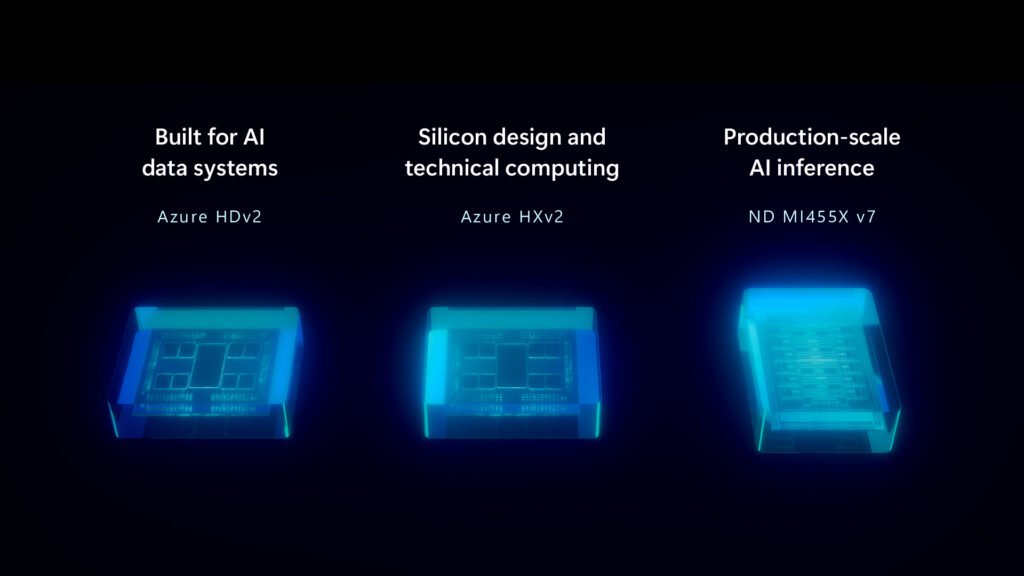
Building on our close collaboration with AMD, Microsoft is bringing AMD’s latest Helios AI platform and next-generation EPYC data center processors to Azure. These technologies will support three upcoming Azure offerings: HDv2 VMs for compute, HXv2 VMs for Electronic Design Automation (EDA), and ND MI455X v7 VMs for AI inference workloads.
Table of Contents
Advanced infrastructure for inference, AI data systems and chip design
YouTube video
Click here to load media
Built for AI data systems – Azure HDv2
CPU infrastructure is critical to the performance and efficiency of modern AI systems. AI accelerators rely on energy-efficient, high-density CPU computing power to process data, coordinate workloads, and keep pipelines running at scale. Without this, training assignments won’t have enough data to learn from and agents won’t have enough capacity to complete tasks on behalf of customers. Azure HDv2 virtual machines are one of our newest offerings, designed from the ground up to eliminate these bottlenecks and enable the launch of massive agent workloads.
Co-developed with AMD, HDv2 VMs expand Azure’s portfolio of purpose-built solutions for AI customers’ most demanding CPU workloads, including data preparation, search, reinforcement learning, and agent coordination at scale. With almost 500 physical 6Th Gen AMD EPYC CPU cores, 4 terabytes of RAM, 32 terabytes of local NVMe storage, and 400 GB of Azure Boost networking: HDv2 VMs are designed to meet the workload needs of our most demanding AI customers.
Optimized for silicon design and technical computing – Azure HXv2
The AI era has created tremendous need and opportunity for companies developing silicon products that power this infrastructure. That’s why Azure HX virtual machines, launched in 2023 in collaboration with AMD and featuring AMD’s unique 3D V-Cache technology, have become popular with silicon design firms working to bring more powerful and efficient AI silicon to market. Today we are announcing the next step in our workload optimization journey for these customers: HXv2.
HXv2 virtual machines build on and extend the strengths of HX. Both continue the differentiation that Azure provides for RTL simulation workloads by once again leveraging 3D V-Cache technology while providing significant improvements in single-threaded performance and memory. HXv2 VMs have 176 AMD 6Th EPYC generation CPU cores with clock speeds exceeding 5 GHz, 50% more addressable cache per core, and VM sizes with nearly 2 or 4 terabytes of RAM help customers adapt their workloads to storage needs.
Azure HXv2 is also designed to support a broader range of technical computing workloads, including scientific simulations, engineering analysis, and other distributed storage applications. The significantly increased performance per VM and per core as well as the inclusion of 800 Gbit InfiniBand enables large-scale MPI-based simulations, making HXv2 the ideal solution for a wide range of HPC customers.
AMD, a leading HX series customer, highlights these impacts directly:
“Engineering teams are pushing the boundaries of simulation, chip design and scientific computing. At AMD, we experience these requirements firsthand as we develop future AMD EPYC CPUs and AMD Instinct GPUs. Azure HX is a critical platform for scaling complex EDA workloads, and we’re excited about Azure HXv2, designed for even greater performance and scalability. We look forward to continuing our collaboration with Microsoft and helping to advance the infrastructure for the world’s most demanding engineering and scientific tasks.”
— Mark Papermaster, Executive Vice President and CTO, AMD
The HXv2 also leverages Microsoft’s long-standing collaboration to optimize Synopsys’ AI-powered EDA solutions on Azure:
“As AI computing continues to push the boundaries of semiconductor design, our collaboration with Microsoft on the Azure HX Series demonstrates a shared vision to enable customers to deliver next-generation AI systems with precision and scalability in accelerated design cycles. These systems have enabled Synopsys customers to reliably and efficiently leverage cloud-based computing and extend EDA workloads beyond traditional infrastructure limitations, allowing them to meet ambitious development schedules while maximizing design quality and dramatic “We can achieve improvements in performance.”
— Shankar Krishnamoorthy, Chief Product Development Officer, Synopsys
Production-scale AI inference – ND MI455X v7
ND MI455X v7 is designed for the reasoning, search and agent workloads behind modern AI services. Based on the AMD Helios Rackscale solution, it expands Azure’s infrastructure options for large-scale inference and is designed to deliver strong performance and efficiency for demanding AI workloads.
Together, these new capabilities expand Azure capabilities while providing customers with greater flexibility in choosing the right computing power for each individual AI workflow: from inference to data systems to chip design. Customer choice is a core design principle built directly into Microsoft Azure, and we are excited to bring AMD’s most advanced innovations to production scale.
To learn more about Azure’s high-performance computing and AI infrastructure capabilities, visit Azure.com.
Scott Guthrie is responsible for a range of hyperscale cloud computing solutions and services, including Azure, Microsoft’s cloud computing platform, generative AI solutions, data platforms, and information and cybersecurity. These platforms and services help companies around the world solve urgent challenges – and prepare for the future.
https://blogs.microsoft.com/blog/2026/07/20/microsoft-expands-azure-ai-and-hpc-infrastructure-with-amd/
