

The industry is entering a new era of intelligent machines.
Cars and trucks that drive themselves. Construction machines that work autonomously. Robots that continuously learn. Drones that swarm adaptively. And mines, ports and factories that are getting smarter every day.
But how can intelligent machines be deployed safely on an unprecedented scale?
Nowadays, the development stack is the bottleneck. Data lives across systems. Simulation, training, and validation often take place in different environments, forcing development teams to switch between legacy tools. Context is lost during handoffs. Insights gained through years of development often become tribal knowledge that is difficult to scale.
We have decided to change that.
Introducing Dana.
Table of Contents
We are on a mission to make a billion machines intelligent. Dana is how we do it.

We are on a mission to make a billion machines intelligent. Dana is how we do it.
Dana is Applied Intuition’s agent platform for developing physical AI applications, designed to address the complexity of building and deploying intelligent, safety-critical machines in the physical world.
For us, Dana is not just a new product. It is a new way to develop physical AI applications at scale that can accelerate the development of intelligent machines from sea to space and make our lives safer and more productive.
“Agents have transformed our digital world, and now we’re bringing that revolution to the physical world,” says Qasar Younis, co-founder and CEO of Applied Intuition. “Dana is a groundbreaking new platform that will help bring intelligence to a billion machines.”
Welcome to Dana: A New Way to Build Physical AI
Dana’s biggest advantage is the intelligence built into the platform.
Since 2017, Applied Intuition has been working with many of the world’s leading OEMs and autonomy developers on some of the most difficult problems in physical AI. Dana leverages this rich domain experience and delivers it through intelligent agents and workflows in a single interface.
Developers can access Dana through natural language, APIs, SDKs, custom applications, embedded interfaces, and it even integrates with enterprise systems and collaboration tools like Slack and Jira. The result is a unified platform that helps companies build and deploy intelligent, safety-critical machines much faster.
It provides developers with an agent platform to help them quickly move from concept to production deployment.
“With Dana, we haven’t just integrated AI into existing products,” says Peter Ludwig, co-founder and CTO of Applied Intuition. “We’ve taken the infrastructure, tools, workflows and expertise we’ve built over the last decade and made them operable by agents. This gives Dana the context and skills to help engineers solve real-world physics AI problems much faster and more accurately, helping to expand the potential of intelligent machines in new ways across industries.”
We built Dana, and then Dana changed the way we build
Applied Intuition has been using Dana internally since last year, developing and delivering solutions on the platform to long-standing automotive, trucking, mining and agricultural customers. Dana’s agent-driven workflows have shortened critical phases of vehicle development timelines from months to days in some cases. Applied Intuition has offered limited early access to select customers, including Isuzu Motors, which is using the platform to accelerate L4 autonomy for its commercial vehicle fleet.
“We were impressed by Dana’s ability to streamline complex engineering workflows and accelerate development,” said Yasuhiro Yazawa, Director, Isuzu Motors Limited, Japan. “Dana gives our engineering teams greater confidence to develop, track and deploy safe autonomous vehicle capabilities much more quickly.”
Another early access customer is Komatsu, a leading manufacturer of heavy equipment for the construction, mining and forestry industries.
“Applied Intuition has been a valuable technology partner in advancing the digital capabilities that support the next generation of mining equipment and solutions,” said Peter Salditt, CEO of Komatsu Mining. “Dana represents another step forward in bringing intelligent, agent-based capabilities to our engineering workflows to help our teams innovate faster, improve efficiency and ultimately add greater value to our customers’ operations.”
Internally, at Applied Intuition, we have replicated the functionality of complex products and applications that took years to develop with far less code. Months of work were reduced to weeks or even days. Development cycles became 20x faster and output quality was higher. Engineers went from deploying every few weeks to deploying an average of five to 10 times a day.
The most ambitious example is our autonomy tools platform, which we have spent years building and refining. At Dana, we rebuilt a significant portion of its core functionality in six months to make it available with agent capabilities.
Building the flywheel behind autonomy
A critical part of developing an end-to-end autonomy stack is building a production-grade flywheel: a continuously running pipeline that transforms massive amounts of real and synthetic sensor data into better models and ultimately safer systems.
Building this flywheel is extremely difficult. It requires extensive expertise in data, simulation, training, inference, assessment, integrated software, cloud infrastructure and deployment. Large teams can spend years building the underlying systems before they can begin comprehensive improvement.
Dana combines these capabilities into three core phases: data, workflows and insights.
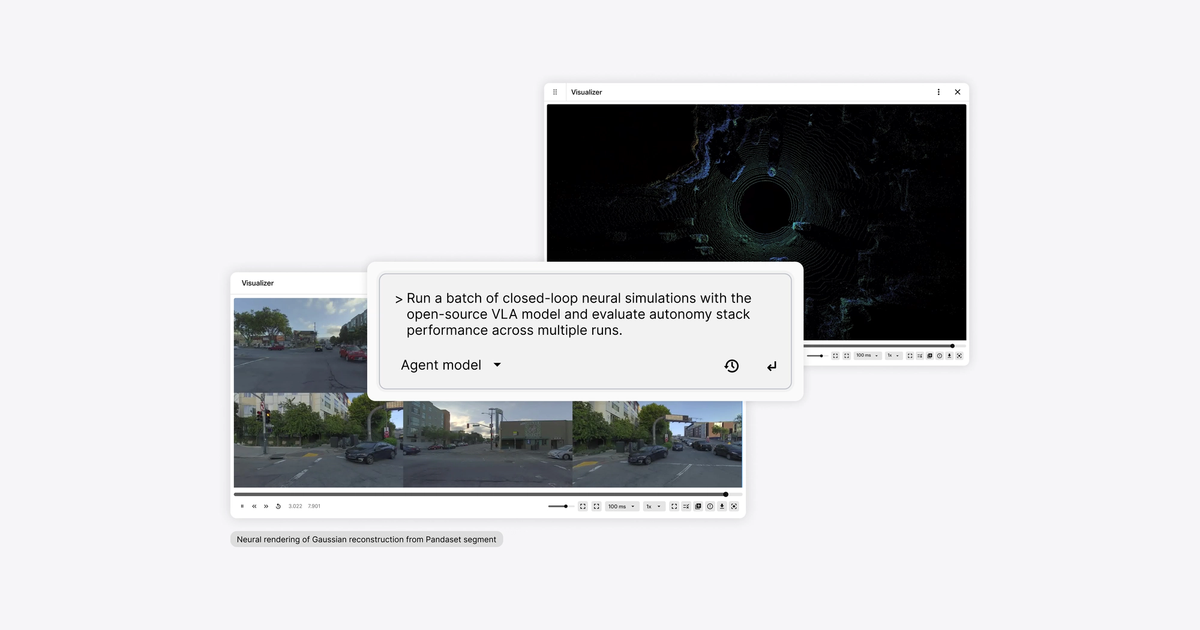
Developers can use Dana for Physical AI to access and curate production-ready sensor data or ingest and validate their own data. You can filter large datasets for events of interest, map locations, or data quality metrics and then prepare that data for training, inference, or simulation.
Dana for Physical AI: Building Autonomy at Agent Speed
Dana for Physical AI: Building Autonomy at Agent Speed
From there, Dana can orchestrate complex workflows across thousands or millions of jobs. Developers can make inferences about autonomy models, evaluate regressions through open-loop replay, reconstruct real-world scenes for closed-loop neural simulation, generate adversarial behavior with reinforcement learning agents, or use world models to generate variations in weather, lighting, and environmental conditions.
Every result remains traceable, with complete lineage throughout the entire workflow.
Dana then brings these results into a common metrics and analysis layer. Instead of manually reviewing thousands of runs, developers can compare autonomy stacks based on safety-critical metrics, build dashboards, query results, identify errors, and use specialized agents to determine what to do next.
In short, Dana keeps the flywheel moving with every rotation – and the system learns.
“The real breakthrough is the continuous development loop,” says Ludwig. “Dana can transport context from data to simulation to evaluation and back again. Each run provides information that can improve the next, while maintaining the traceability and accuracy required for safety-critical development.”
Here Dana goes beyond a general-purpose AI assistant. It combines state-of-the-art models with the tools, infrastructure, data and domain knowledge required to apply these models to physical AI.
From months of vehicle development to one afternoon
The same principle also applies to other physical AI applications, such as the development of AI-defined vehicles.
Imagine something seemingly simple like a personalized welcome lighting sequence for a passenger car. Today, changing this feature can require work across requirements, architecture, code, multiple ECUs, simulation, hardware, and the vehicle itself.
Dana can combine this process into a single workflow.
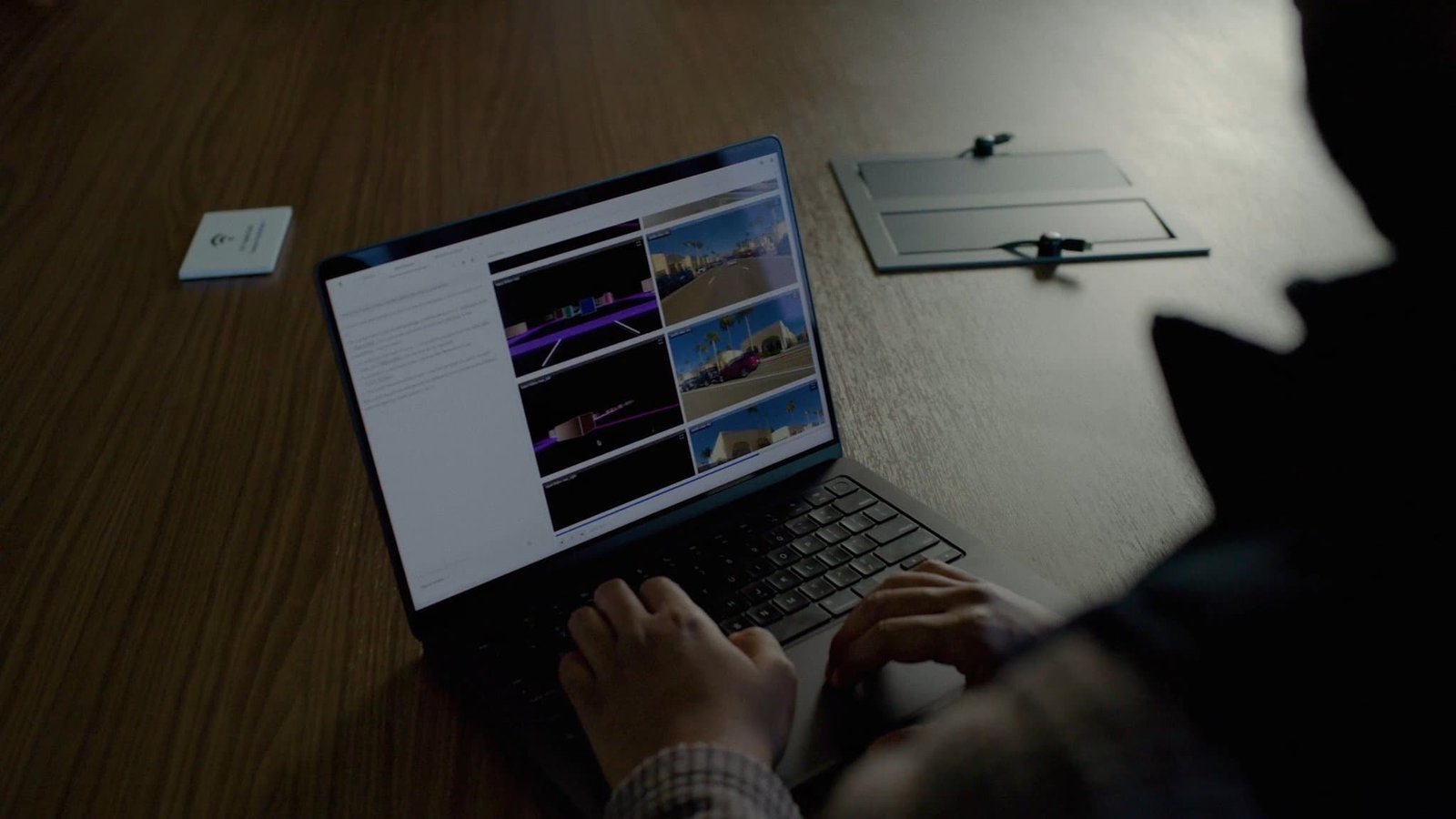
It can read and evaluate requirements, reason across software architectures, work with code in reproducible cloud environments, validate changes in software-in-the-loop and hardware-in-the-loop environments, and ultimately test the same software on a real vehicle.
Equally important, Dana provides context to the entire process. Work that once took months to complete between separate tools and specialized teams can, in some cases, be completed in an afternoon by a single developer, systems engineer, or product manager.
“We have spent the last decade building the infrastructure behind physical AI alongside some of the most advanced engineering organizations in the world,” says Younis. “Dana transforms this experience into a scalable platform.”
The next decade of intelligent machines
Dana is one of the most ambitious products we have ever built.
We didn’t build it for a single application or industry. We built it to work with everyone. Develop and validate end-to-end autonomy for cars and trucks. Build and operate autonomous fleets. Accelerate software-defined vehicle development. Orchestrate robots at industrial sites. Develop operating systems for mines, ports and other complex environments.
In the coming weeks and months, we’ll share more about what Dana can do in the areas of autonomy, vehicle software development, fleet operations and more.
Over the next decade, intelligence will be embedded in vehicles, robots, industrial facilities, factories and machines used throughout the physical world. And as these systems become more powerful, the bottleneck shifts from creating information to implementing these systems securely, reliably, and at scale.
This is the future Dana was created for.
Dana is a new way to build physical AI that moves at the speed of AI.
To see Dana in action and request more information, sign up here.
https://www.appliedintuition.com/blog/dana-new-way-to-build-physical-ai
