

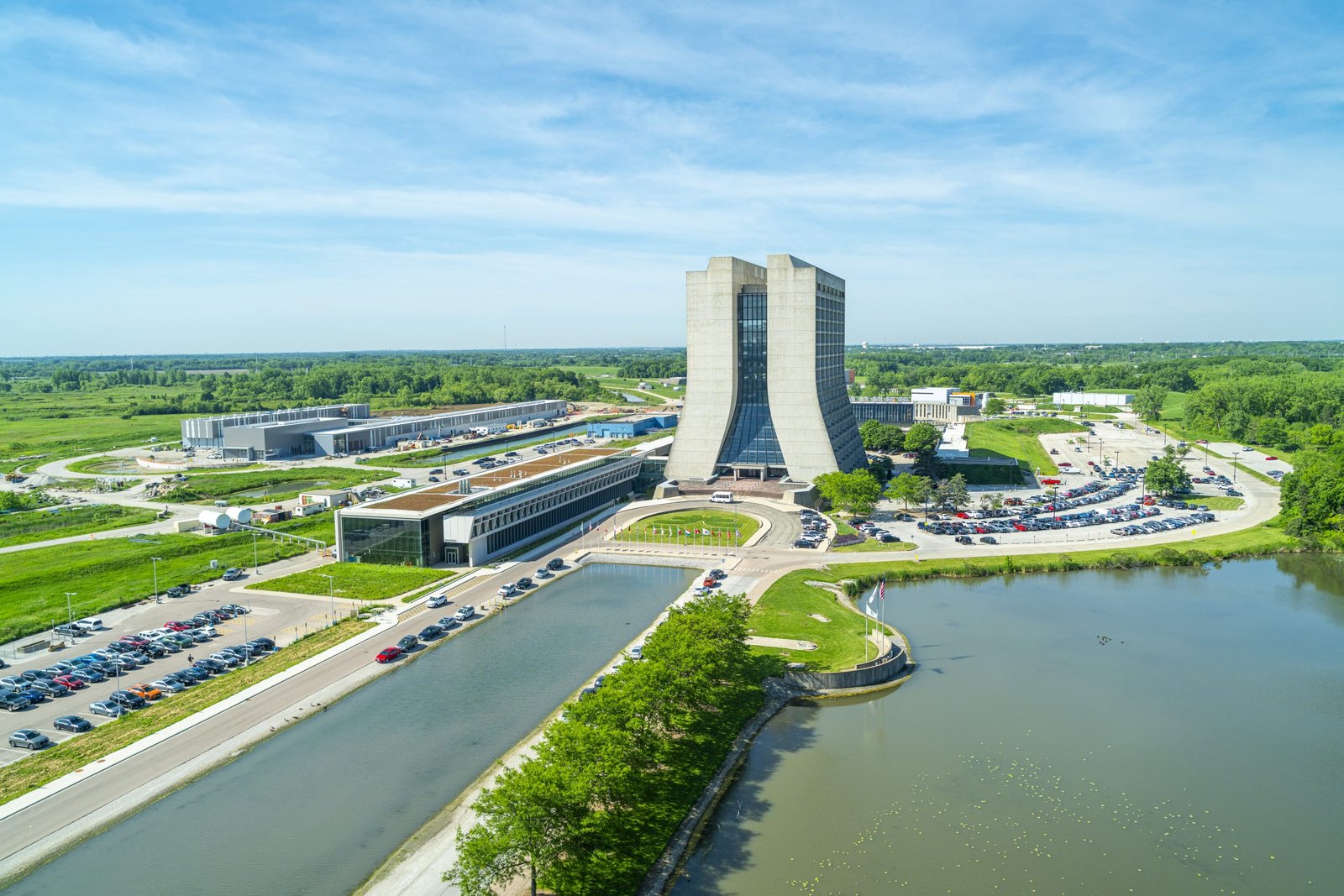
The Department of Energy today announced the list of projects funded under the Genesis Mission: Transforming Science and Energy with AI. The Fermi National Accelerator Laboratory has been selected for a number of initiatives, including the Fermilab-led AI/ML project and eight others in which the laboratory is a key collaborator. These awards position Fermilab as a strong contributor to the Genesis mission and demonstrate the laboratory’s leadership in applying artificial intelligence and advanced technologies to accelerate scientific discovery.
“Fermilab is honored to receive this support to advance artificial intelligence as part of DOE’s Genesis Mission. This investment strengthens our ability to accelerate scientific discovery, develop next-generation technologies, and advance innovation at the frontiers of particle physics and cutting-edge technology,” said Fermilab Director Norbert Holtkamp. “We are proud to bring our expertise to a mission that will help shape the next era of U.S. leadership in science and technology.”
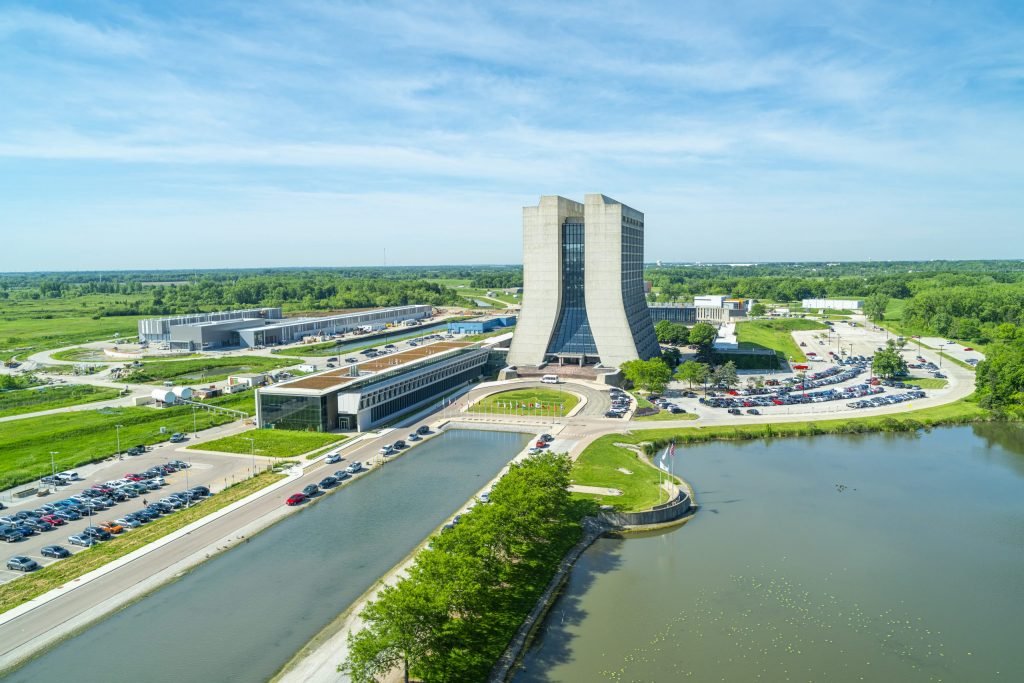 The DOE today announced the first phase of the Genesis Mission Awards, in which Fermilab received funding for an AI/ML project it leads and eight other projects in which the laboratory is involved. Photo credit: Ryan Postel, Fermilab
The Fermilab-led project will develop AI/ML-based resonance control algorithms to enable highly reliable and cost-effective accelerator operations that will significantly improve the performance of particle accelerators that advance discovery science. Several partner institutions, including national laboratories, universities and industry partner xLight Inc., are contributing to this project.
The Genesis Mission is a historic national initiative of the U.S. Department of Energy that is building the world’s most powerful integrated platform for scientific discovery. By uniting government, industry, academia and philanthropy, it accelerates breakthroughs in energy, scientific discovery and national security through a new platform that combines AI, supercomputing, quantum systems and advanced scientific instruments.
The projects named today are funded through a Request For Applications (RFA) announced by the DOE in March. The goal of the Phase I RFA awards is to identify promising pathways to transformative scientific capabilities and provide a foundation for future investment and scale. Fermilab project teams will design and demonstrate research workflows that integrate AI with scientific inquiry, rigorously evaluating whether these approaches can accelerate discovery, improve predictive capabilities, improve experimentation, or generate new scientific knowledge.
Fermilab participated in today’s Genesis Mission Summit as a recipient of a first-round Genesis Mission award, underscoring its leadership in advanced accelerator technologies as the Department of Energy announced the selected projects.
The AI/ML algorithms that will emerge from the Fermilab-led project will expand scientific reach, improve stability for users, extend the life of radio frequency amplifiers, and reduce operating costs. Superconducting radio frequency (SRF) cavities are electromagnetic resonators that transfer energy to beams in particle accelerators. Because they are extremely efficient resonators, they can be disrupted by small vibrations and pressure fluctuations. For current and future SRF-based accelerators such as Fermilab’s Proton Improvement Plan-II (PIP-II) linear accelerator, SLAC National Laboratory’s Linac Coherent Light Source-SC, Brookhaven National Laboratory’s Electron-Ion Collider (EIC), Michigan State University’s Facility for Rare Isotope Beams, Argonne National Laboratory’s Argonne Tandem Linac Accelerator System, and industrial accelerators, this is critically precise Control of cavity resonance frequency.
“These awards recognize the tremendous opportunity to combine artificial intelligence with Fermilab’s world-leading expertise in superconducting accelerator technology,” said Anna Grassellino, chief technology officer and deputy laboratory director of the Technology Directorate at Fermilab. “By developing AI-driven control of superconducting RF cavities, we can make future accelerators – like our own PIP-II – more efficient, reliable and autonomous, enabling higher scientific performance while reducing operational complexity. This is an important step towards a new generation of intelligent accelerator facilities that will advance discoveries in particle physics and many other areas of science.”
Fermilab will serve as a key collaborator on several other projects focused on core research areas of the laboratory, such as: B. Neutrino and collider physics, the muon-to-electron conversion experiment (Mu2e), Precision Frontier, the Electron-Ion Collider and advanced scientific computing. The following projects have been selected for Genesis Mission funding:
- How AI will accelerate the discovery of highly complex data streams from electron-ion colliders
Lead Institution: Purdue University - Using an AI-driven approach to detect anomalies in the CMS Level-1 Scouting System
Lead Institution: University of Colorado - Standardize and advance high-performance computing workloads using AI
Lead Institution: University of Wisconsin-Madison - Using agent workflows to accelerate search and discovery of loaded lepton flavor violations in Mu2e
Lead Institution: University of South Carolina - Using advanced AI-accelerated systems to detect, identify, classify and communicate supernova events in real time for the Deep Underground Neutrino Experiment (DUNE)
Lead Institution: Duke University - The use of AI agents for simulations and analysis operations in high energy physics
Lead Institution: University of Alabama - Accelerating DUNE physics with AI to discover uncertainties in neutrino interaction
Lead Institution: Florida State University - Physics-driven digital twin simulations for fusion magnetic systems
Lead institution: Lawrence Berkeley National Laboratory
Fermilab is an international leader in particle accelerator science research, using accelerator and detector technologies to generate massive streams of data for scientific discovery. The lab’s high-energy physics research creates unique opportunities for AI innovation. That’s why researchers are developing and implementing AI tools to improve the precision of measurements, optimize operations, and accelerate discoveries.
The Fermi National Accelerator Laboratory is America’s national laboratory for particle physics and accelerator research. The Fermi Forward Discovery Group manages Fermilab for the U.S. Department of Energy’s Office of Science. Visit Fermilab’s website at www.fnal.gov and follow us on social media.
https://news.fnal.gov/2026/07/u-s-department-of-energy-invests-in-fermilab-projects-to-accelerate-ai-enabled-scientific-discovery/
