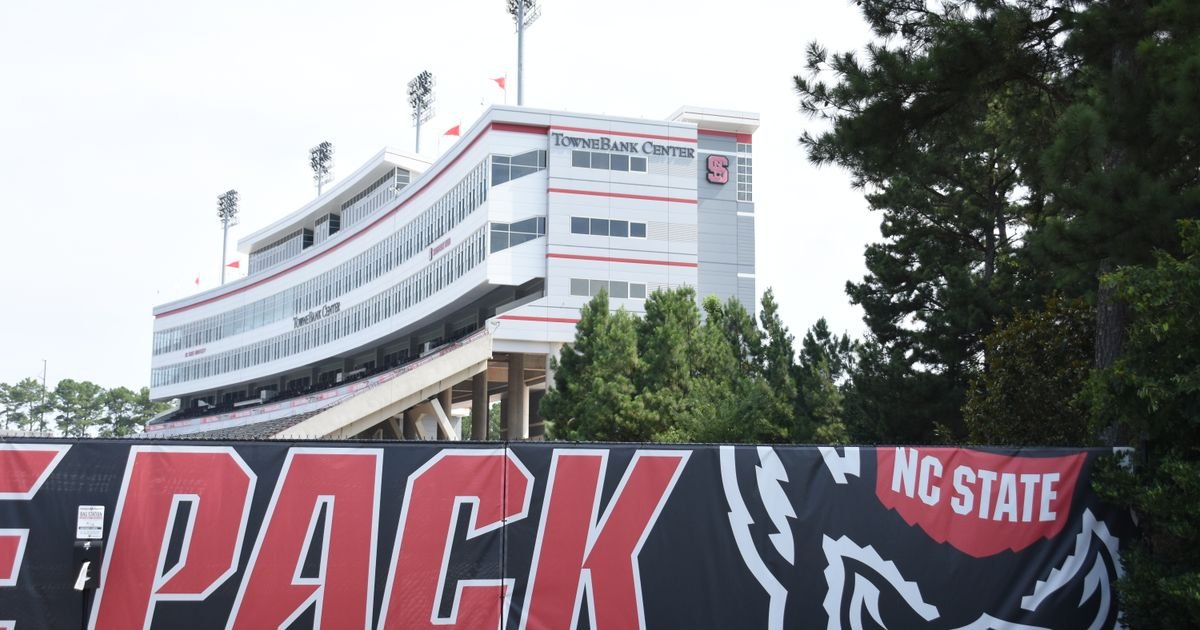
RALEIGH — NC State won’t play a home football game for the next seven weeks, but the school will host two major music concerts at Carter-Finely Stadium, just one way to generate additional revenue for its athletics department at a time of rising costs.
Rock and Roll Hall of Fame band Guns N’ Roses will play the football stadium on Thursday, July 23rd, while popular singer-songwriter Noah Kahan’s show is sold out on Saturday, July 25th.
“They’re moneymakers for us,” North Carolina State athletic director Boo Corrigan told WRAL. “I think it’s a great thing we can do for Raleigh. For the students that are here, if we can provide that too, it’s part of the whole college experience.”
Last year’s sold-out Chris Brown concert was the first major music show at Cater-Finley Stadium since Beyonce in 2016 and the Rolling Stones in 2015. U2 played the stadium in 2009. Other music greats such as Pink Floyd, The Who, Grateful Dead, Paul McCartney, George Strait and Jimmy Buffett have played the stadium since 1988.
The Chris Brown concert in October led to massive traffic problems in and around the stadium – problems that the university and Raleigh police are working to prevent this weekend.
“We have been working with police to make sure we are as prepared as possible to make sure it is a major event for the city, the state of North Carolina and the residents,” Corrigan said.
NC State earned $500,000 from the concert last year, and Corrigan said the school is interested in holding more events at Carter-Finley Stadium, which has a capacity of 56,919 for football games. Most of these spaces are available for musical performances.
“We’re open for business,” Corrigan said, adding that Raleigh is becoming an increasingly popular destination for touring acts.
NC State projected an athletics department deficit of more than $18 million on a budget of $144.6 million for the fiscal year that ended June 30. This was the first year that revenue was shared directly with athletes. North Carolina reported a $14 million deficit in its athletics department in 2024-25. Schools could share up to $20.5 million with student-athletes in the 2025-26 school year. That number rises to $21.3 million for the 2026-27 school year, leaving athletic departments in need of additional revenue.
A place to look: A huge football stadium that is packed for about seven home games every year.
Rival North Carolina hosted the Savannah Bananas baseball team for two games at Kenan Stadium earlier this year. Corrigan said he would like to see Carter-Finley Stadium host a multi-day summer concert festival with other events at the Lenovo Center and other entertainment venues that would be part of a development around the sports facilities.
The search for extra dollars
Every little bit helps – and it takes some creativity.
The athletics director position received a $5 million donation in early 2025 and the school is exploring selling naming rights for display cases at Reynolds Coliseum. The school has increased ticket prices and raised donation amounts for tickets and parking, but Corrigan said he is hesitant to put the entire cost on fans.
“I don’t think there’s this magic bullet,” Corrigan said. “It would be great if someone wrote us a check for $25 million every year.”
In the budget recently passed by the state legislature, the state of North Carolina and North Carolina will receive money from sports gambling tax revenue. Since the launch of legal online sports betting in March 2024, the other 13 UNC System schools with athletic departments have received about $5 million. NC State and UNC, along with App State, Charlotte and East Carolina, can receive up to $3.8 million in the fiscal year and up to $5.3 million in subsequent years, which WRAL first reported last month.
The university is also contributing money – more than $5 million in direct institutional support in 2024-25.
The university is working to sell naming rights to Carter-Finley Stadium. Corrigan said NC State has been “very close to making a deal several times” but doesn’t expect to have found a partner before football season. NC State is also in discussions about selling patches on its uniforms.
“It’s just the complexity of the business,” he said. “It is not easy.”
ACC is also looking for more sales
The 16-team Big 12 Conference sold jersey patches on its members’ football and basketball uniforms and other branding placements for $20 million, which was divided among the schools. The Atlantic Coast Conference, home to NC State, North Carolina and Duke, will allow its member schools to sell them themselves. California became the first ACC school to announce a jersey patching deal with artificial intelligence platform Dialpad.
Arkansas, LSU and Memphis are among the schools that have announced jersey patch offers for their entire divisions. South Florida and Louisiana-Monroe have signed football deals. Wisconsin sold patches for its basketball, softball, women’s hockey and women’s softball programs.
“The data showed us that this was an asset that was best monetized at the local school level,” said Anthony Macri, who was hired as the ACC’s first chief revenue officer in October.
NC State received $46.4 million from the ACC in 2024-25, the most recent year for which data is available. That’s up from $31.0 million in 2019-20. Conference revenue has increased from $496.7 million since the ACC Network launched in 2019 to $826.4 million in 2024-25. Commissioner Jim Phillips said last week that revenue for the 2025-26 year would exceed $900 million.
The Big Ten and Southeastern Conference each generated more than $1.1 billion in 2024-25 and paid their teams an average of more than $70 million.
Therefore, the league, like its schools, is seeking additional revenue, including through corporate sponsors. According to the Associated Press, the league has doubled its list of corporate sponsors to nine in the last five years. At its football opener last week, the ACC announced a deal with ReliaQuest, an AI cybersecurity company. The conference is also focused on maximizing revenue from its ten neutral site championship events.
Macri and Marques Zak, the ACC’s first chief marketing and brand officer, visited all 18 member schools last year and met with athletic directors, marketing and finance executives, administrators and some coaches and players to find out how the league can help schools like NC State.
“We want to understand where the conference can start to make the most of what it is trying to do locally,” Macri said. “We want to generate as much revenue as possible at the conference level so we can distribute more. But if we can also add value for them locally, we make the conference an attractive venue.”
https://www.wral.com/sports/nc-state-guns-roses-noah-kahan-concert-revenue-athletic-department-boo-corrigan-july-2026/
