

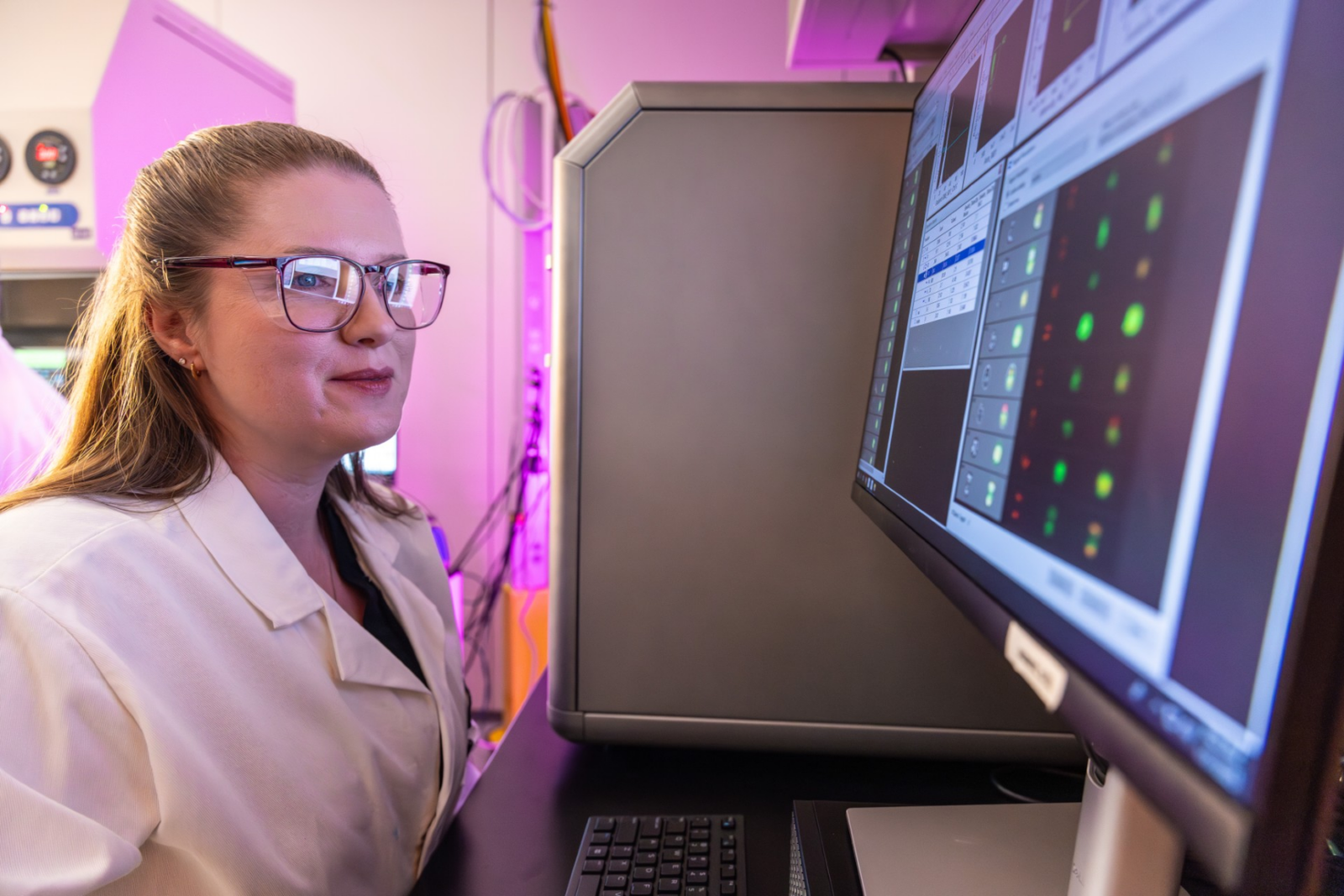
Erin Davis calls it the “SuperDuperPOD.” That’s two things in one name: pharmaceutical giant Bristol Myers Squibb (BMS) already runs one of the largest AI clusters in life sciences and has serious results to show. And they double their commitment.
BMS announced today that it is deploying its second deployment NVIDIA DGX SuperPODthis one built on eight DGX Vera Rubin NVL72 systems – the most powerful and energy efficient AI cluster in life sciences.
“Instead of giving access to the supercomputer to a small group of researchers, we are making it accessible to literally every scientist,” says Davis, vice president of research business insights and technology at BMS. “No one has to wait and no one is told that there is a limit.”
The eight rack-scale systems, each consisting of NVIDIA Vera CPUs and Ruby GPUs deliver up to 10x more performance per megawatt of infrastructure they replace. It will give researchers at the global pharmaceutical giant access to a unified AI platform – including NVIDIA BioNeMo Agent Toolkit for biological AI – to run predictions, train models, and drive drug workflows across the drug development pipeline.
What Davis and other top BMS researchers are really after is what this access enables: faster cycles, larger chemical spaces, and a complete drug development pipeline in which researchers think about the science and not the logistics of resource deployment.
The mandate, says Payal Sheth — a scientist who spent her career in drug discovery labs before taking on an expanded role as senior vice president of therapeutic research sciences at BMS in January — moves from “a kind of abstract position of what AI can do to actually translating those results into measurable impact.”
BMS operated a DGX SuperPOD for about three years and delivers meaningful results. AI-powered target identification is already saving scientists weeks of manual work and giving them time to focus on the most important scientific decisions. The BMS team has used AI to expand its library of CELMoD compounds – molecules designed to selectively degrade cancer-causing proteins, with applications in blood cancer treatment and beyond. This has opened the door to new targets and new potential drugs for a broader range of diseases. AI is also being used in lead optimization phases of drug discovery, using a method Sheth calls “Predict First,” which enables experimental gating based on design predictions.
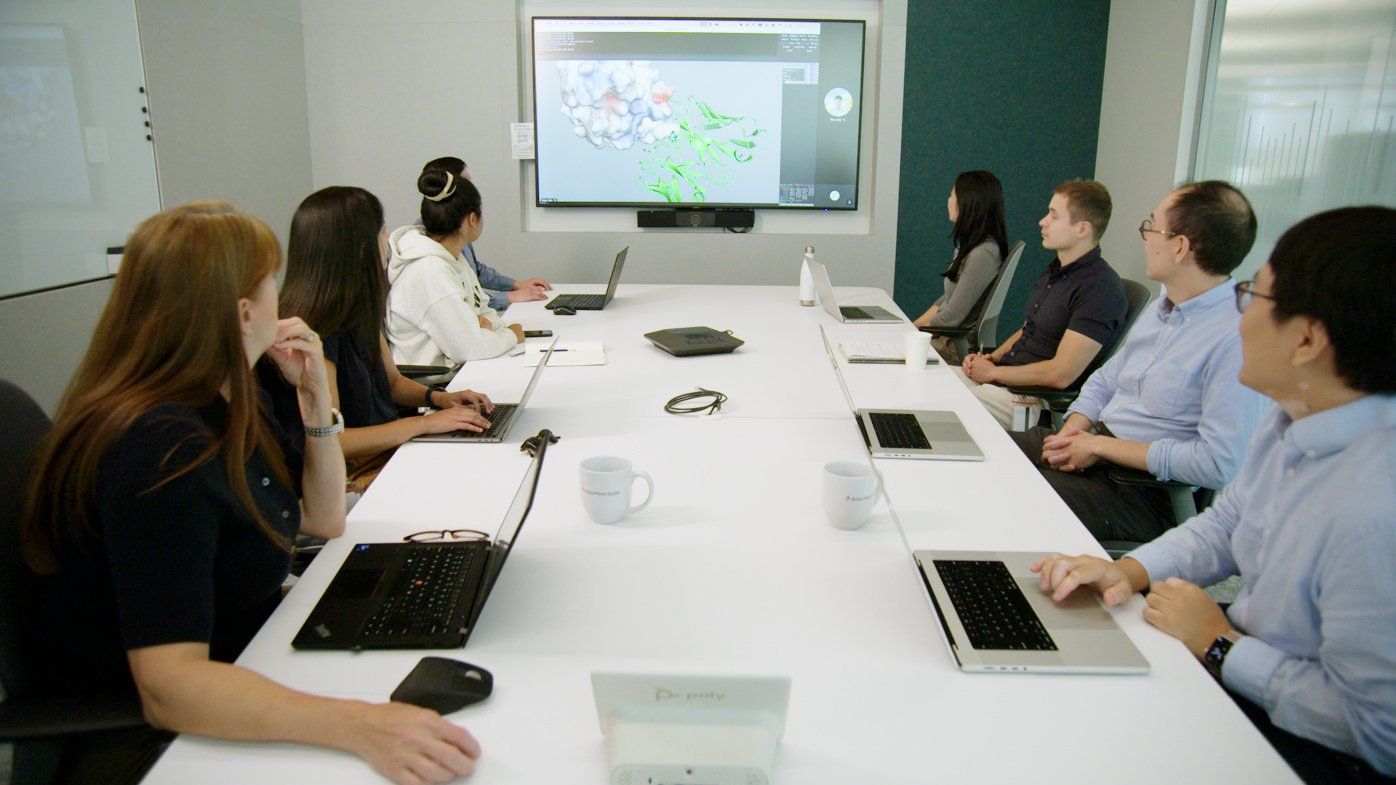 Teams at Bristol Myers Squibb check a computer model of a molecule’s structure. This is part of the predictive design process that helps scientists predict how a molecule will behave in the clinic. Photo credit: Bristol Myers Squibb
“We use prediction to prioritize the synthesis of molecules with multi-parameter optimization,” she explains, “to weed out molecules that don’t necessarily match the properties we’re working toward. This ensures that valuable laboratory experiments are directed toward advancing molecules that have the highest probability of success.”
These research AI applications have a significant impact on the computing needs of the entire research organization. “We’re saturated,” Davis says. “We’re in production with some very large-scale predictions around large molecules. We’re building our own basic models, and that requires a lot of GPUs.”
With the launch of the new system, Davis has already made her pitch to researchers thinking about where they can do their best work: “Welcome to Limitless Compute.”
A trained computational chemist, Davis dabbled in science for years before deciding that the technology couldn’t keep up—and that she’d rather fix it. She spent approximately 15 years on the supply side, building enterprise platforms at ChemAxon, Schrödinger and X-Chem. The pharmaceutical industry struggled with the same bottleneck in every company.
“It’s not the technology,” she says. “The challenge is to get this into the hands of real scientists and learn from it.”
She personally knows what it’s about. Her father died five years ago, she says, “a very terrible death from Alzheimer’s.” BMS is investing significantly in brain health – a notoriously difficult area. “Even if he still died,” says Davis, “easing the symptoms would have spared all family members the suffering. Dementia is particularly cruel.”
Davis’ team combines the existing DGX SuperPOD and the new DGX Vera Rubin NVL72-based system into a unified environment – a single data layer that can be accessed from any BMS location worldwide.
Barriers that made the previous system difficult to access – site-specific limitations left over from previous acquisitions, the need for deep computing expertise – are being replaced with AI-native tools got through NVIDIA Mission Control. Researchers will be able to make complex predictions in plain English.
“The computing infrastructure connects all of our scientists and ensures that our findings are institutionalized,” explains Sheth. Data sets from a program in Lawrenceville, New Jersey, feed models that a team in San Diego, California, can use. The findings “can be applied in the context of any program we work on.”
“There is a cumulative learning loop in drug discovery today that didn’t exist when I started my career,” explains Sheth. “Each project was treated differently, and there were discrete sets of intelligence that did not fit together in any intelligence framework within the discovery.”
Today, BMS uses AI to extend this learning loop into a discovery system where every experiment, clinical evaluation, and partnership leads to more informed scientific decisions, faster.
Agentic workflows can further improve the architecture of research and development.
“The agents don’t care,” Davis says. “They apply everywhere. And that’s a big game changer because now we can learn from decisions across silos and programs.”
“If you, as a scientist, have access to an army of well-vetted, fully trained virtual scientists who have BMS knowledge, you are now a whole team unto yourself.”
Human instincts, says Sheth, will not be replaced, “they will be complemented by more quantitative insights and predictions.” She says the ability to scale this using computers “will fully demonstrate the excitement about the impact of AI.”
“You still have to have the human brain driving things,” Davis adds, “still looking for caveats and pitfalls and still teaching them how to use knowledge. But that takes a significant toll on individual people’s capabilities.”
According to Davis, a plan is already in place for the new system: a detailed mapping of all modalities, from small and large molecule design to clinical applications to digital twins. “We didn’t just buy this to have the most computing power,” she says. “The SuperDuperPOD is basically at every junction along the way.”
When BMS Chief Digital and Technology Officer Greg Meyers asked Davis if she was sure she could even utilize the SuperDuperPOD, her answer was direct.
“Just give us time,” she told him.
Photo credit: Bristol Myers Squibb
https://blogs.nvidia.com/blog/bristol-myers-squibb-building-life-science-industrys-most-advanced-ai-factory-on-nvidia-vera-rubin/
