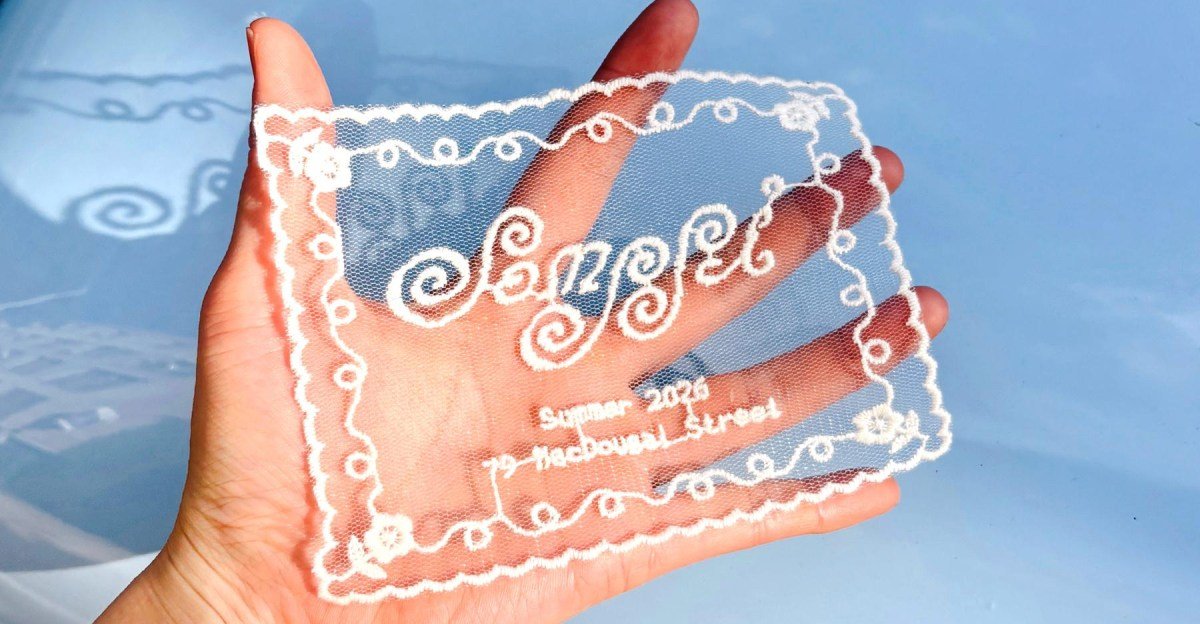
What struck me most about the Instagram announcement for the new Manhattan restaurant Somssi was the fact that it came in such an unexpected way. In the photo, a hand holds a piece of lace against the shiny background of a powder blue car. The custom-made lace is about the size of a postcard and features the restaurant’s name in twisting swirls of white thread, with the address and opening date sewn in block letters underneath. Sunlight streams through the lace, casting shadows on the scrolls that border the piece’s scalloped edges. The scene seems tangible, like a moment that really existed. It stopped me in my tracks.
“Somssi” is a Korean word that refers to “a skill or talent that you hone over time and has a lot to do with things you make with your hands,” explains managing partner Ahris Kim. For Somssi, this sense of handcrafting continues in the logo, which features the restaurant’s name sewn into the fabric and whose custom font is reminiscent of Asian calligraphy. The curtains are made from old crochet and lace tablecloths, and the curtain on the front door features the restaurant’s name in embroidered cutouts (it was also the focus of an Instagram post). Margaret Muza, Kim’s childhood best friend, handled the interior design and sourced vintage glassware and tchotchkes; Muza’s mother made the curtains using fabrics from her own collection, which she had built up over decades.

The curtains at Somssi are made from vintage fabrics, in keeping with the restaurant’s commitment to handcrafted elements. Photo by Dan Ahn
More and more, my scrolling is stopped by something that evokes the opposite feeling: a kind of half-suppressed disgust that I attribute to the flood of images that bear the grotesque characteristics of AI generation. They are the opposite of handmade, often full of mistakes that only technology without real human experience would make: the sandwiches that defy gravity; the cocktails in glasses that cast physically impossible shadows; the flyers for restaurant events that are so crowded and over-stylized that the camp almost comes full circle; the fantastical scenes, like a cat holding two tacos, that would be cute if an illustrator had dreamed them up, but seem rather cynical and smug in their absence.
The backlash against AI images is growing in a certain part of the culture. Opinions like “I would rather see a Sharpie-made poster on a piece of paper than an AI event flyer” or “I won’t go to your restaurant if the advertising is AI” are spreading. “Frictionmaxxing,” a term coined by author Kathryn Jezer-Morton to describe a rejection of convenience technologies in favor of slower and more analog processes, has escaped containment and refers to the general decision to choose paths of creation and problem-solving before the Internet. In this sense, it can refer to the choice of the hand-crafted over the AI-generated.
And even if it’s not obvious Gamethere is at least one friction filled one reaction This is what is currently happening culturally in design, right up to the sudden dominance of AI. The work of photographer Szilveszter Makó, known for his reliance on “real materials” such as absurd physical props and natural light, has taken over the fashion scene in recent months. I see a similar ethos reflected in recent images from publications such as Enjoy your mealwho have recently embraced creative elements that represent a clear physical, real-world effort, such as stop-motion animation using shaky paper cutouts for an article about hosting watch parties.
I wondered in the early days of AI whether its inevitable abundance would eventually lead to a renewed valorization of the analog, the physical, and the explicitly human-made, and indeed this seems to have increasingly become a reality. Take New England grocery chain Market Basket, which recently released a limited edition of its weekly newsletter, entirely hand-illustrated by artist Katie Christensen. It’s intended to harken back to the store’s earlier days, when newsletters were always signed by one person.
Or take Fearless Coffee in Johnson City, Tennessee, which released a series of images promoting its new menu earlier this summer. “Currently our world is saturated with digital noise and content. AI advertising and graphics dominate the landscape,” the shop wrote on Instagram. Hoping to stand out from the crowd, the store hired photographer Jamey Booher to do a photo shoot that would take people “back to a time before.” [AI] existed,” for example, posing with a banana latte in a scene reminiscent of late ’90s summer, tapes and all. The gesture (and attitude) didn’t go unnoticed, hitting the feeds of people like me who only know Johnson City from “Wagon Wheel,” and apparently becoming the most-liked post ever.
Shinji, a new Japanese restaurant in Toronto, caught my attention through a video shared by calligrapher Sylvia Wong, who was commissioned by the restaurant to hand-engrave the logo on wine glasses. In her post, Wong acknowledged that while hand engraving is less efficient than machine engraving, it is more in line with the restaurant’s artisanal ethos. Friction maxxing!
Amid this flood of AI content on Instagram, photos of handwritten menus now fill me with a feeling similar to Somssi’s lace and fabric – something between relief and admiration, an anchoring in the realm of the real. Melissa Martin of Mosquito Supper Club in New Orleans recently changed the way she promotes her restaurant on social media, posting snapshots of handwritten paper menus instead of the professional photos from her cookbooks.
After a shockingly slow summer, the posts are a way to remind people that her restaurant is still open, Martin told me in a message, but she also appreciates the task. “I like the feeling of handwriting the menu, cutting it with scissors, taking a photo and posting it,” she says. Even though the handwritten menu is just for Instagram, the process feels more “personal.” Your restaurant menus are created on a blackboard – primarily to save printing costs, but also because of the analogue appeal. “I’ve never used AI for anything and don’t plan to,” says Martin.
Superiority Burger in Lower Manhattan has always had a punk irreverence, thanks to its chef-owner Brooks Headley’s background in the hardcore music scene. It stays true to its vegetarianism in a decidedly unfashionable way (even as plant-based diets fall out of favor), championing the produce of small farms and delighting guests with, for example, Campo Rosso’s short-lived cauliflower sprouts.
In the age of the AI slop restaurant, I’m even more attracted to Superiority’s DIY approach to something as corporate tech as Instagram. Special offers are often announced through notes hand-scrawled on a piece of paper with a Sharpie, which are then photographed and shared online. To announce a collaboration between the restaurant and Queens sandwich shop Salty Lunch Lady’s Little Luncheonette, the two restaurants posted crumpled and randomly cut paper letters spelling out the news.
What once seemed like the pretentiousness of Superiority Burger now feels like an affirmation of the restaurant’s values. Someone did this, just like someone made your food, just like someone grew vegetables from seeds. Sometimes Sharpie on scraps made quickly and inexpensively says more than an AI-generated image ever could.
Inspired by the menu in pubs in the UK, the menu at Dean’s is hand written and photocopied each week. Courtesy of the Dean
The menu at Dean’s, the long-awaited new British restaurant in New York City, is also handwritten. Each week, interim operations manager Tommy Hunt receives the menu updates, then comes in and handwrites the menu so it can be photocopied. “When we talked about the pubs we admired most, our sources of inspiration [United Kingdom]“There was always a handwritten menu because it’s a really personal experience,” says co-owner Annie Shi. “[Hunt] has a really classic English handwriting for me. It’s bold, somewhere between italics and straight type.”
She imagines the handwriting could change over time, but she likes this possibility: a way to track the restaurant’s evolution. At Shi’s other restaurant, King, which opened in 2016, the branding appears similarly handcrafted, with illustrations by artist RF. Alvarez; The logo is a sort of scratchy, squiggly scrawl. For Shi, there is a connection between these clearly handcrafted images and her restaurants’ views on food. Even at the height of the farm-to-table approach, it was never her style to “shout from the rooftops where we shop,” she says. “But I think there are other ways to show that this is a personal, artisanal project through small details like a handwritten menu.”
This is nothing new for restaurants. But in the post-AI world, these markings of real hands behind something seem even more appealing: a direct confrontation with what has been taken over. Let us return to the expression “somssi,” which means skills honed over time. “Anywhere we could impose a handcrafted detail, we did,” says Kim. Thus, “even AI-generated work would contradict what ‘somssi’ should stand for.”
There is hardly any path that involves more friction than the decision to manage a restaurant. Why add more friction? Under these circumstances, while it may cost more to hire a photographer to promote your new menu than to create one using AI, it’s also becoming increasingly clear that many people would rather see a poorly captured, faithful photo than an artificial AI image. For one thing, it feels like a reflection of your own values. To me, a restaurant using AI art capitulates to slop culture, akin to reheating pre-prepared food from Sysco. It is impossible to reconcile a value system that emphasizes craftsmanship and integrity.
https://www.eater.com/trends/975087/restaurants-lean-into-bespoke-handmade-elements-during-ai-flyer-backlash
