This article is made possible by Spotlight PAs Partnership with knowna nonpartisan news organization that covers government and politics with the fresh eyes of young journalists and the expertise of seasoned reporters.
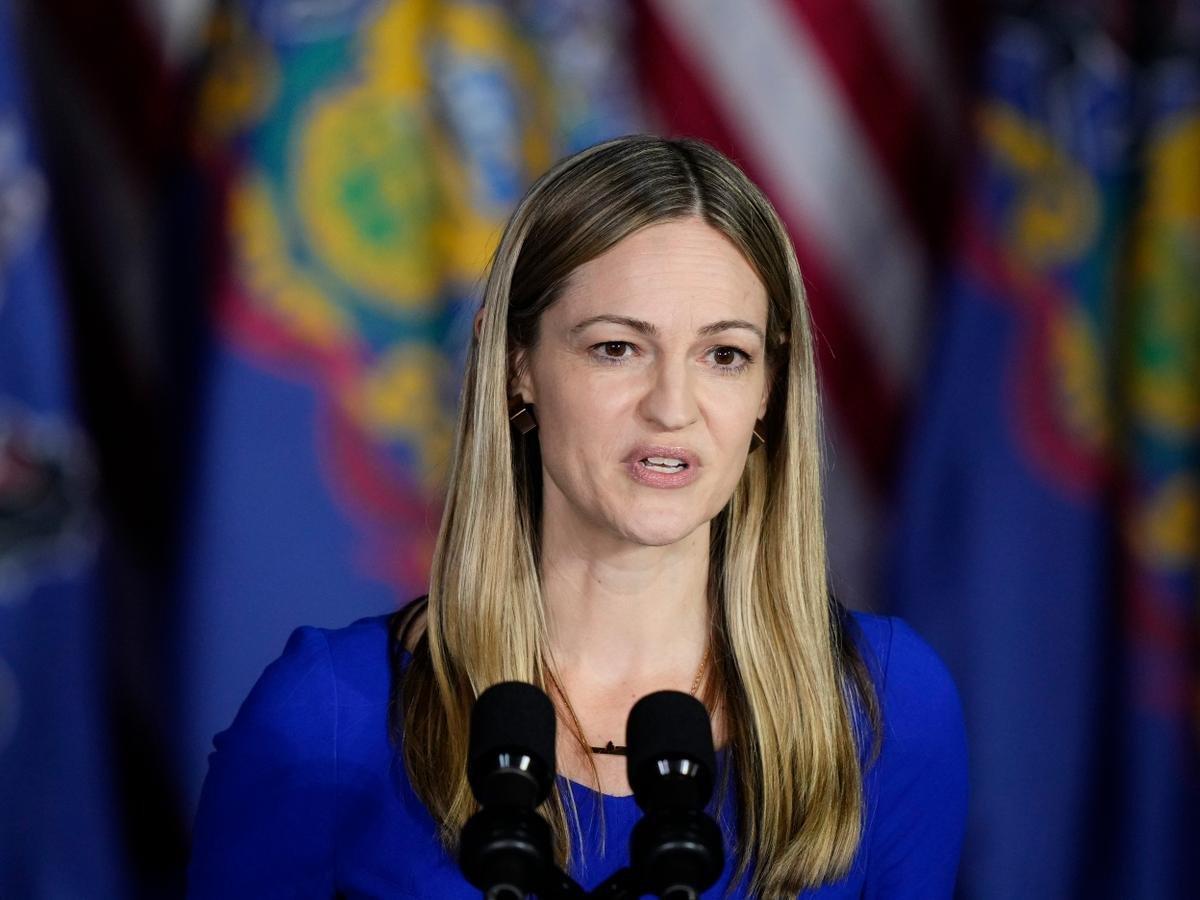
Paige Cognetti, the mayor of Scranton, Pennsylvania, who Democrats hope will replace Republican Rep. Rob Bresnahan this November, has repeatedly promised not to accept money from corporate political action committees as a candidate or legislator.
“No corporate PAC money. As a candidate and member of Congress, I will reject the influence of special interests,” Cognetti wrote on her campaign website.
But federal campaign finance records show that Cognetti has accepted donations from numerous political committees, which in turn are flooded with cash from corporate PACs, including money from defense contractor Boeing, banking giant JPMorgan Chase and insurance company UnitedHealthcare.
Many of the non-corporate political committees supporting Cognetti are leadership PACs run by Democratic federal lawmakers to promote their party’s congressional candidates.
For example, during her 2026 campaign to represent Pennsylvania’s 8th Congressional District, Cognetti received $5,000 from the Blue Hen Federal PAC, a committee sponsored by Sen. Chris Coons (D-Delaware).
The Coons Committee has received hundreds of thousands of dollars this election cycle from a who’s who of business and trade association PACs affiliated with companies such as Visa, FedEx, Pfizer, Northrop Grumman, Eli Lilly, Google, McKinsey and Fox News parent Fox Corp. are connected, among several dozen others.
Cognetti’s campaign also received $4,000 from House Democratic leader Katherine Clark’s campaign committee, which itself is partially funded by numerous corporate PACs, including those sponsored by Delta Air Lines, Verizon, Allstate Insurance and the law and lobbying firm Alston & Bird.
Cognetti took money from dozens of these leadership PACs that report significant corporate contributions — including the PACs of Rep. Ted Lieu, the vice chairman of the House Democratic Caucus, and Rep. Nancy Pelosi, the former speaker.
“Paige is the only candidate in this race who does not accept donations from corporate PACs, supports a federal ban on corporate PAC donations and will never be handed a corporate check in return for special access or political favors,” said Emma Mustion, the campaign’s communications director. “The reason for her promise is simple: Paige is independent and works only for the people of Northeast Pennsylvania.”
Cognetti’s promise to reject corporate PAC money has become a central feature of her campaign, cited in endorsements from advocacy groups like End Citizens United and lawmakers like Sen. Mark Kelly (D-Arizona).
Campaign finance and other money matters are key issues in the race between Cognetti and Bresnahan. Cognetti has repeatedly attacked Bresnahan, who accepts direct corporate PAC money, for his once-prolific stock trading – the multimillionaire made more than 650 individual stock trades using his own helicopter in 2025, according to federal filings.
Among other things, he traded stocks in companies that administer Medicaid just before the House of Representatives held its first vote on the Republicans’ sweeping tax cut bill that would cut the program. He also personally invested in artificial intelligence companies before getting involved in data centers.
NOTUS previously reported that Bresnahan abruptly stopped trading stocks earlier this year. At the time, a spokesman said a financial institution managed Bresnahan’s stock trades.
“Only a slick politician like Paige Cognetti would make a promise to reject corporate PAC money the centerpiece of her campaign, only to find a loophole to accept it,” Samantha Bullock, a spokesperson for Bresnahan’s campaign, said in a statement to NOTUS.
According to federal records, Cognetti had $3.4 million in cash as of June 30, exceeding Bresnahan’s war chest of $2.6 million. The nonpartisan Cook Political Report rates the race between Bresnahan and Cognetti as a toss-up. Both national Republicans and Democrats consider the race crucial to winning a majority in the House of Representatives in 2027.
For her part, Cognetti continues to champion an anti-corruption platform that includes banning members of Congress from trading individual stocks, imposing term limits on federal lawmakers, withholding lawmakers’ salaries during government shutdowns and banning members of Congress from placing bets on prediction markets.
Other candidates have been criticized in the past for accepting similar contributions. Democrat Abigail Spanberger, now Virginia’s governor, campaigned on rejecting corporate PAC money during her run for Congress in 2022 — and was criticized at the time for accepting money from leadership PACs.
https://www.spotlightpa.org/news/2026/07/pennsylvania-cognetti-corporate-pac-money-campaign-finance-federal-government/
