Connecticut relies on nonprofit organizations to provide addiction treatment, disability services, housing, job training and other public services. Most spend public money responsibly. But once tax dollars leave a state agency or city hall, the public often loses the opportunity to see how they are being spent.
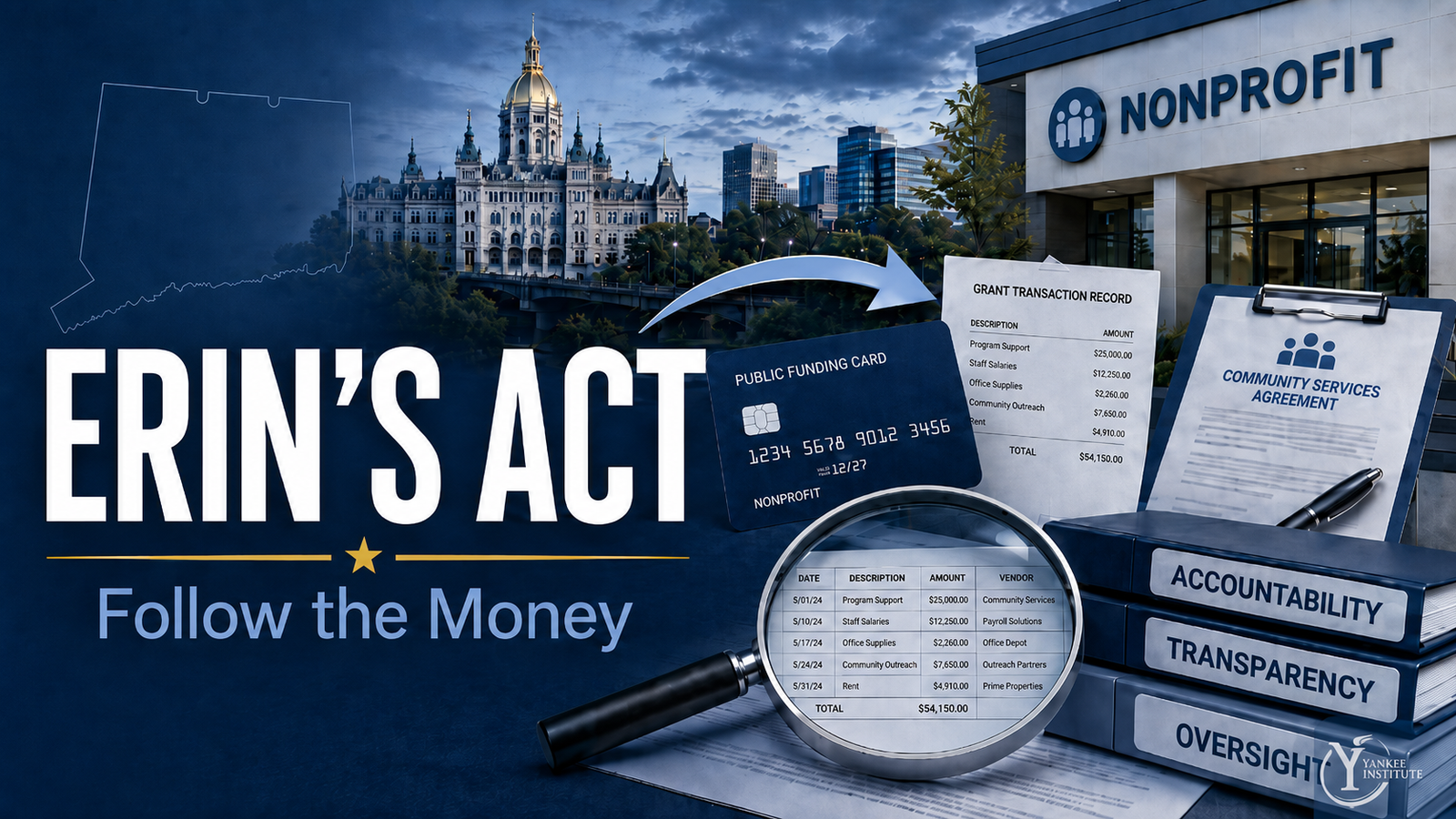
The Expenditure Records and Information Notification Act (ERIN Act) would require disclosure of purchasing card expenditures by government agencies and grant-funded nonprofit organizations alike. The proposal would apply to nonprofit organizations that receive more than $50,000 in state or local grants, contracts, subsidies, or other public assistance during a fiscal year.
Connecticut has already shown why this provision is necessary.
Years of abuse before anyone knew it
The Southeastern Regional Action Council on Substance Abuse (SERAC) is a nonprofit organization in Norwich funded primarily by state and federal grants, including money from the Connecticut Department of Mental Health and Addiction Services (DMHAS).
Beginning around 2008, executive director Michele Devine used the organization’s funds for household appliances, travel, timeshare fees, stays at Canyon Ranch, and donations to private schools. Federal prosecutors said she altered receipts and other documents to disguise personal purchases as business expenses.
Devine stole nearly $400,000 before leaving SERAC in 2022. She pleaded guilty to wire fraud in 2024 and was sentenced to two years in federal prison. The plan lasted about fourteen years.
At Chapel Haven Schleifer Center, a nonprofit organization in New Haven that serves people with developmental and social disabilities, a supervisor used an organization credit card to purchase sporting event and entertainment tickets for himself, friends and family. He submitted false orders claiming the expenses were for Chapel Haven students and community members and also purchased gift cards for himself.
According to federal prosecutors, the credit card scheme ran from 2012 to 2018 and cost approximately $175,872. He pleaded guilty to wire fraud and was sentenced to 33 months in prison.
The prosecution failed to prove that each dollar stolen came from a specific government payment. But Chapel Haven participates in Connecticut’s publicly funded disability assistance system, and the abuse remained hidden for six years.
The Blue Hills Warning
The strongest argument for the nonprofit provision of the ERIN Act is the Blue Hills Civic Association in Hartford.
Blue Hills received about $15.7 million in state funding between fiscal years 2022 and 2025, including legislative grants, federal pandemic relief and economic development funds.
The Department of Economic and Community Development (DECD) ordered a forensic audit after Blue Hills reported that a $300,000 payment for another nonprofit was intercepted as part of a wire fraud scheme. Blue Hills waited months before notifying state officials and its own board.
The audit identified broader issues relating to contracts, record keeping, monitoring of sub-recipients and unsupported expenditure. Auditors found that at least $208,000 in unsupported payouts were related to conflicts of interest or work that could not be proven to have been completed. They also reviewed the spending of organizations that received public money through Blue Hills.
Records submitted to the SHEBA Resource Center included five Netflix charges categorized as marketing, advertising or advertising, as well as transactions at Amazon, Best Buy, BJ’s, Target, Walgreens, Walmart and other retailers. These purchases were not necessarily illegal. The problem was that records often didn’t show what was purchased, who received it, or how it related to the taxpayer-funded program.
Investigators also found approximately $120,439 worth of checks sent to unidentified recipients, as well as what appeared to be a $7,748 Discover credit card payment. SHEBA reported distributing $50,000 to 50 scholarships valued at $1,000 each; Instead, auditors found irregular transactions and checks without any records identifying the recipients.
The audit found that the evidence pointed to possible misuse of public funding, but did not conclude that each transaction in question was fraudulent. Had the transactions and receipts been public during the life of the grants, journalists, board members or state officials could have asked questions about Netflix fees, retail purchases and unexplained credit card payments before a forensic audit was required.
Audits are not real-time monitoring
Connecticut already requires certain organizations that receive significant federal support to conduct audits. This control is important, but occurs only after the money has been spent and does not allow taxpayers to keep a continuous record of card transactions and receipts.
The theft of SERAC took about fourteen years. The Chapel Haven program lasted six years. The Blue Hills problems only became public when $300,000 had already disappeared. Audits document errors afterwards. Disclosure can uncover warning signs while there is still time to respond to them.
Keep the rule in focus
The ERIN Act would not make all nonprofit spending public. The proposal only applies to organizations that receive more than $50,000 in state or local support during a fiscal year, a threshold lower than Connecticut’s $500,000 state single-audit trigger, but the obligations are not comparable. Posting receipts and basic transaction information on a government portal is far less burdensome than commissioning a full audit.
Reporting would include transactions billed, reimbursed, or allocated to a public grant, contract, or program. Private donations and unrelated private income should remain private and medical, donor and other proprietary information would be redacted. For covered transactions, the public would be able to see the seller, date, amount, source of funding, business purpose and receipt. The state would operate a centralized portal and disclosure would be guided by the transfer of public funds from one nonprofit to another.
Most nonprofits already retain revenue and spread expenses between public and private funding sources. The ERIN Act would make records associated with taxpayer funding available before an audit or prosecution uncovers a problem.
Connecticut should not require transparency from government and local governments while allowing those same tax dollars to disappear from view once they reach a private organization. Nonprofit organizations can be private. The money taxpayers give them is not.
https://www.yankeeinstitute.org/2026/07/17/erins-act-should-follow-taxpayer-money-beyond-government/
