Communities in Massachusetts spent opioid settlement money on stadium lighting, recreation centers and police vehicles
Most of Massachusetts’ opioid settlement funds have not been spent
Opioid settlement funds are intended to mitigate the harm caused by the opioid epidemic, but most Massachusetts communities have not spent the money and others have reported questionable purchases.
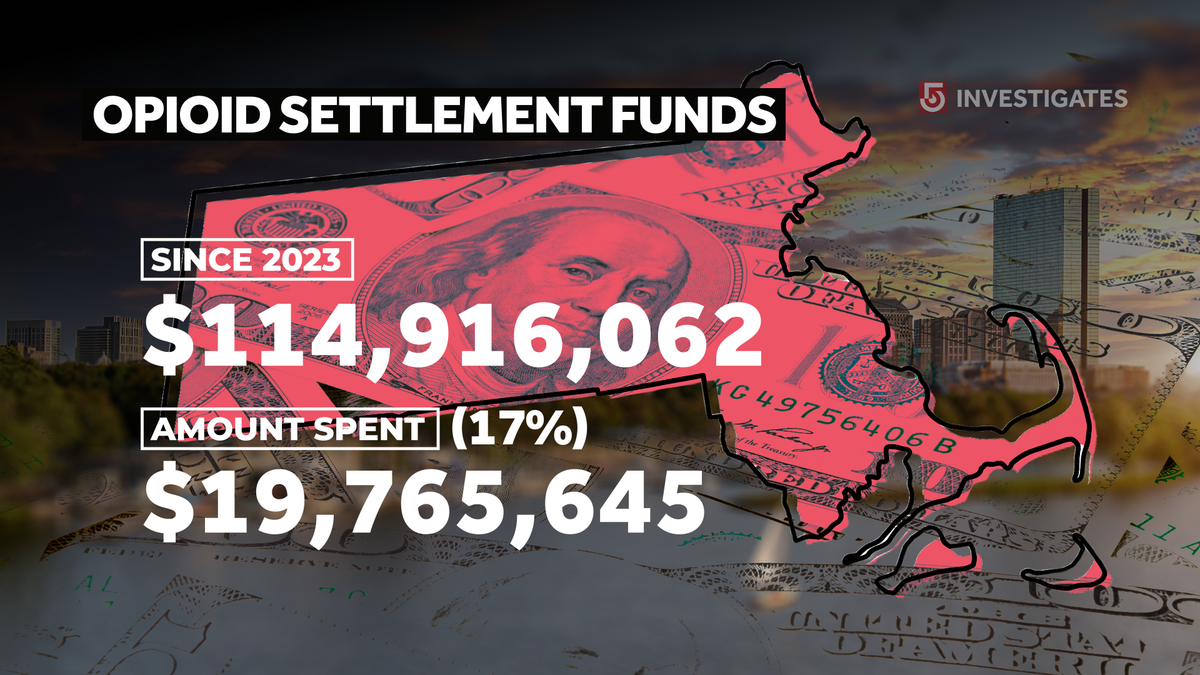
Since 2023, cities and towns have received $115 million from these funds, but they have spent $19 million, less than 20% of what they received. The money comes from settlements negotiated with pharmaceutical companies, distributors and retailers related to the opioid overdose crisis.
5 Investigates partnered with Northeastern University’s School of Journalism and sent public records requests to every municipality in the state to see how they used the money. While some communities didn’t spend a dime, others used the money to purchase stadium lighting, vape detectors and outfitting a police vehicle with new paint and tinted windows.
West Springfield has received more than $500,000 in opioid arbitration awards to date. They spent $10,000 on vape detectors for school bathrooms and additional funds are going toward stadium lighting at Clark Field.
The city’s mayor, William Reichelt, defended the spending.
“The way we spent it was productive and demonstrated data-driven impact for our students,” Reichelt said.
He said stadium lighting will eliminate darkened areas where students could vape or smoke.
When asked how vaping is related to the opioid crisis, the mayor said, “I think in many ways it makes kids comfortable with vaping, it’s illegal whether it’s nicotine or marijuana, but could inevitably lead kids to other things as well.”
The town of Plympton spent nearly $4,000 in opioid funds to paint a police car, tint the windows and add lettering.
Plympton’s police chief declined our request for an interview but said the vehicle would be used for “community outreach programs” including “overdose follow-up.”
A new $8 million recreation and youth services center is being built in Newburyport, thanks in part to $340,000 in opioid settlement funds.
Newburyport’s mayor justified the expense by saying the center will serve as a “hub for prevention, wellness and access to services.”
Although there were 135 opioid-related overdose deaths between January 2020 and December 2024, Pittsfield until recently had not spent any of the $1.6 million in opioid money it had received.
Mayor Peter Marchetti initially said there was a lack of understanding about how the money could be used.
“I think we may have been too cautious in how we used the money,” Marchetti said.
The city began spending some of the money, including $55,000 on a community liaison to support people in recovery, $10,000 on a community legal aid grant and $32,000 on a police co-responder clinician.
A city spokeswoman outlined additional planned allocations of $287,000 for a peer support program, a substance abuse treatment program and a recovery coach.
Barbara Gillmeister had asked Pittsfield for part of her funding.
She runs Gilly’s House, a men’s sober home in Wrentham. She opened it after losing her son to a heroin overdose in 2016.
“We had to do something positive to come out of such a tragedy,” Gillmeister said.
The fees residents pay only cover payroll, but she said there are many other costs associated with running the home and supporting the men.
One of the men at Gilly’s House is from Pittsfield, so Gillmeister wrote a letter to Mayor Marchetti in February.
It said: “We respectfully request assistance from the City of Pittsfield to cover one year of home expenses – $15,000 – for this gentleman. He is deeply committed to his recovery and is actively participating in all programs available to him.”
She didn’t get the money to support the man.
A city spokeswoman said in a statement: “The mayor supports remedial housing because it is an important part of continuity of care. While remedial housing is an eligible category, this request is for direct financial assistance to an individual. Pittsfield utilizes settlement funds that support broader, structured mitigation initiatives with measurable community impacts.”
Gillmeister said overall access to opioid medications has been “extremely difficult.” One day she went to six different town halls to submit requests. Despite all of these visits, she said she “really came home with no information about how much money they had, how they were spending it, or how to apply for it.”
“There’s a lot of money out there and a lot of money that just isn’t being spent,” she said.
The Department of Health did not comment on examples of questionable spending, but a spokesperson said some communities may need additional guidance to use these resources most effectively.
The state will launch a new risk assessment tool later this year that will highlight possible misspending of the opioid settlement funds.
Extreme cases are referred to the Attorney General’s Office.
Communities seeking help using their opioid settlement funds can turn to Mosaic’s municipal training and technical assistance program.
Reporting for this investigation occurred as part of a seminar on investigative reporting taught by Mike Beaudet of 5 Investigates, who is also a journalism professor at Northeastern University. The following students took part in the project: Sk Safrin Begum, Asher Ben-Dashan, Kirsten Burek, Ricole Chen, Emily Glick, Zoe MacDiarmid, Claire Ogden, Mark Puskey, Thomas Rozelle, Hikari Terasawa and Zihan Zhou.
https://www.wcvb.com/article/massachusetts-communities-spent-opioid-settlement-money/73221157
