

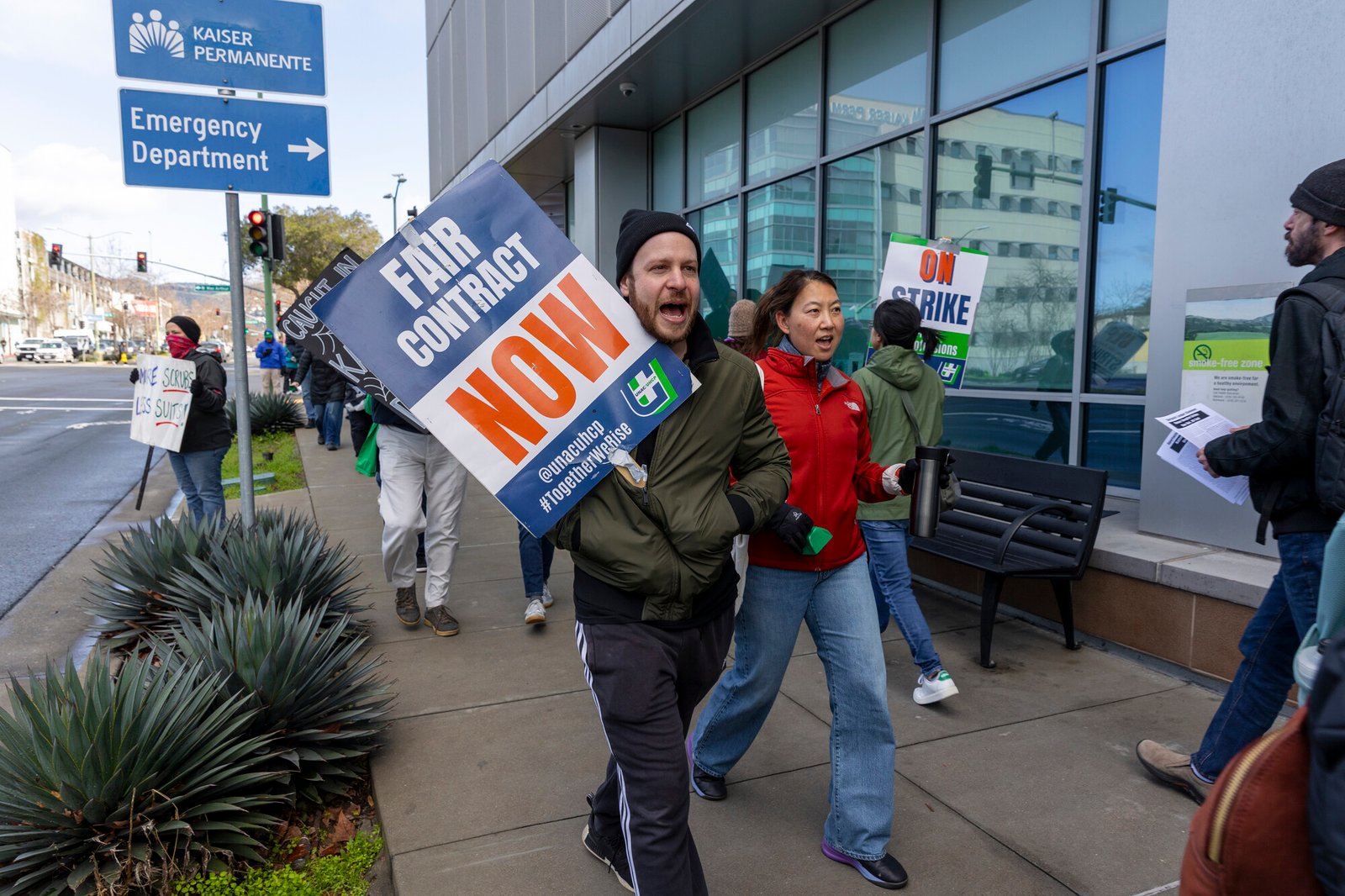
In a hearing, therapists rejected contract terms proposed by Kaiser during labor negotiations that they said would compromise mental health care. The largest health insurer for city employees said it remains focused on providing timely, high-quality mental health services.
July 22, 2026
Updated at 4:58 p.m. PT
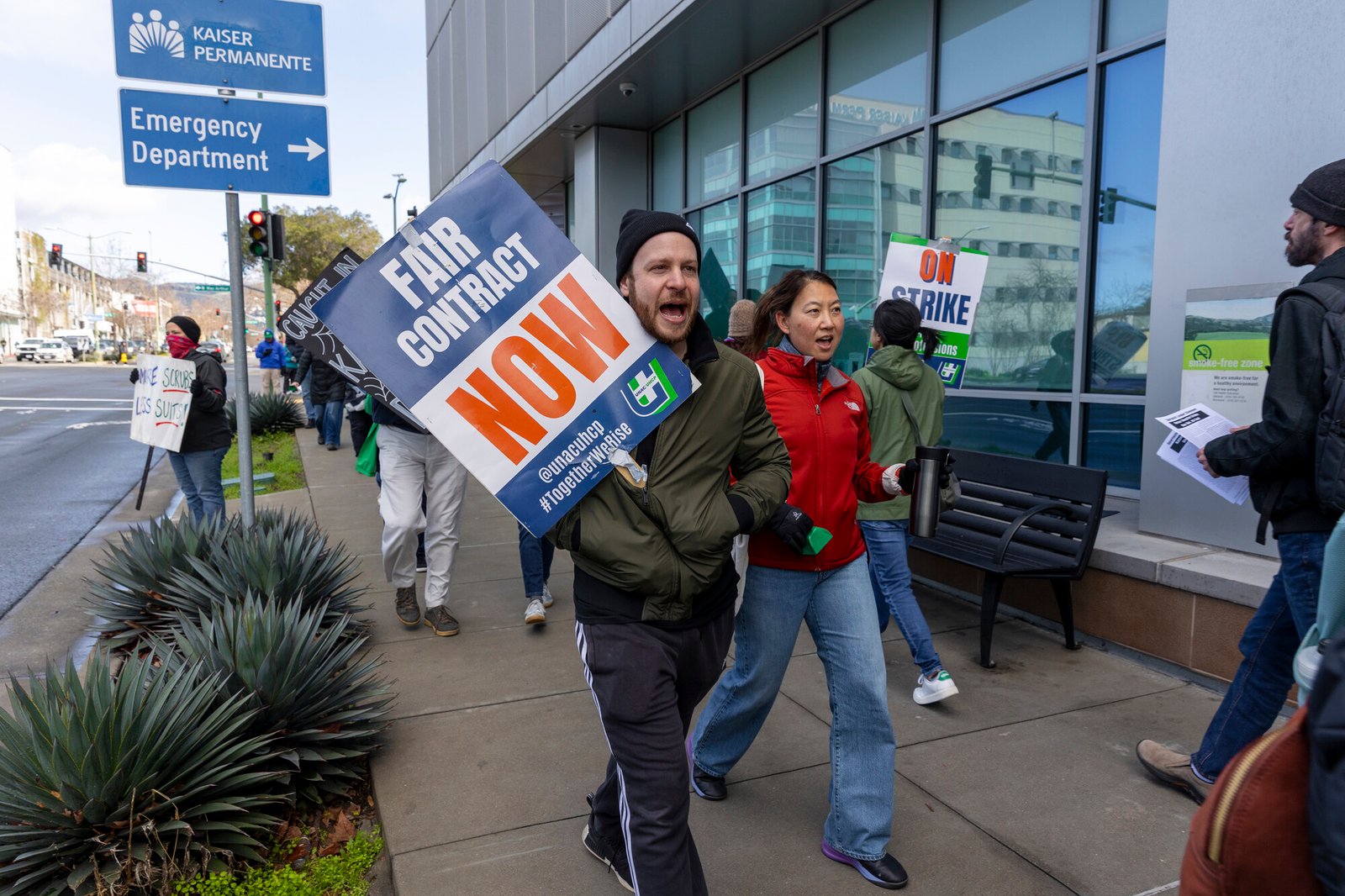
Josh Sokolski (left) and Brenda Hinaga (right), both occupational therapists from Kaiser Walnut Creek, march on the picket line outside Kaiser Permanente Oakland Medical Center on Feb. 19, 2026. (Tam Vu/KQED)
Unlicensed phone operators and algorithms direct patients to inadequate telehealth services. Controversial artificial intelligence technologies are increasingly being used in hospitals. Desperate patients who can’t get an appointment with a human for weeks.
Those were some of the alarm bells Kaiser Permanente doctors raised when they told the San Francisco Board of Supervisors that the health care giant had failed to significantly improve its mental health services, even after state and federal regulators recently imposed sanctions for denying or delaying treatment.
Tuesday’s hearing examined Kaiser’s contract proposals during labor negotiations, which the union said would allow the employer to expand the use of AI tools in mental health care and lay off more therapists who currently provide them.
Experts said these changes could worsen care because it would give the company carte blanche to outsource patients to companies that use chatbots and pressure overworked professionals – claims Kaiser denies. Clinicians pleaded with supervisors to pressure their employer to strengthen patient care and support its staff.
“The things we discussed today are upsetting, concerning and unacceptable,” said Supervisor Chyanne Chen, who called the hearing after several constituents, including Kaiser employees, complained about the health care company’s actions.
Chen said she will introduce a resolution next week calling on the state’s largest health plan to agree to contract language that says AI will be used to help therapists — not replace them — and to withdraw a proposal that would allow it to refer more patients to third-party providers.
Kaiser executives declined to attend the hearing, a move that several supervisors described as disappointing or even “disrespectful.” According to the San Francisco Health Service System, the city of San Francisco, the San Francisco Unified School District and other public employers paid $508 million in health premiums to Kaiser last year to cover more than 39,000 employees and retirees.
 The Kaiser Permanente building at 1800 Harrison (top center) in Oakland on March 16, 2026.
“Their absence suggests to me that the picture that the workers are painting is quite accurate,” said supervisor Rafael Mandelman. “We don’t want to put our employees and retirees in a situation where they don’t receive the care they need.”
In a statement, Kaiser said the company does not use AI to diagnose patients or make clinical decisions and remains focused on providing timely, high-quality mental health care while reaching a fair agreement with the therapists’ union.
Since 2023, Kaiser has agreed to pay more than $231 million in settlements after the U.S. Department of Labor and the California Department of Managed Health Care investigated the company’s access to behavioral health care.
The nonprofit health organization said it has invested more than $2 billion since 2020 to expand its mental health facilities and provider networks and is now consistently compliant with California law that requires health plans to ensure timely access to care. Kaiser, headquartered in Oakland, had net income of $9.3 billion last year.
“This is not about true innovation. This is about saving money at the expense of patient care and public health. If we don’t stop it now, we won’t have a chance in the future,” she said.
Kaiser argued that office staff who schedule appointments for patients are trained to refer an emergency to clinical staff and that the behavioral health e-visit tool helps connect members to care more quickly.
“It is an additional route to care – not the only one,” the company’s statement said. “On each screen during the e-visit process, the patient is presented with a phone number that they can call at any time to speak to a live person.”
https://www.kqed.org/news/12091959/unacceptable-san-francisco-officials-question-kaisers-approach-to-ai-in-mental-health
