

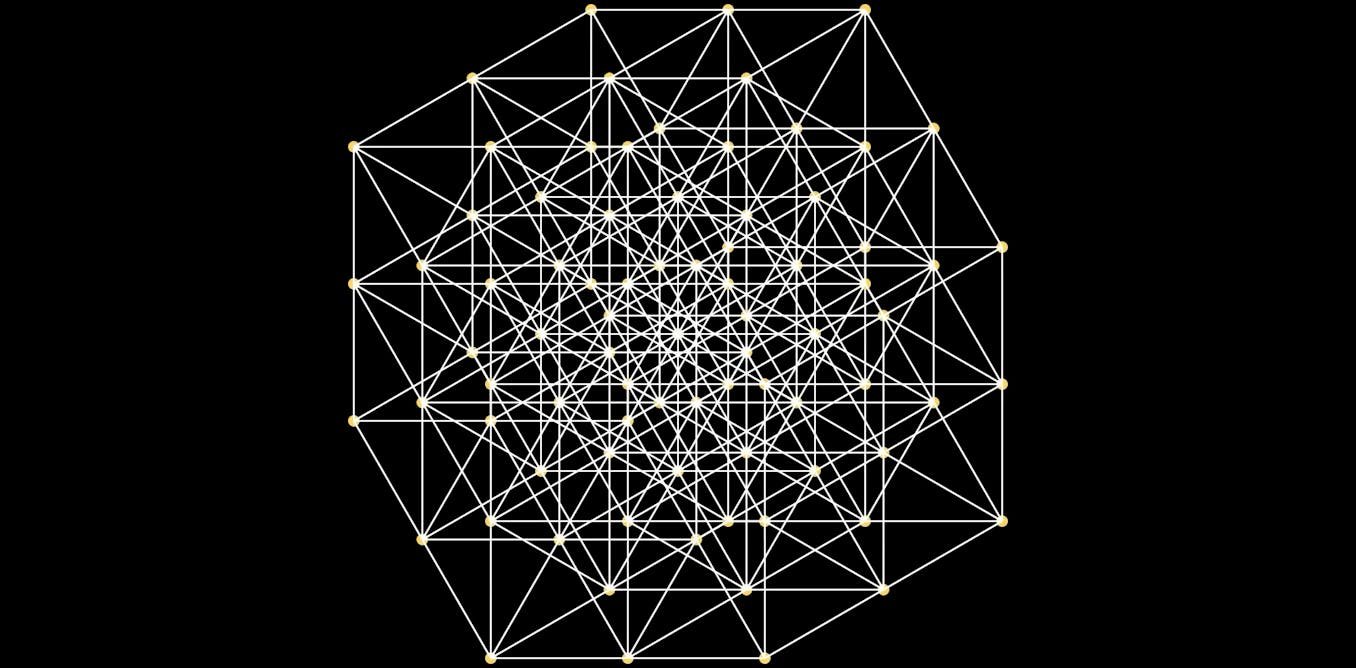
In May 2026, OpenAI released a new mathematical result that sent shockwaves across the world of mathematical research. A major unsolved problem called “Unit Distance Conjecture” has just been solved by generative AI.
Since then, there has been a steady stream of new results that either partially or fully utilize artificial intelligence to solve research-level mathematical problems. However, most new mathematical results published in a given month are still generated by humans.
So where does this lead? How well and how quickly will AI capabilities grow? Will most mathematical research be predominantly artificial intelligence? Or, as some mathematicians suggest, will AI combine with human ingenuity and other computational tools to create a golden age of mathematics?
Table of Contents
A list of unsolvable problems
One of the most productive mathematicians of the 20th century was the Hungarian Paul Erdős, who is known for his extensive collaboration with mathematicians from many disciplines.

Paul Erdős teaches the future mathematician Terence Tao at the University of Adelaide in 1985.
(Wikimedia Commons)CC BY-SA
Over the course of his career, he proposed hundreds of unsolved problems, now known as Erdős problems. This list is a tempting starting point for any AI company that wants to show it can solve math problems.
Over the decades, human researchers have gradually solved many of the Erdős problems, but a large number remain unsolved. One of them was the unit distance problem from the area of geometric graph theory.
Author Trefor Bazett explains the unit distance problem.
People on the shoulders of AI
This wasn’t the first mathematical problem solved by AI – it wasn’t even the first Erdős problem solved by AI – but it was the most significant. The unit distance problem is an important problem that many researchers have attempted to solve since 1946, when it was proposed.
What was particularly notable was that, after reading AI’s proof of the unit distance problem, human researchers managed to adapt the central technique of the proof to solve – just a week later – another important conjecture called the “sum product conjecture.”
As much as the AI achievement rested on the shoulders of many mathematicians before, humans have been able to climb a step further due to advances in AI.
Author Trefor Bazett explains how the sum product conjecture was disproved.
A combination of technologies
Computer-aided tools have been helping people with mathematics since the advent of computers. These tools have become increasingly sophisticated and could run on the world’s largest supercomputers and model climate change or pandemics.
Even within pure mathematics, preliminary research shows that proofs of some theoretical results can reach petabytes in size – the equivalent of a million gigabytes.
Computer tools are not the only way to support people. How can you be convinced of the validity of an argument that is too large or technical to be easily verified even by experts? Using a computer language designed for proof checking, mathematicians can create extremely precise versions of each component of an argument. The proof verification system then checks whether each step follows logically from the underlying axioms or starting points of the proof.
In a recent preprint paper, mathematicians combined each of these technologies – computational tools, proof verification and artificial intelligence – with their own human ingenuity to produce a new result in a field of mathematics called Ramsey theory.
Author Trefor Bazett explains the Ramsey theory.
After extensive and fairly clever computational searches, the AI was able to hypothesize a general pattern for a particular phenomenon, prove that the pattern is actually true, and help authors convert the argument to proof-testing.
This combination of technologies led them to believe that we are now entering a “golden age” of mathematics.
Million dollar math problems
Today, AI capabilities are mixed. Some mathematical areas, particularly graph theory, have been particularly amenable to AI-based proofs, but others appear to be quite resistant.
For every mathematical problem that AI solves, there are a large number of problems that the AI was unable to solve when asked to do so. For the most famous unsolved problems – like the six remaining Millennium Prize problems, where the Clay Mathematics Institute will pay you a million dollars if you can solve one of them – the problems seem to be as completely out of reach for AI as they are for us humans.
Mathematician Sir Michael Atiyah explains the Millennium Problems.
As for the future, we don’t know how far and how quickly AI capabilities will grow. If progress is significant, what will human mathematical research look like in five or ten years? These early examples of people building on AI results or using AI alongside existing tools to reach new mathematical heights could provide a glimpse into a possible future.
On the other hand, students’ fear of spending years of their lives improving their math skills is understandable. There are natural fears that AI could replace humans in research mathematics. Luckily we’re not close to that yet.
https://theconversation.com/a-new-golden-age-of-mathematics-may-be-dawning-thanks-to-ai-and-human-ingenuity-287346
