

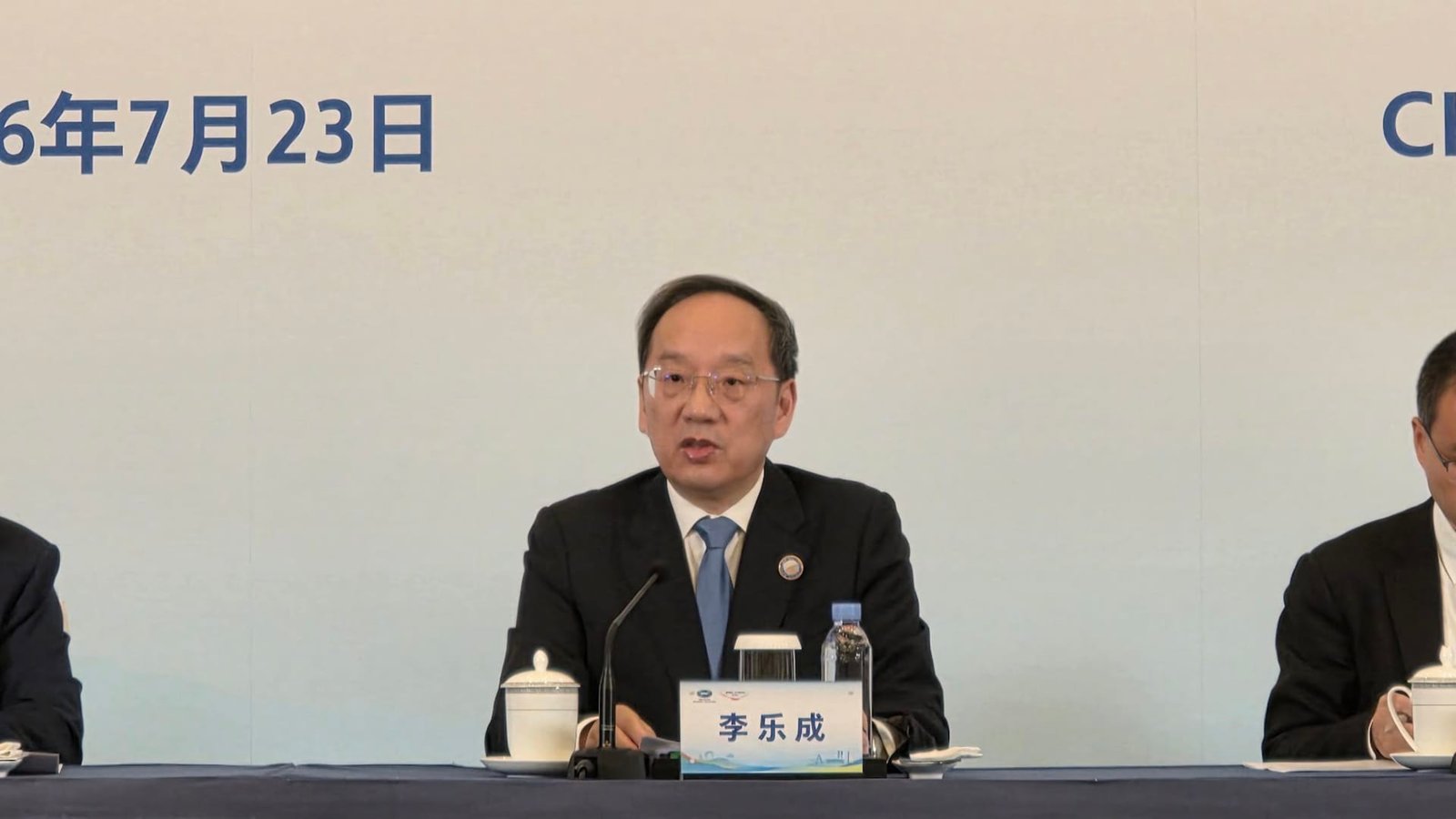
Li Lecheng, China’s Minister of Industry and Information Technology, spoke at a press conference on July 23, 2026 in Chengdu, China, as part of the APEC Digital Weeks.
Evelyn Cheng | CNBC
CHENGDU, China – Governments are increasingly seeking to control artificial intelligence as companies release more powerful open source models, a new multilateral statement says.
The 21 APEC member countries, including the US and China, released a “Chengdu Declaration” on AI, emphasizing respect for “security, privacy and intellectual property rights” while calling for support for open source development.
The statement released Thursday also specified support for models and projects “that provide a strong security guarantee through development and deployment.”
These details reflect how open source is moving further away from its libertarian roots and toward more government oversight. China has recently been a leader in open source AI development, while the US has claimed it stole American technology to do so.
Open source models from Chinese companies like DeepSeek and GLM 5.2 are free to use and download, unlike US companies like Anthropic that only offer closed, paid AI models.
The Chengdu Declaration’s “explicit focus on open source ecosystems and computing infrastructure” confirms that the Asia-Pacific region is shifting from closed models to open systems combined with state-coordinated energy, telecommunications and digital infrastructure, said Winston Ma, an associate professor of law at New York University.
The APEC AI declaration is the first to provide for open source cooperation at the ministerial level, said Li Lecheng, China’s minister of industry and information technology, who chaired the leaders’ meeting on Thursday.
He noted that all parties recognized the risks of AI and encouraged dialogue between government, the private sector and academia to share information on cybersecurity, supply chain resilience and online fraud.
The comments come amid growing reports that Washington and Beijing are seeking tighter control of domestic AI capabilities.
“Getting 21 economies, including China and the United States, to support trustworthy open-source AI as something worth supporting makes sense,” said Wei Sun, chief artificial intelligence analyst at Counterpoint Research.
“The phrase ‘strong security assurance’ gives room for more security-conscious economies to support open models while requiring testing, transparency, data protection and deployment controls,” she said. “The debate goes beyond open vs. closed to the question: Who can now build an open ecosystem that is also trustworthy enough for governments and companies to use?”
But the technology could end up evolving much faster.
Earlier on Thursday, Janet De Silva, chair of the APEC Business Advisory Council’s Digital and Innovation Working Group, urged ministers to prepare for the era of quantum computing.
“We need trusted encryption to ensure the security of our entire financial system and to ensure that quantum computing is not just a security measure but also an opportunity to increase competitiveness.”
Choose CNBC as your preferred source on Google and never miss a moment from the most trusted name in business news.
https://www.cnbc.com/2026/07/24/china-ai-open-source-apec.html
