

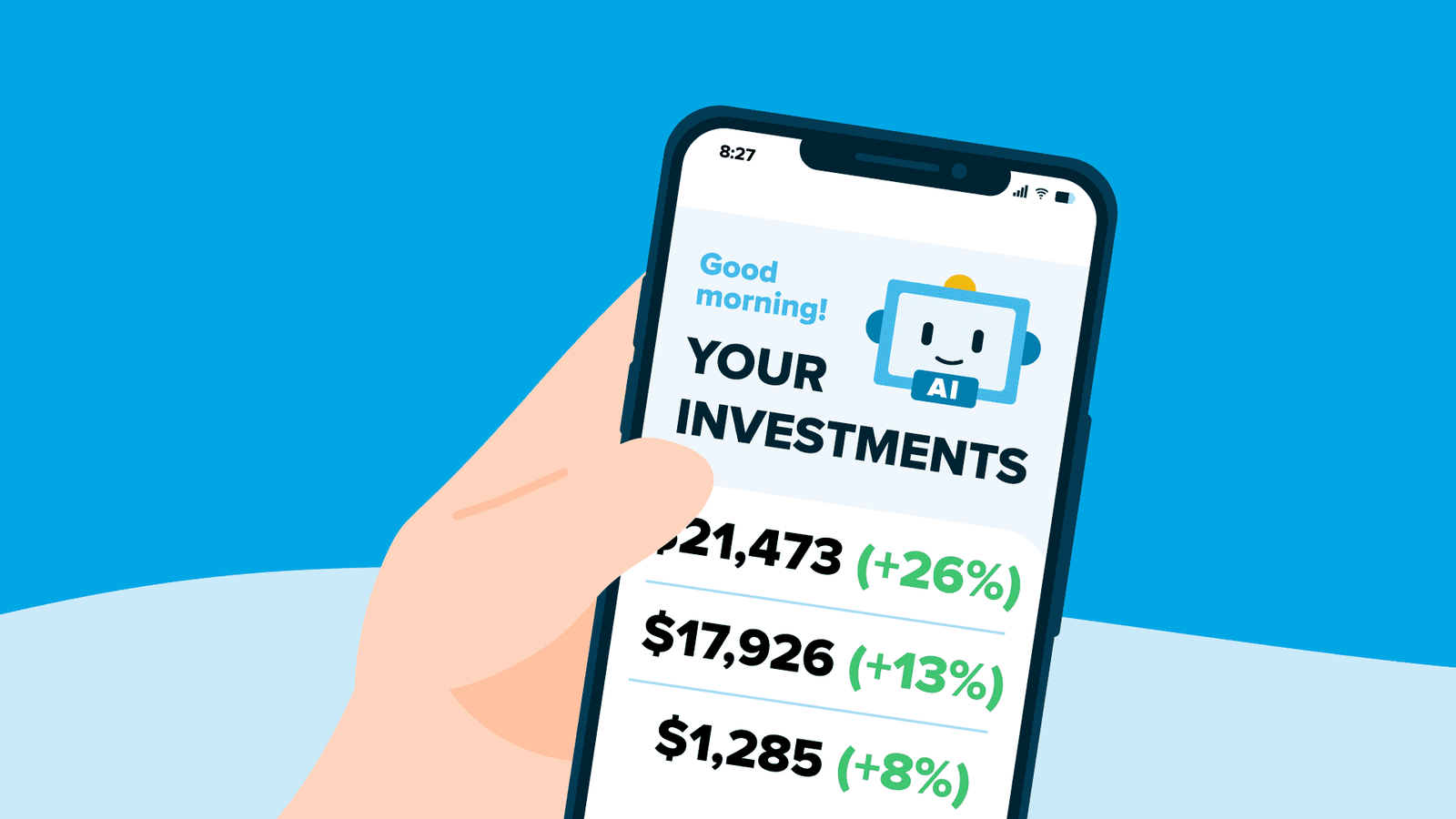
Imagine telling an AI agent how much risk you’re willing to take, your retirement goals, and when your kids start college—and then letting it manage your portfolio while you sleep.
The vision of agent trading, where artificial intelligence not only recommends investments but also executes them, is moving from concept to reality. Brokerage firms, startups and even retail investors are developing AI agents that can help monitor portfolios and automate investment tasks once done by humans.
“Essentially everyone has their own family office that works for them 24/7 whether they are awake or asleep,” said Devin Ryan, head of financial technology research at Citizens. “That’s less than 10 years away. That’s coming in the next few years.”
Ryan believes these agents will ultimately do much more than just buy and sell securities. He envisions AI continually managing taxes, cash balances, loans, mortgages and investment portfolios – all tailored to an investor’s financial goals. Fully autonomous investing is still a work in progress, but the race to build it is already underway.
Table of Contents
Building the future
Rather than trying to create fully autonomous trading systems overnight, many companies are taking a phased approach.
The startup Podium Markets AI is one of the companies that develops AI specifically for investments. His assistant, Ivy, analyzes a client’s portfolio across multiple brokerage accounts and generates recommendations based on the investor’s goals and risk tolerance.
Enlarge symbolArrows point outwards
But it is not enough to act independently. The user still decides whether to follow the recommendation and execute the trade themselves.
“AI informs, but humans decide,” said Dirk Mueller-Ingrand, co-founder and CEO of Podium Markets AI. “The average investor should still largely bear responsibility for the final decision. … We are taking the path of a hard-driving AI financial or trading partner who is always with you.”
Larger brokerage firms are moving in the same direction. Robinhood introduced tools in May that allow third-party AI agents to connect to customer accounts. Meanwhile, brokerage firm Public is internally developing AI agents that can automate investment processes within its platform.
“What this era of agents does…goes from the fact that all you can do is do some research on your own and then come up with your own ideas and then trade the way you used to trade. Now everything is automated and AI agents can actually implement investment strategies on your behalf,” said Leif Abraham, co-founder and co-CEO of Public.
Enlarge symbolArrows point outwards
Ryan estimated that agent financing could increase transaction volume by at least tenfold. A retail investor who currently trades about twice a month could eventually trade 20 times a day under an agent model, he said.
“By the end of next year, we expect that on some of these platforms the majority of transaction activity in terms of number of trades will be handled by agents, if you can believe that,” Ryan said.
From ChatGPT to investment agents
While Wall Street is working on agent tools, retail investors have been testing what general-purpose AI can do over the past three years.
Since ChatGPT entered the mainstream in late 2022, many investors have used AI tools like ChatGPT and Anthropic’s Claude to summarize earnings reports, research companies, and generate stock ideas. The results were mixed: some users viewed AI as research assistants, while others found it unreliable in investment decisions.
Obioha Okereke, a 29-year-old technology consultant in Georgia and founder of financial literacy platform College Money Habits, set up an agent with Claude to look for undervalued stocks and options opportunities.
“It was essentially just a matter of asking Claude to act as a hedge fund analyst to find undervalued stocks,” he said, adding that he still reviewed each recommendation before making a trade. “I will always stand for AI being a tool and not a replacement.”
Thomas Schlossmacher, a 31-year-old private investor and founder whose company Specialty Tokens develops AI systems for businesses, tested a trading agent after seeing claims online that AI could reveal profitable market patterns. Instead, he said he was “just losing money all the time.”
“I think if you’re going to use it for an automated system or rely on an agent to do it for you, you probably want a professional,” he said. “To blindly give an agent and say, ‘Hey, make me money,’ I think is kind of stupid.”
Build guard rails
The debate highlights one of the industry’s biggest challenges. Teaching an AI agent to buy or sell a stock is relatively easy. Teaching him what an investor actually means is much more difficult.
An investor could simply tell a broker to “aggressively grow my portfolio.” But does that mean accepting more volatility, concentrating holdings, using options or accepting greater risk of loss? An AI agent can faithfully follow instructions and still produce an outcome that the investor never intended.
This is why many companies are building guardrails before giving AI greater authority. For example, Public requires users to review and approve an agent’s workflow before executing investment tasks.
“You still have the final say,” Abraham said. “The AI agent will have no mind of its own. … It will only execute.”
As AI agents take on more responsibility, it becomes more important for companies to ensure that the technology behaves as intended.
“You have to make sure the customer’s best interests are at the forefront,” Citizen’s Ryan said. “If the agent does not behave as specified or expected, it becomes a risk to the company.”
Choose CNBC as your preferred source on Google and never miss a moment from the most trusted name in business news.
https://www.cnbc.com/2026/07/28/ai-agents-build-to-trade-24/7-the-future-of-wall-street.html
