

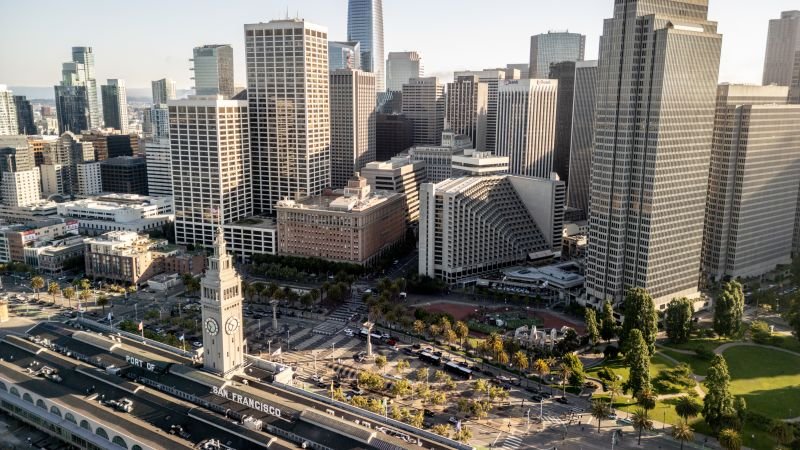
At the Richmond Neighborhood Center in San Francisco, more than 200 people are on the waiting list for food distribution. The center is just a few miles west of “AI Alley,” where a collection of large AI companies are making billions of dollars in investments and paying high salaries to employees — which in turn drives up house prices and rent payments.
San Francisco is a prime example of how the thriving AI industry is helping to drive overall economic growth but masking economic inequality for low- and middle-income families.
And San Francisco reflects the same patterns nationally: In the first three months of the year, the U.S. economy as a whole grew at a solid annual rate of 2.1%, largely due to companies increasing their investments in AI, according to the Commerce Department.
Still, consumer sentiment is stagnating near record lows due to war-related price spikes, and the lowest quarter of Americans on the income spectrum have seen the weakest wage growth of any other cohort this year, according to the Federal Reserve Bank of Atlanta.
“Neighbourhood inequities have continued to grow,” Yves Xavier, director of community programs at the Richmond Neighborhood Center, told CNN. “We can’t make a direct connection to the impact of AI and say, ‘That’s exactly it,’ because it’s been happening for some time, but you don’t necessarily have to be an expert to see how it’s widening inequalities in a city that’s already dealing with these issues.”
He added that demand for the nonprofit’s pantry has increased about 10% this year.
Table of Contents
“An economy of winners and losers”
The differing fates of the poorest and richest Americans have become a central theme of the U.S. economy, and experts say AI plays an important role.
According to a report from Oxford Economics, the billions poured into the AI industry have created a cadre of well-paid workers in tech hubs across the country, including San Francisco, New York, Seattle, Los Angeles, San Jose and Washington, D.C. These workers are among the wealthiest 10% of Americans, whose spending is increasingly fueling U.S. economic growth, accounting for as much as 62% of growth, according to Moody’s.
“You’re seeing incredible concentration of wealth through AI for these new companies, their founders and their first employees,” said Manuel Pastor, director of the Equity Research Institute at the University of Southern California. “It exacerbates the economics of winners and losers.”
The winners in today’s economy are clearly involved in developing and funding AI, including early investors, experts told CNN.
SpaceX debuted on Wall Street last month with the largest IPO ever. The AI and space exploration company is now worth more than $2.1 trillion, and investors widely expect it to be a windfall for Americans’ retirement accounts. AI stars OpenAI and Anthropic, both headquartered in San Francisco, are also preparing for their own IPOs that would bring a new market value in the trillions. San Francisco companies account for nearly two-thirds of global AI funding, according to data firm Crunchbase.
The losers include large swathes of the American population, especially recent college graduates, who have difficulty finding jobs; low-income Americans who continue to go into debt because they feel the pain of higher inflation; and even workers in the creative industries, Pastor said.
“What people put on the internet or publish in books is being privatized by these AI companies, making it harder for those same people to make money,” he said. “This happens to people who are writers, people who are musicians, anyone who is creative.”
The AI hype is also affecting the health of Main Street businesses.
“If you exclude AI, business investment would actually decline, which is pretty unprecedented outside of recessions,” said Maxime Darmet, senior economist at Allianz Trade. “Technology can greatly stimulate the economy, but at the same time a lot of spending is being cut in more traditional areas.”
Meanwhile, the gap between broader AI-powered economic growth and the lived reality for millions of Americans continues to widen.
“The inequalities here are very, very large,” Xavier said of San Francisco. “It’s been a problem for a long time, and I think it just continues to be a problem.”
https://www.cnn.com/2026/07/07/economy/ai-masks-inequality-americans
