Table of Contents
The proposal comes as AI-generated music makes up an increasing proportion of what is available on streaming platforms

Christian Thorsberg |
July 15, 2026
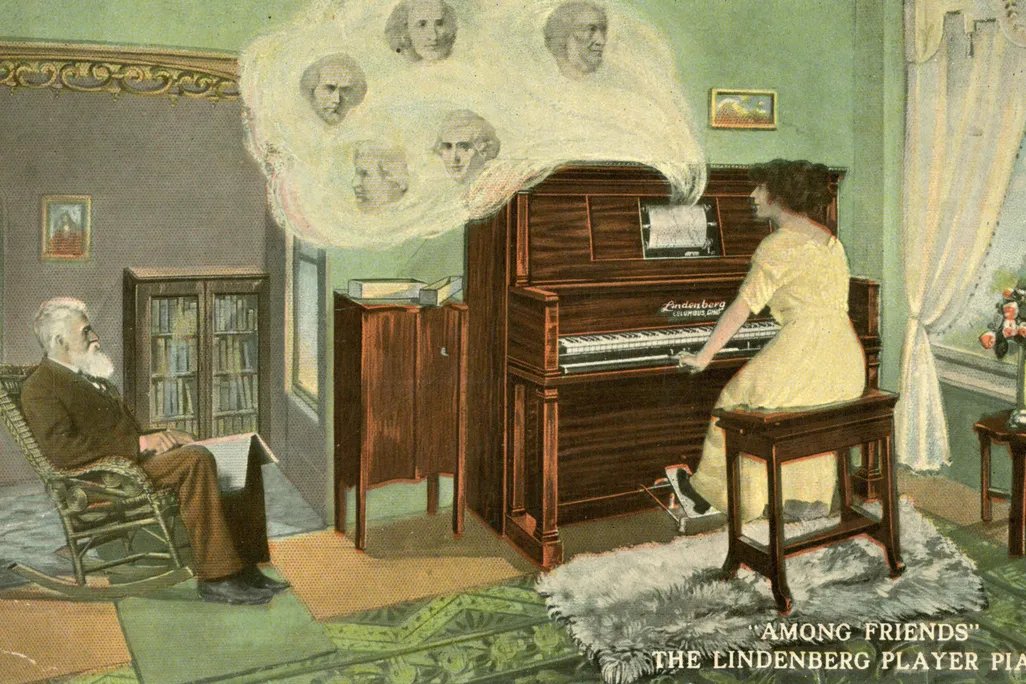
An advertising postcard for the Lindenberg Player Piano.
Public domain via Wikimedia Commons
Top music industry executives calling for greater transparency in the age of artificial intelligence have put forward a new proposal to clearly label songs created in whole or in part using AI
Proponents say the labels — which would look and function similarly to the parental advisory sticker first introduced more than 35 years ago to identify tracks with explicit lyrics — are intended to protect the ingenuity of human artists while giving listeners a comprehensive understanding of the art they interact with.
“Fans want to know if and how generative AI has been used in the music they hear,” Vikki Oakley and Mitch Glazier, respective CEOs of the International Federation of the Phonographic Industry and the Recording Industry Association of America, said in a joint statement. “Given the importance of human artistry and authenticity to music lovers everywhere, these labels will provide an immediately understandable and easily scalable approach to transparency.”
A design, an “AI” in all caps, would indicate that a song is “AI generated,” meaning that “the entirety or majority of the creative elements of the recording” were created by the technology. This includes AI-generated lead vocals or key instrumental performances. The other designation, a lowercase “ai,” would indicate that a song is “AI-powered,” meaning that it is “essentially created by humans and expresses human creativity,” but still uses generative AI for some “expressive elements.”
Interesting fact: technology and music
In the early 1900s, pianos came onto the market that had mechanisms inside that read out music rolls and pressed the keys to produce sounds without a human musician.
Creating songs with AI tools is becoming easier and many people are experimenting. In April, French streaming platform Deezer reported that 44 percent of new music uploaded was AI-generated, which equates to about 75,000 songs per day. That same month, Apple Music executives estimated that more than a third of newly uploaded songs were created by AI. Although these songs accounted for less than 1 percent of people’s listenership, billboard‘s Kristin Robinson reported that some tracks have broken through into the mainstream, raising concerns that AI music is taking revenue away from human musicians – and stealing the spotlight.
A series of controversies reported in recent weeks have heightened these concerns. Musicians and producers in Australia are wondering whether one of the country’s current top-charting songs, a cover of “Like a Prayer” that has racked up more than 35 million streams on Spotify, was actually created using generative AI. Experts say the track’s “highly compressed” tone is a telltale sign.
“This is a very… impressive vocal performance if it was performed by a human, but if it wasn’t it raises really worrying questions about what we still value in terms of human expression,” says Sam Whiting, senior research fellow in RMIT University’s Faculty of Media and Communications GuardianThis is Caitlin Cassidy.
Owen Lyman-Schmidt, one half of the folk group Makeshift Hammer, writes in Philly Magazine how he discovered a few years ago that recordings of his band’s music had been stolen from another “artist” on Spotify and sped up or slowed down slightly. These fake titles, he says, had thousands more streams than the originals, which Lyman-Schmidt attributes to “fake listeners” or AI bots inflating streaming numbers to generate additional revenue.
And last year, a fake band called Velvet Sundown surpassed 1.4 million monthly listeners on Spotify with AI-generated music, images and backstories. For some music experts, their popularity offered a fascinating perspective on the anonymity of AI music-making.
“Ghost artists have been part of music culture for generations, and AI is just the latest tool in that lineage,” said Ben Camp, associate professor of songwriting at Berklee College of Music Berklee nowis Tara Bellucci in 2025.
It is not clear whether the proposed AI labels will be adopted or mandated by streaming platforms or distributors.
“This initiative ensures that creativity, authorship and artistic intent are at the heart of every song,” said Harvey Mason Jr., CEO of The Grammys, in a statement. “Giving artists the opportunity to tell this story builds trust and supports a more sustainable future for music.”
Get the latest stories in your inbox every weekday.
https://www.smithsonianmag.com/smart-news/ai-music-is-already-here-to-protect-human-artists-the-record-industry-proposes-labels-for-it-like-those-for-explicit-lyrics-180989128/
