

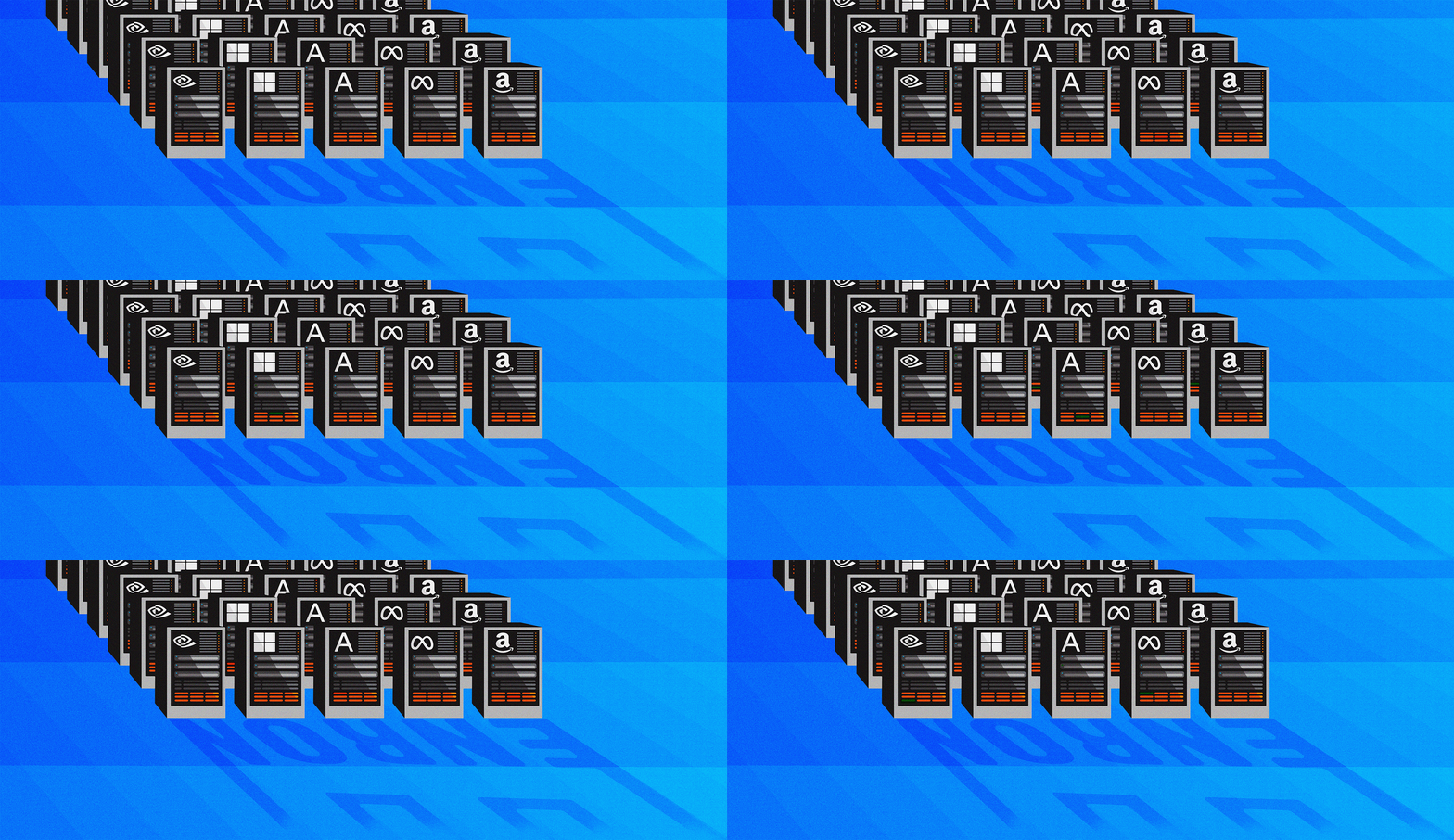
Enron Corp. took advantage of U.S. accounting rules to hide from investors and lenders hundreds of millions of debts it had bundled in off-balance sheet companies – liabilities that contributed to one of the largest corporate collapses in U.S. history.
Twenty-five years later, new risks have emerged as some of the world’s most valuable companies create similar financing vehicles that can disguise the debt they take on, as the tech industry plans to spend more than $3 trillion to run artificial intelligence systems.
Tech companies rely on these agreements to pool debt tied to multibillion-dollar assets with uncertain returns — including chips, servers and energy equipment — while spreading those risks across developers, vendors and lenders. Significant infrastructure costs baked into the financing structures are not reflected in the parent company’s financial reports, providing uninformed investors a more optimistic view of performance and leverage.
“The accounting treatment itself is fashionable. But what if one of these companies was a house of cards and supported itself with this accounting treatment?” said Tom Selling, technical accounting consultant. “For me, that’s the risk.”
Alphabet Inc. and Meta Platforms Inc. have each turned to vehicles known as variable interest entities (VIEs) as part of the financing mix needed to build data centers and associated energy infrastructure.
Meta, Facebook’s parent company, last year formed a joint venture, a VIE, to build a data center in Louisiana as part of a partnership with Blue Owl Capital. The social media giant’s maximum commitment to the company is $46 billion, according to its filings with the Securities and Exchange Commission. The company announced last week that it would expand its planned campus and is expected to spend up to $250 billion on the project, Bloomberg News reported.
Alphabet, Google’s parent company, keeps VIE agreements for data center leases and loan guarantees, as well as other guarantees related to energy infrastructure, off its balance sheet.
AI financing arrangements can take many forms and may require different accounting practices.
Microsoft Corp. provides few details about its VIEs, saying only that it does not consolidate these entities.
Alphabet, Meta and Microsoft declined to elaborate on how they apply U.S. accounting rules beyond their recent SEC filings in response to questions about their AI financing and any off-balance sheet arrangements. They declined or did not respond to questions about the impact of the Enron scandal on modern accounting.
The nature of the financing deals gives tech companies the ability to exit for a price if they ultimately no longer need the data capacity in the future. The durability of powerful computer chips on which these investments are based is uncertain. The development of more powerful chips or insufficient demand could make the complexes obsolete.
Whether company managers consolidate these arrangements or record another company’s debt on the balance sheet is one of the most difficult decisions in accounting. The auditors highlighted Meta’s assessment of whether the Louisiana data center should be consolidated, citing the “significant judgment” involved..
Enron had tried to take advantage of the Financial Accounting Standards Board’s guidelines, which at the time allowed companies to avoid recording side deals on their balance sheets when those deals involved a small third-party equity investment.
The accounting treatment of these complex arrangements has since evolved, imposing restrictions to curb abuse of off-balance sheet treatment. Companies must provide investors with more detailed information about the nature of the companies and their risk in the footnotes to the financial statements.
Modern lease accounting rules also provide investors with a forecast of certain significant data center-related lease obligations that could ultimately pad their balance sheets and impact cash flow.
Oracle Corp. for example, has agreed to secure another company’s lease for up to $3.3 billion. The database management company has $260 billion in future leasing obligations, mostly for data centers, which will ultimately be added to its balance sheet, according to its SEC filings. Ratings agency S&P Global downgraded Oracle’s credit rating earlier this month, citing in part the company’s “excessive leverage.”
Chipmaker Nvidia has reached agreements with its suppliers to further develop AI infrastructure and indicated future purchasing commitments of $119 billion in its recent SEC filings. The company announced a multibillion-dollar optical technology purchase commitment and related investment in March.
Purchasing and computing capacity obligations are typically only recorded on company balance sheets upon receipt of the services or goods.
Oracle declined to comment and Nvidia did not respond to questions about accounting for AI investments.
Under current consolidation guidelines, a company would report the assets and liabilities of a VIE if the company has both the power to control the significant activities of the entity and is subject to the risk of significant gains or losses from the structure.
For example, according to its first-quarter report, Alphabet is keeping its data center lease agreements and loan security agreements off its balance sheet because it doesn’t control the structures and isn’t the “primary beneficiary.”
To finance Meta’s data center in Louisiana, called Hyperion, both Meta and Blue Owl invested equity in a separate legal structure. This company has taken on $27 billion in debt, while another related legal entity will act as landlord and a Meta subsidiary will be the sole tenant of the project, according to data from ratings agency S&P Global.
Meta concluded that it should not transfer billions in debt from the Louisiana project to its own balance sheet because it is not responsible for finding tenants to replace or join it at the nearly 4,000-acre campus – a critical task that impacts the company’s economic performance, the social media company said in its most recent quarterly SEC filing. Meta said his role is limited to construction management, administrative and property management services.
Transactions that spur data center construction represent the latest test of the rules governing such off-balance sheet vehicles, including whether accounting records accurately who is responsible for the risks associated with the ventures.
Meta’s auditors at Ernst & Young said it would be “challenging” to assess whether the social media giant had the power to control the activities of its Blue Owl joint venture.
Company managers’ judgments about whether to consolidate another company or entity are difficult to dispute because they depend on the specific details of the contracts, said David Gonzales, a senior accounting analyst at Moody’s. Companies should explain more clearly why they control a company or not, he said.
Ben Butler, an investment analyst at Veritas Investment Research Corp., says Meta should add its Hyperion data center project to its balance sheet.
Meta — as the project’s sole tenant, an equity investor and property manager — appears to have the power to direct its activities, Butler said. The social media giant also disclosed billions of dollars in commitments related to the project, he said.
Off-balance sheet arrangements more broadly, often referred to as special purpose entities, can provide business managers with a tool to manage the optics of their financial reporting and present a healthier picture.
These arrangements may not necessarily trigger variable equity accounting requirements or consolidation.
SEC staff pay close attention to companies describing their relationships with other companies and the accounting practices they use, Kurt Hohl, the regulator’s chief accountant, said during an accounting industry webinar last week.
Not reporting interest payments for debt financing of AI infrastructure projects boosts profit metrics such as EBITDA, said Jennifer Law, finance and operations manager at K2 Integrity, a risk advisory firm.
“It can say a lot about what stage we’re at if companies are relying on SPVs to make their return on capital look good, their free cash flow look good and debt look more attractive,” Butler said.
The rating agency Moody’s evaluates future leasing obligations and weighs up the debt burden of companies. Those future payments would eat up cash and impact metrics such as free cash flow, Gonzales said.
“If we just looked at the financial reports, we would be more or less myopic: missing liabilities, missing commitments, missing key elements of these structures that really represent the economy,” Gonzales said.
Investors must scour the disclosures accompanying company financial statements to find out details about the off-balance sheet structures and how each company accounts for these arrangements and any related obligations.
The information is there, but it takes more work to find it than if, say, Meta were to borrow directly to finance the buildout, said Gil Luria, head of technology research at DA Davidson & Co.
“Enron’s crime was not having special vehicles. Enron’s crime was hiding them,” Luria said.
Photo credit: David Paul Morris/Bloomberg (California high-speed rail project, Louisiana LNG export facility); Chip Somodevilla/Getty Images (Artemis II launch); Maryland Transportation Authority (key bridge replacement); Gateway Development Commission (Hudson River Tunnel Project)
https://news.bloombergtax.com/financial-accounting/big-tech-ai-spree-revives-accounting-devices-that-toppled-enron
