
Open USD claims to be the solution to all stablecoin settlement problems, but will it be a solution despite having 150 partners at launch?
getty
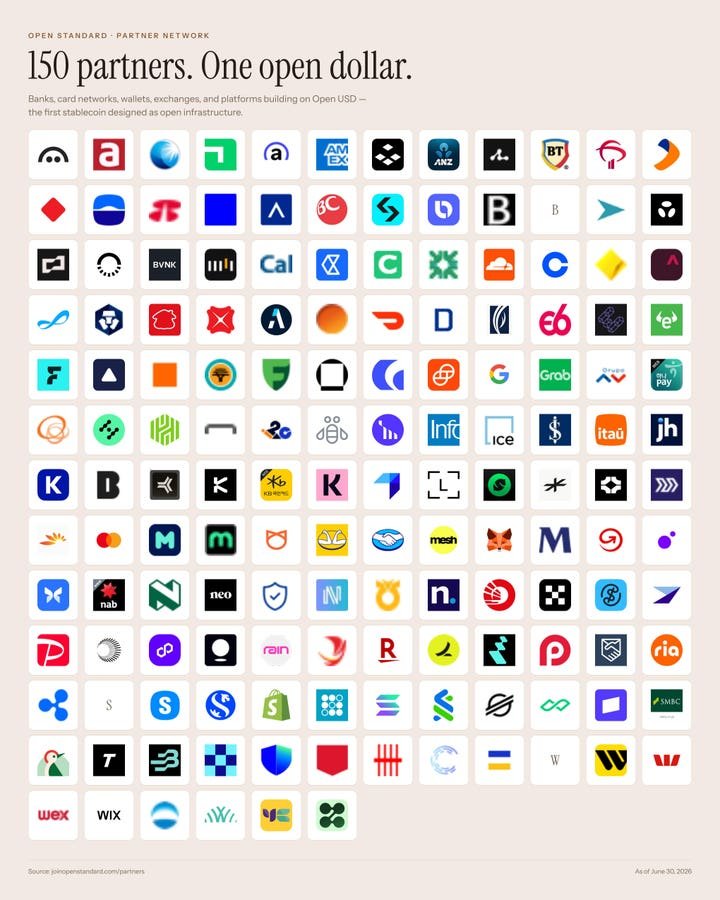
Open USD’s guest list is more important than the coin itself. When a single dollar token launches with more than 140 partners, including the world’s largest asset manager, two daily competing card networks, a global custodian, the largest merchant software platform and a number of crypto firms, the coin is almost secondary. Every layer of the financial class has decided they need a seat at the same table.
Founding partners Stripe, Coinbase, Mastercard, Visa and BlackRock call the shots, and the broader roster fills out the map: BNY, Standard Chartered, DBS and US Bank alongside Shopify, Google, IBM, Mercado Pago, Ripple, Aave, MetaMask and Anchorage, with American Express and Discover among the names other outlets have confirmed. Read the list by category and you’ll get a chart of who expects stablecoins to play a role and who isn’t ready to cede control to a rival.
No coalition this broad emerges by chance. Each category on the list represents a different way to benefit or be threatened by dollars moving on a blockchain. The founders put it together deliberately because the value of a stablecoin is the breadth of places that accept it, and the quickest way to build that breadth is to make the places that accept it owners of the coin.
Table of Contents
Why the asset manager came
BlackRock’s presence is the one to study first. A stablecoin’s reserves are its economic engine, and these reserves are held in short-term government bonds and money market instruments, the very assets that BlackRock manages. A dollar token on a large scale, from an asset manager’s perspective, is a very large and very stable pool of cash that needs a manager. BlackRock already offers tokenized money market products alongside stablecoins. Joining Open USD puts it into the reserve business of a coin designed to reach hundreds of partners rather than compete for mandate outside of it.
This mandate is not a side effect. A dollar coin of the size its supporters envision would contain tens of billions of dollars in Treasury bonds and cash, a pool that generates income every day it exists. Whoever manages it charges fees for the largest and most predictable balance in the system. BlackRock’s decision to be a member rather than a provider signals that Open USD will be so big that the reserve business will be worth owning a piece of the coin to win.
Why the traders and banks came
Shopify is there for the other end of the process: checkout. Merchants pay interchange on card payments and have working balances that earn them nothing and a coin that pays out instantly, has lower acceptance and, under the Open USD model, pays them the return on their balance – both at once. For a platform with millions of traders, a stablecoin that lowers adoption costs and returns reserve income on unused balances goes straight to margin.
Banks are the most powerful participants because they have the most to lose. BNY, Standard Chartered, DBS and US Bank all make money by holding deposits and transferring funds across borders, both of which pose a threat to stablecoins. Their calculation is defensive: if tokenized dollars are to drain balances from accounts, it is better to sit in the coalition that issues the token, retain the custody and settlement business, and share the reserve revenue, than watch deposits being drained for a coin in which they have no stake.
This hedge runs next to another one. The largest U.S. banks are separately building a shared tokenized deposit network to hold money in the banking system. Whoever is on Open USD’s list says they are unsure which model will win and are taking out insurance on both.
The technology and crypto contingent
The technology names suggest the next use as well as the current one. Google and IBM are not retailers or banks; It is an infrastructure on which agent-driven trading is built, where software makes purchases on behalf of a user. A machine that pays requires a programmable dollar with predictable rules, and a coin governed by an open consortium is easier to build on than one controlled by a single competitor. Their presence is evidence that the coins that process machine-to-machine payments should not be owned by a specific company.
The crypto members deliver what the banks and traders cannot. Ripple brings cross-border liquidity, Aave a lending market, MetaMask a wallet with tens of millions of users and Anchorage requires regulated custodians to even touch a token. For Open USD, they are the difference between a coin that exists on paper and a coin that provides a place to live, trade and settle from day one. For crypto firms, joining a coalition that includes BlackRock and Visa is the path to the mainstream they have pursued for a decade.
The inclusion of Mercado Pago points south. In Latin America, dollar stablecoins already serve as a means of savings and payments for people and businesses that hedge local currencies, and Mercado Pago is at the heart of this demand across the region. A member who can introduce Open USD to tens of millions of Latin American users gives the coin something its US-centric founders cannot: immediate relevance in markets where stablecoins are not a convenience but a necessity.
The rivals sit in a room
The strangest thing about the list is how many members compete with each other. Visa and Mastercard operate competing networks; American Express and Discover operate two others. Coinbase and Ripple have been on opposite sides of the crypto legal and cultural disputes for years. Solana and Polygon are competing blockchains. That these companies would co-sign a coin shows that the fear of being excluded from the stablecoin infrastructure is now stronger than the instinct to create a proprietary version. It’s the logic that gave birth to shared card networks decades ago: No single player could build adoption alone, so they built it together and competed at the top.
The position of the card networks is the most paradoxical and revealing. Visa and Mastercard earn their margins exactly on the card rails that a cheap stablecoin could undercut, yet both are founding members. They assume that if the money moves on the chain anyway, they would rather sell services on the new track, from tokenization to settlement to fraud tools, than defend the old track to the last. By joining the coin that threatens them, they stay in the flow.
This is also the weakness of the coalition. A coin managed by competitors is slow to manage, and the shared governance that makes Open USD attractive to members makes it harder to make decisions. Someone has to set the management fee, allocate the reserve income, choose which chains it runs on, and decide who bears a loss. Each of these decisions pits members against one another, and the card networks that co-founded the initiative each have their own stablecoin ambitions. A consortium only lasts when you join together, you beat when you go alone.
What the squad tells you
Go back from the individual names and the pattern is the message. Asset managers want the reserves. Dealers want the cash register. Banks want to defend deposits. Crypto companies want distribution. Card networks want to keep the toll booth. Big Tech wants to participate in the payment flow of an agent-driven internet. Each of them has looked at stablecoins and come to the same conclusion: this is becoming a shared financial infrastructure, and the cost of being outside this infrastructure is greater than the inconvenience of sharing it with competitors.
For Circle and Tether, this is the real threat on the list. They have developed the best standalone dollar tokens, and standalone is exactly what Open USD members no longer want. Circle’s shares fell more than 17% on the announcement, not because Open USD was technically superior, but because the announcement was actually a list of customers that Circle needed to be on the other side of the table together.
The absences say as much as the names. Circle and Tether are not on the list because the coalition is designed to bypass them, and it also misses the largest U.S. retail banks, which are busy building their own tokenized deposit network rather than supporting a stablecoin. The list is a self-selected group, the companies that have concluded that a common stablecoin serves them better than a proprietary one or none at all.
The coin could take a year to ship and could stumble on the governance that makes it interesting. But the guest list has already given its verdict. Stablecoins have evolved from a product sold by a company to an infrastructure owned collectively by an industry, and the companies that saw it first made sure they didn’t have to rent it from someone else.
https://www.forbes.com/sites/digital-assets/2026/07/02/look-at-who-joined-open-usd-to-understand-where-money-is-going/
