

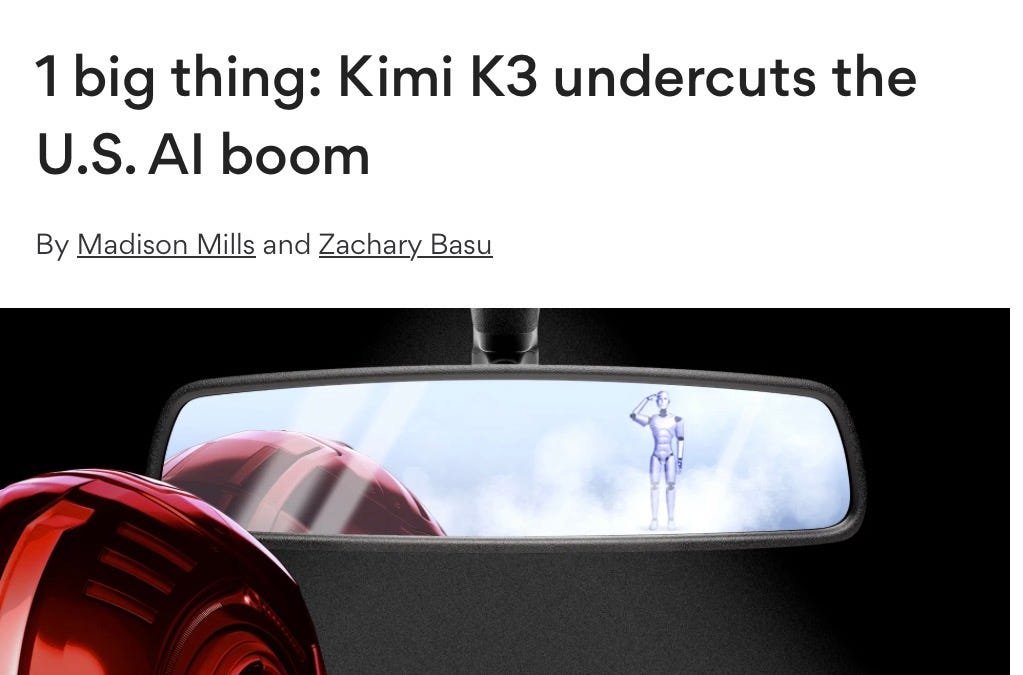
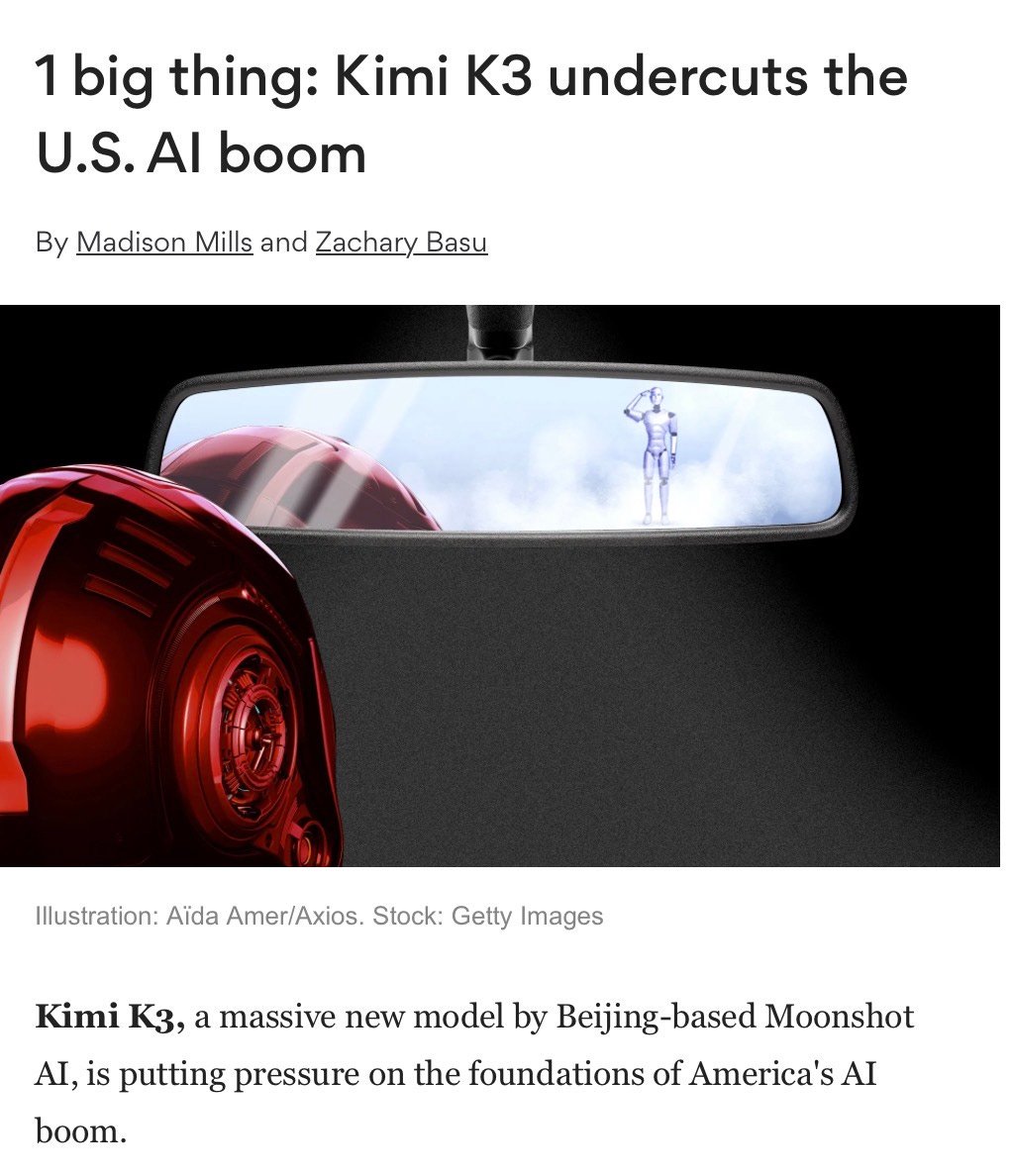
 Axios coverage of the new model
three weeks ago, That’s what I warned here
“The ultimate climax of the “No moat => more competitors => price wars => profits are tight” argument that I have been making regularly here since summer 2023, has arrived – and could destroy the US AI industry”
Last week, the Chinese company Moonshot.AI announced a model called Kimi K3, which is largely on par with the best American models. Unlike these models, it is an “open weight” model that consumers can download for free and run locally (as long as they have the appropriate hardware). The US stock market partially fell on Friday on this news, and the impact is likely to be immense. It’s not a coincidence either. The Chinese model GLM 5.2 from Z.ai recently caused a stir. Alibaba’s new Qwen model could add to the disruption.
All of this seriously challenges OpenAI and Anthropic’s business models and may negate or severely undermine their IPOs. It also casts serious doubt on the never-too-plausible notion that America could “win” the AI race.
Ryan Fedasuak (who later went on CNN to discuss it) expressed some surprise at this:

Ryan Fedasiuk@RyanFedasiuk
We can’t ignore what just happened. The American moat in AI software is not as strong as many of us had hoped. It is time to recognize the AI race for what it really is: an industrial systems competition to develop and install computing power. My latest for @AEI: aei.org/foreign-and-de…
3:08 p.m. · July 17, 2026 · 49.9K views
28 answers · 43 reposts · 168 likes
But it’s not like everyone else should be surprised. The essay I wrote in January 2025 after the release of DeepSeek – which a reader last week called “shockingly accurate” – I’ve pretty much explained everything. I warned that back then
The US would not achieve a decisive victory over China in AI if it continued to focus largely on LLMs
that we would agree to a draw instead
that the lack of a technical moat would result in companies like OpenAI remaining unprofitable.
that Nvidia would be vulnerable
that the CHIPS Act would backfire without doing much to restrain China
that the models continue to become more efficient and cheaper, but the hallucinations and reliability problems still remain.
that the endless race for LLMs would devour resources that could instead be channeled into developing more original ideas.
That’s basically what happened. I wish more people had listened.
That this was not the case is probably inevitable in a government that had no distance from Silicon Valley and rarely consulted anyone for an outside opinion. By treating Silicon Valley fantasies as real, the US government made a huge mistake; The economy is now precarious, the companies they support appear marginal, and China appears poised to further undercut these companies. We should never have fully focused on GenAI, which never seemed to have a technical moat to begin with.
A series of cheap, xenophobic layoffs against China have gotten us nowhere.
The question is, what should we do now?
§
Well, first of all, Congress should investigate the matter. How did the USA squander its lead? Were there any strategic or tactical mistakes? Was it stupid to bet everything on a single reproducible technology? Have US companies done enough to protect their intellectual property? Does the Chinese government subsidize Chinese companies and to what extent? Is espionage from China involved? Are US companies making good decisions? Would investments in U.S. companies likely make money or lose money? Have immigration restrictions backfired and led to a talent drain? (Kimi’s founder went to Carnegie Mellon and returned to China. Why?) Are there lessons for the next iteration of AI or for future technologies like quantum computation or fusion?
But the investigation won’t get us very far. The real questions are strategic.
§
Here are seven options the Trump administration could consider, ending with a wild card that could do more for the world in the long run than any of the first seven.
Do nothing. Let OpenAI and Anthropic stand on their own two feet. No government subsidies or backdoor bailouts. If OpenAI and Anthropic can find a way to be successful, for example by focusing on narrow industries or focusing on individual large customers, that’s great. If they go down, so be it. Google, Microsoft and Amazon are not going anywhere and can cater to US needs, especially classifieds where Chinese models are unlikely to be welcome. However, this could result in China losing a large share of the AI market, which is not ideal.
Ban open source. Good luck with that; At least when it comes to LLMs, the cat is already out of the bag. (And even if it were illegal, at this point it would continue to thrive on the Dark Web and in countries that haven’t banned it.
Build a regulatory moat, as a back door to protect American companies. Over the weekend, Dean Ball, who just moved to OpenAI, seemed to argue that things are heading in that direction. I hope not. As Will Manidis sits me downt, this would be protectionism, “…a proposal to use the informal coercive power of the bureaucratic state in the final stages to rid the American market of a cheaper frontier competitor to OpenAI or Anthropic.” This would likely crush US startups too. In the words of Matt Stoller, it is “corporate communism” instead of an open and competitive market. Certainly it would slow progress and raise prices, helping two U.S. companies at the expense of hundreds of thousands of others.
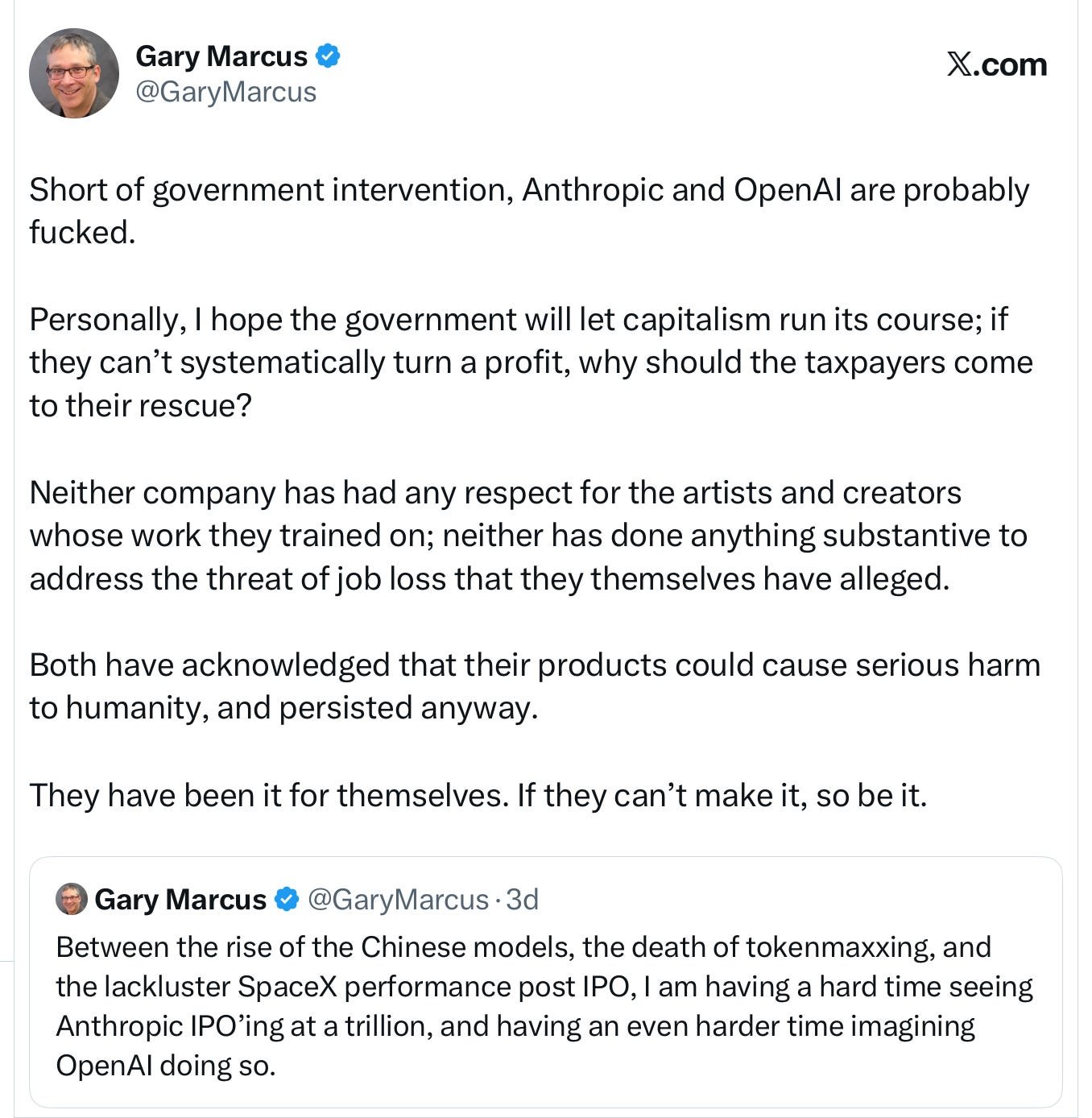
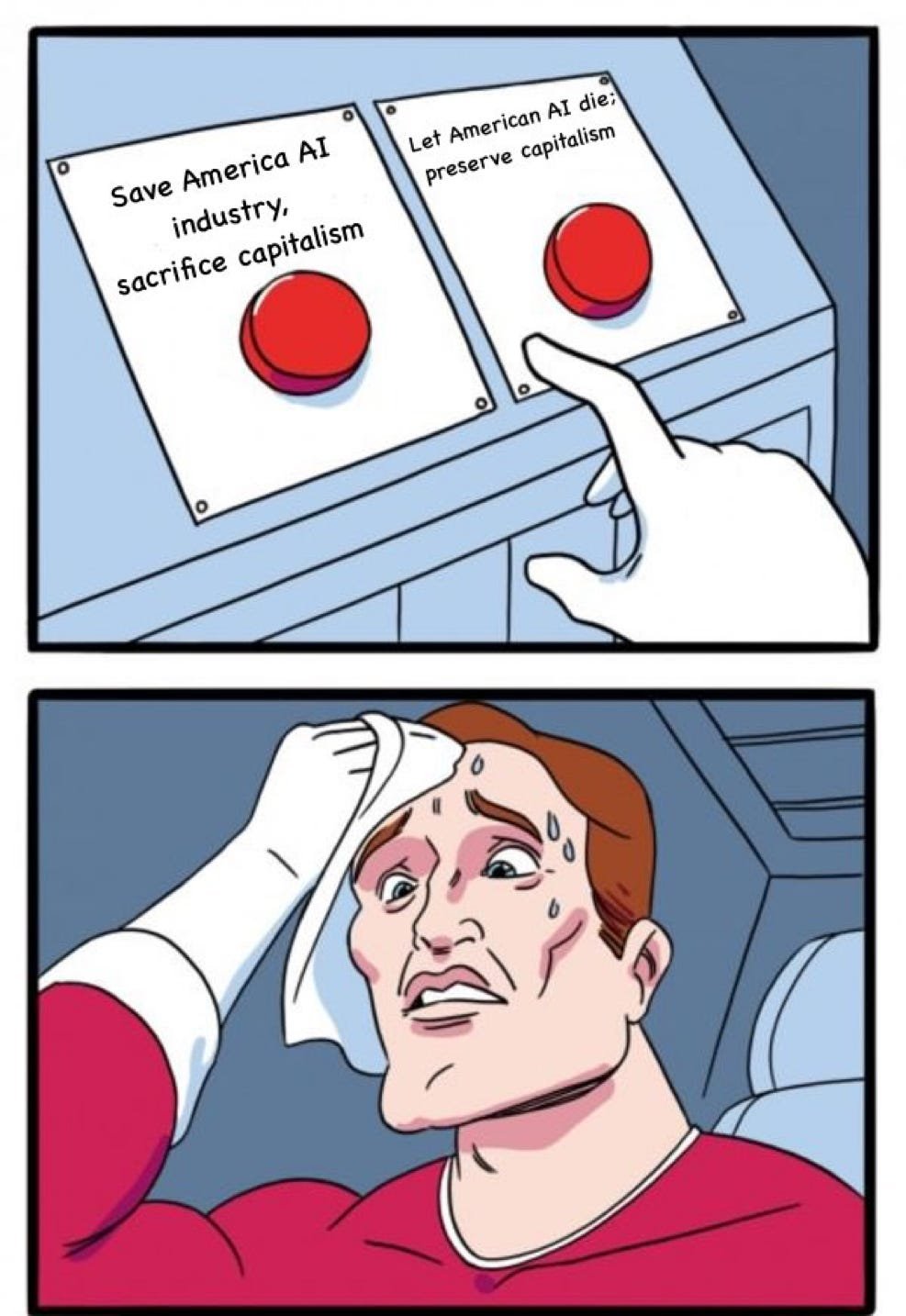
Save the big AI labs. Just no:

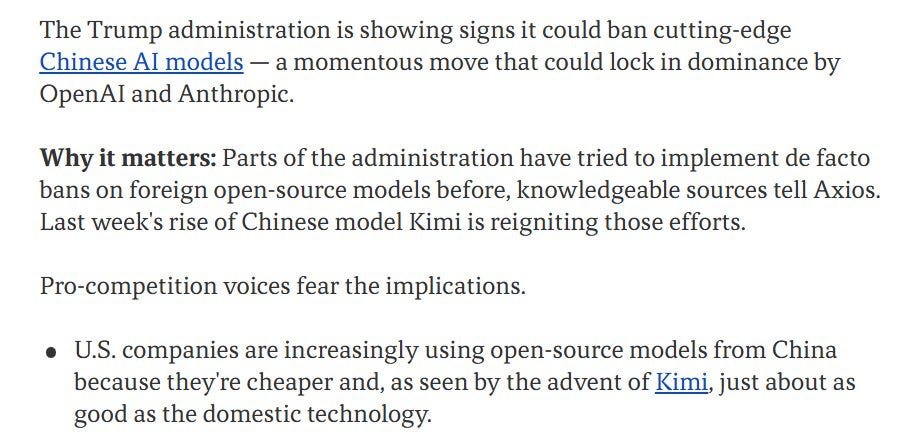
Ban Chinese models completely. Axios believes this could be in the works. Variant to what was said above; This will certainly increase prices for consumers and stifle innovation.

Even before I read the above rumors, I made a joke about it on X:

As investor and CEO Phil Libin told me in a message this morning, “The American system thrives when capital, ideas, and people flow freely. We don’t have to ‘win’ a zero-sum game.” We win by turning games into non-zero-sum games. That’s how we won the 20th century and it’s our best chance to win the 21st.”
Completely buy out the major AI labs OpenAI and Anthropicfor two cents on the dollar – which is generous since both are mostly losing trades in an industry that has not yet convincingly demonstrated profitability. Transform them into national laboratories available to all accredited scientists through a competitive process. Since AI is based on human intellectual property, most of which has been acquired without compensation, there is poetic justice here too. The downside is what unsavory things the government could do with the data, e.g. B. in the sense of mass surveillance. Given that Hegseth has condemned Anthropic for its refusal to do just that, and given the current administration’s tendency to persecute critics and enemies on flimsy grounds, we should be concerned about government abuse.
Abandon zero-sum efforts to “win” the AI war and instead move toward making AI a global public good. In 2017, I suggested in the New York Times (based on a 2016 talk at the AI for Good conference) “CERN for AI“, Write
I look with envy at my colleagues in high energy physics and especially at CERN, the European Organization for Nuclear Research, a vast international collaboration with thousands of scientists and billions of dollars in funding. They pursue ambitious, well-defined projects (like using the Large Hadron Collider to discover the Higgs boson) and share their results with the world rather than limiting them to a single country or company… An international AI mission… could really change the world for the better – even more so if it made AI a public good rather than the property of a privileged few.
Maybe the time has finally come? For a long time there seemed to be a good chance that it would succeed, but perhaps now is the right time. China itself seems to be open to such a thing, according to a speech Xi Jinping gave just as he chaired an AI conference for the first time:
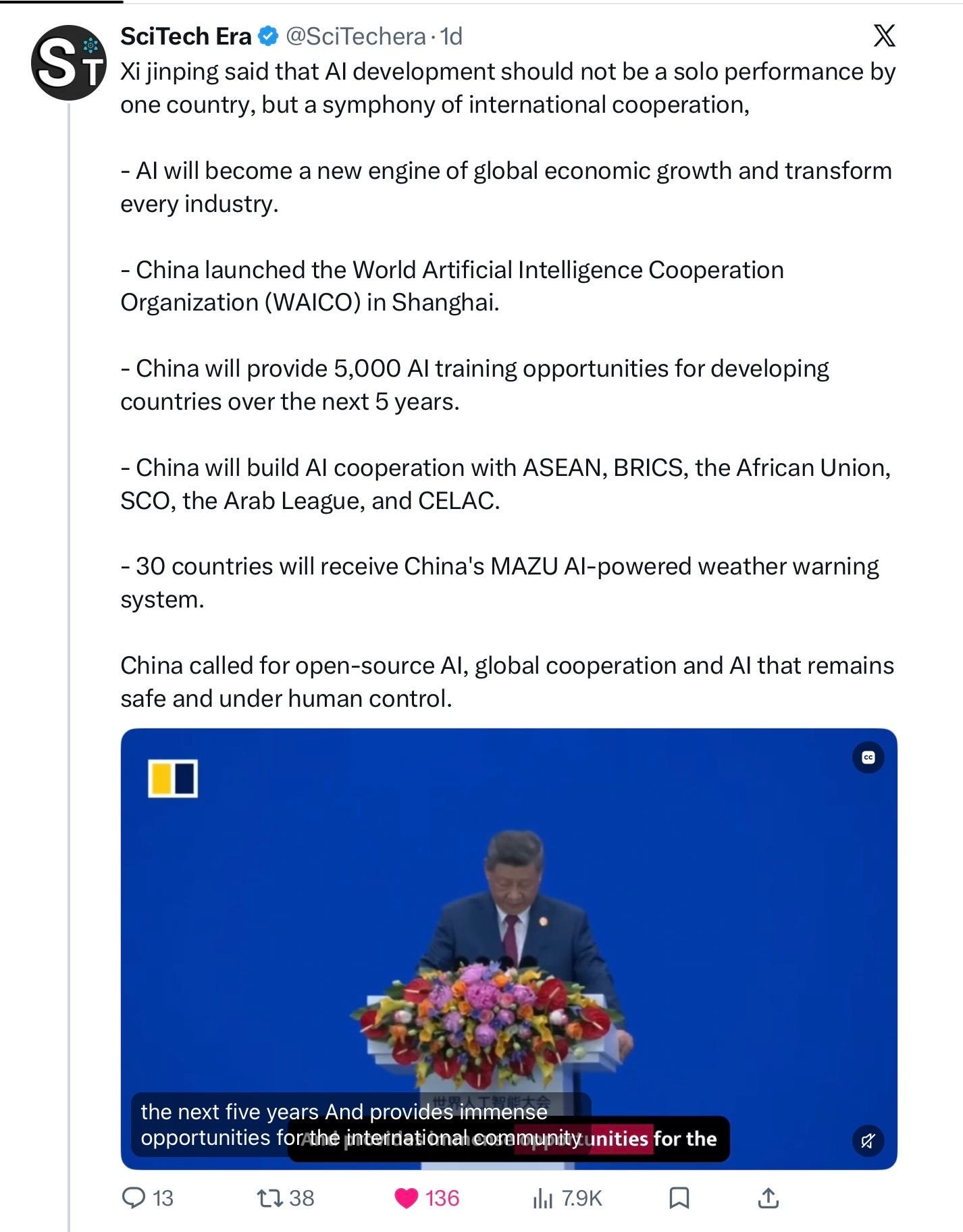
I don’t know whether to take Xi at face value – you can watch his full talk Here) – but the fact that he said this is a huge source of debate. I still think it would be a good idea to make AI publicly available and have an international effort for medicine and science. Of the options I have discussed, it seems to me to be the most promising, a last resort to transform AI, built on a large part of the Internet created from the public’s hard work and largely uncompensated thinking, into a real public good for the world.
If Trump really wants to win the Nobel Peace Prize, this could be his chance. A decision to ostracize closed Source AI – the commitment of all manufacturers to share their weights, architectures and training data with accredited scientists and research organizations – coupled with an agreement with China to dedicate AI to the public good – would be a great gift to humanity.
Gary Marcus proposed a CERN for AI in 2016 and gently reiterated it in the Senate in 2023. We would love to see some variations of this idea see the light of day.
https://garymarcus.substack.com/p/china-has-all-but-caught-up-the-us
