

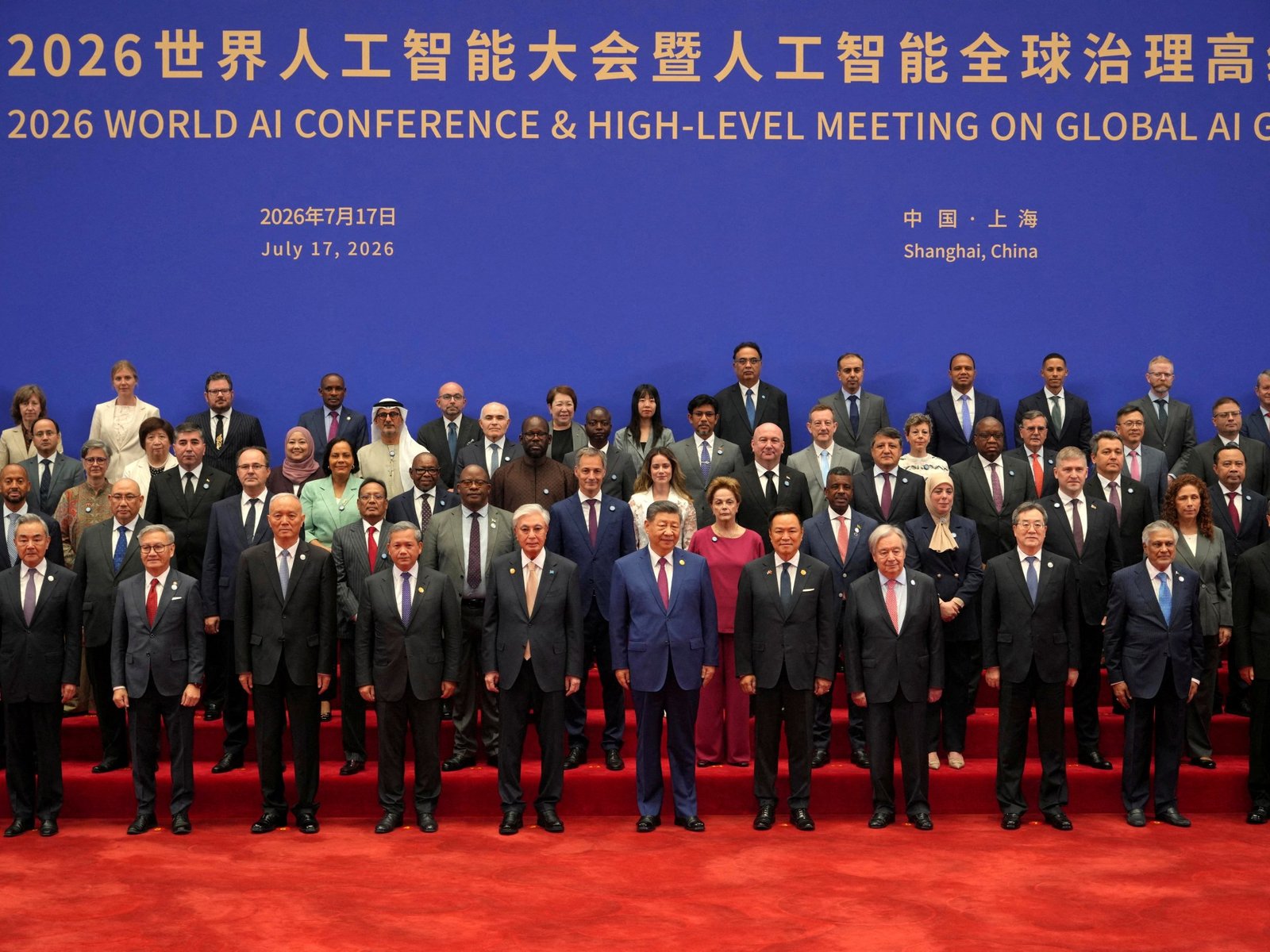
It was an artificial intelligence summit with very real geopolitical messages.
Chinese President Xi Jinping on Friday called on countries to cooperate on artificial intelligence and ensure that no one country dominates the technology – an apparent swipe at the United States.
Table of Contents
Recommended Stories
List of 4 itemsEnd of the list
Xi spoke at a major technology conference in Shanghai on Friday where China showcased cutting-edge technology that rivals U.S. capabilities.
Both countries are engaged in a battle for dominance in the technology and AI fields and view each other’s advances in these areas as deliberate attempts to hinder each other.
As Chinese AI models gain traction around the world, Beijing appears to be casting itself as the leader of the new global AI order, challenging U.S. influence over the development and regulation of the rapidly evolving technology.
At the heart of that strategy is a new 29-nation coalition that China announced on Thursday called the World Artificial Intelligence Cooperation Organization (WAICO) at a high-level event also attended by UN Secretary-General Antonio Guterres.
Here’s what we know:
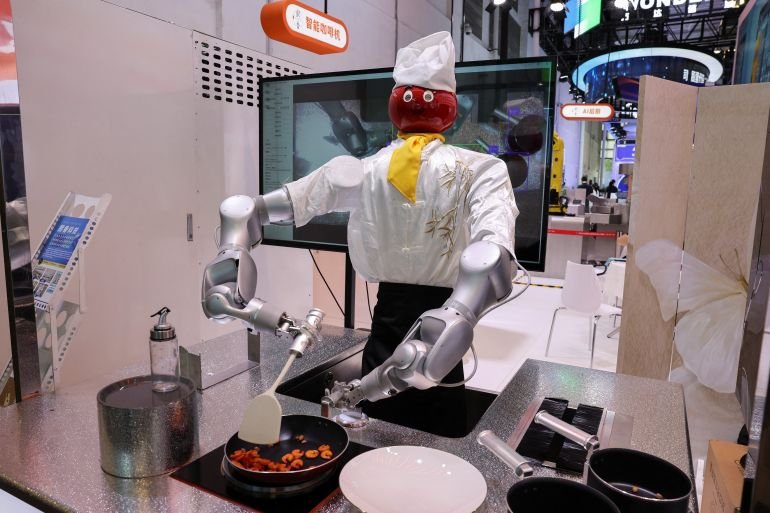 A humanoid robot that cooks is displayed at the Xi Xiang booth during the World Artificial Intelligence Conference (WAIC) in Shanghai, China, July 17, 2026 [Go Nakamura/Reuters]
What did Xi say?
Speaking at the World Conference on Artificial Intelligence in Shanghai, Xi urged countries to seize the “historic opportunity” presented by open source AI.
He said China has played a role in ensuring equal access to AI capacity building for developing countries to prevent the emergence of “new historical injustices” and announced Beijing’s plans to continue working with countries in Africa, Latin America and Asia.
“AI development should not be a solo effort by a single country, but a symphony of international cooperation,” Xi said.
“We should speak out together against overextending the national security concept in the area of AI or prioritizing the security of one country over that of others.”
Xi also emphasized the need for a “human-centered” approach to AI, ensuring that “AI is always under human control” by using safeguards such as regulations, technological monitoring, early warning and emergency response systems.
What is WAICO?
The intergovernmental organization was officially launched on July 16, although Beijing has been touting a global AI alliance since last year.
Its stated goals are to promote international cooperation and develop cross-border AI regulations that ensure the technology is useful and safe for humans.
Headquartered in Shanghai, WAICO’s 29 founding member countries include several major countries in the Global South, including Indonesia, Brazil, Malaysia, South Africa, Senegal, Russia and Pakistan.
Analysts speculate that Beijing will likely use the alliance to shape AI policymaking at the United Nations.
Why is this important?
AI is an important pillar of Chinese industrial policy. Beijing has invested heavily in building a self-sufficient domestic ecosystem, from chip production to consumer use.
This has led to a “chip war” with the US as both vie to control the production of chip-based technologies such as advanced military weapons and AI-powered systems.
While Beijing lags behind the US in access to the most advanced semiconductors, it is currently ahead when it comes to powering massive data centers needed to train and operate AI models. China also dominates the production of critical rare earth minerals needed to make chips.
An abundant supply of cheap electricity has given China the advantage to meet the enormous energy needs of artificial intelligence. Beijing already generates more than twice as much electricity as the United States, a lead that is expected to widen amid aggressive government investment in the country’s energy grid.
China is currently facing import restrictions on technology from the US, with Washington citing national security concerns.
However, Beijing sees the US move as an attempt to hinder its artificial intelligence efforts.
In May, the US Commerce Department reiterated restrictions on shipments of critical semiconductors to subsidiaries of Chinese companies that have headquarters or a parent company in China. Beijing responded by banning exports of dual-use technology and critical minerals to US companies.
Until now, countries have struggled to balance AI regulation with their rapid growth. Concerns about the use of AI in areas such as military combat lead to some of the most intense governance debates.
China’s pioneering role at the AI conference and the WAICO alliance now also gives Beijing an influential position in shaping AI policy.
Where does WAICO fit in?
Chinese Premier Li Qiang first unveiled plans for WAICO in July 2025.
At the time, analysts speculated that Beijing was moving from exporting Chinese AI infrastructure to shaping global AI policies and institutions to reflect Chinese interests on the world stage – ahead of the US.
Many point out that China, for example, has long been wary of the Internet due to its US heritage and decentralized models and is therefore actively trying to isolate itself domestically.
Analysts say acting ahead of a predictable global adoption of AI could help China reverse the trend, especially with the support of its middle-power and low-income allies, whose numbers will matter at the United Nations.
“Washington is rapidly withdrawing from global processes setting cyber and AI norms and withdrawing its financial support for cyber diplomacy more broadly. Beijing is eager to demonstrate its global leadership,” governance expert Arindrajit Basu wrote in an analysis for the US think tank Carnegie Endowment for International Peace.
“In this way, the country hopes to garner support for its state-centric technology governance vision from the Global South,” he added.
https://www.aljazeera.com/news/2026/7/17/chinas-xi-jinping-launches-new-ai-alliance-what-is-it
