


AI has the potential to dramatically accelerate the pace of scientific discovery and the development of health interventions. Since we launched our life sciences efforts last fall, we have worked to improve our modeling capabilities, connect to the scientific ecosystem through MCPs and capabilities, and launch partnerships to realize this potential.
Today we’re introducing our most significant addition to these efforts: Claude Science, an AI workbench for scientists. Claude Science is an app that integrates the tools and packages most commonly used by researchers, creates verifiable artifacts, and provides flexible access to computing resources.
Table of Contents
Introducing Claude Science
Scientific research is often lengthy. Researchers must work across dozens of databases, each with its own schema, deal with file formats that require customized data pipelines and viewers, and switch between a range of tools: PubMed, Jupyter, R, a cluster terminal, and more.
Claude Science brings these fragmented tools into a single research environment where scientists can carry out all phases of their work. It helps you analyze literature and conduct multi-stage research, creates detailed artifacts, and allows you to iteratively refine figures and manuscripts until they are ready for publication. Each output includes a verifiable history of how it was created, so you can validate and reproduce the results. Like a Jupyter notebook, you can access Claude Science wherever you already work – locally on macOS or Linux, or on a remote computer via SSH or with an HPC login node.
Users interact with a generalist coordination agent with access to over 60 curated capabilities and connectors pre-configured for genomics, single cell, proteomics, structural biology, cheminformatics and more. These agents can launch others and interact with user-created special agents. And a reviewer checks quotes and calculations, highlights and corrects errors.
We’re releasing Claude Science in beta today for Claude Pro, Max, Team, and Enterprise users and will continue to refine the platform as we collect feedback from users.
How it works
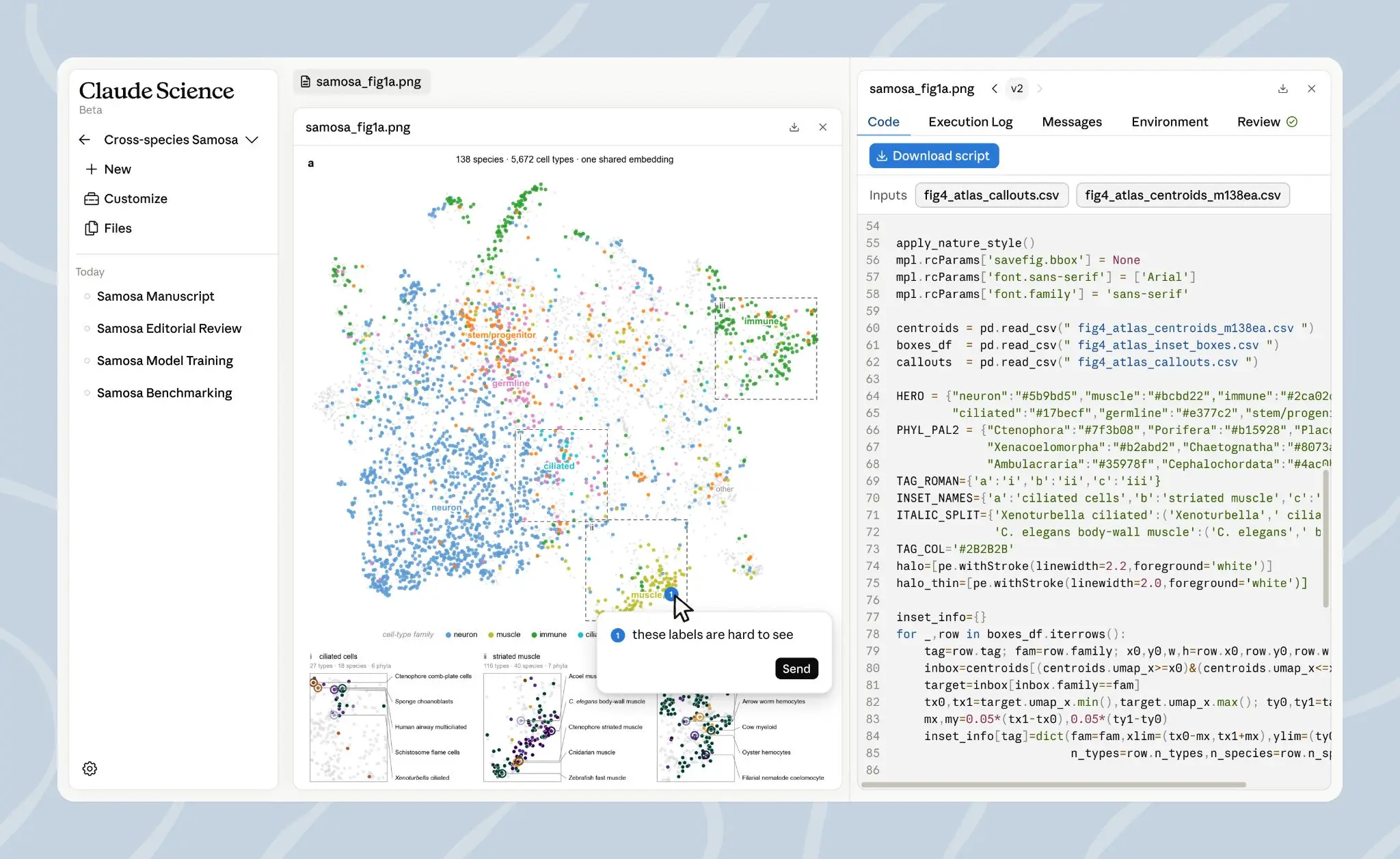 Claude Science represents proteins, structures and molecules natively, with each result reproducible and traceable to its code.
Rich scientific artifacts, fully reproducible. Scientific research is inherently visual, so Claude Science generates figures and manuscripts along with the code that created them. It natively renders rich scientific artifacts, including 3D protein structures, genome browser tracks, chemical structures, and more. You can chat with the agent about every detail and annotate illustrations and manuscripts directly so the agent knows what to address to prepare them for publication.
When generating a number, Claude Science includes the exact code and environment that generated it, a plain-language description of how it was created, and the full message history. This allows you to understand the entries and validate and reproduce the work more easily, even months later. You can ask Claude Science to make changes to plain text figures – for example, removing grid lines or changing an axis to a logarithmic scale – and the agent will then edit its own code.
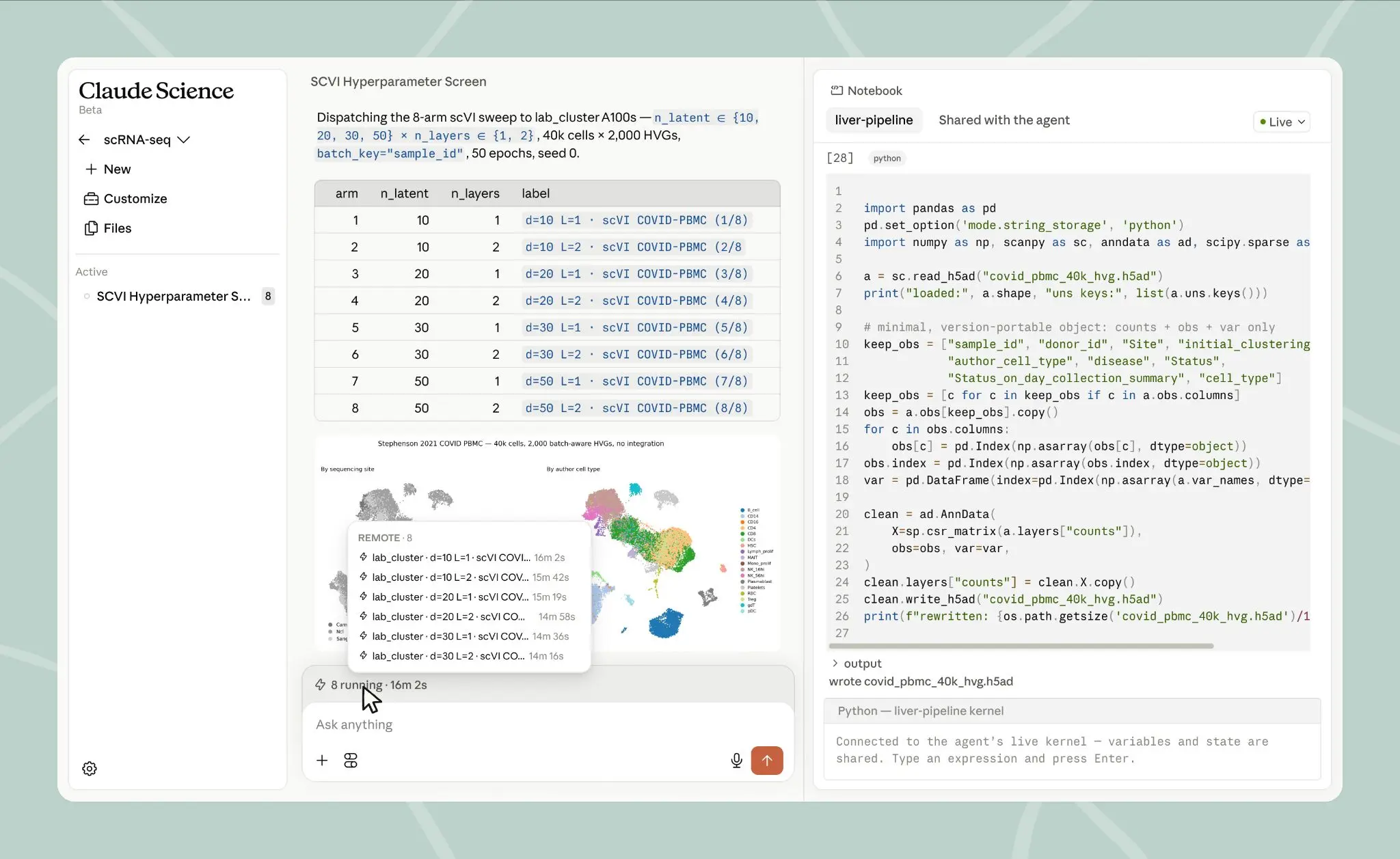 Claude Science creates environments and manages computing power on your laptop, cluster or GPUs as needed.
Manages your computing power and scales as needed. Large analyzes—for example, folding a protein or running a genomics pipeline over a massive data set—often require researchers to shift their focus to setting up a computing job, waiting while it is sent to a cluster, checking whether it succeeded or failed, and getting the results back. Claude Science takes care of this process for you. It creates a plan, polls before new resources are reached, allows you to review or revoke any decision before writing and sending the job to the computing resources your lab is already using (your own HPC cluster over SSH or your Modal account for compute-on-demand), and scales analysis from a single GPU to hundreds as needed.
Because its agents work within a running session that keeps the context in memory, even large data sets only need to be loaded once. It runs on your lab’s own infrastructure – your laptop, Linux machine, or HPC login node – so large or sensitive data sets never have to leave the systems they already reside on, and only the context needed for each step of the analysis is sent to Claude. As the pipeline runs, a reviewer reviews the output, flagging misquotes, obscure numbers, and figures that don’t match the underlying code, while making self-corrections. You can pause the session at any time to compare two approaches without losing the original thread.
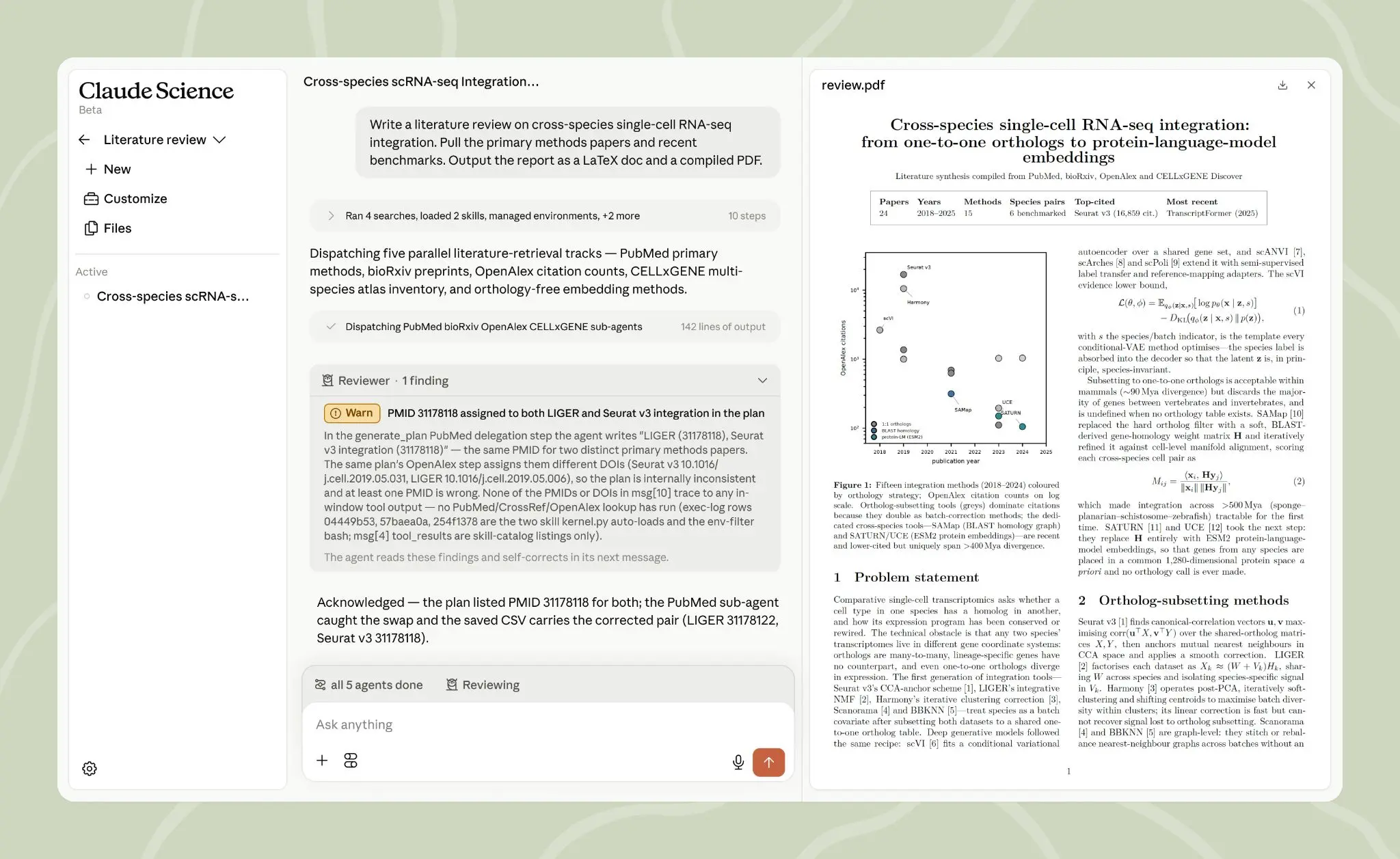 Claude Science is pre-configured for genomics, single cell research, proteomics and cheminformatics and is supported by more than 60 scientific databases.
Domain ready from day one. Scientific knowledge is scattered across hundreds of specialist sources. In biology, for example, relevant data could be stored on resources such as UniProt, PDB, Ensembl, Reactome, ClinVar, ChEMBL, GEO – each with its own schema and query language – as well as in journals and preprint servers, as well as in domain-specific open models. When you ask Claude Science a question in simple language, specialized agents query and synthesize all of these sources so you don’t have to navigate through them individually. Claude Science leverages the capabilities of NVIDIA’s BioNeMo Agent Toolkit to connect natively to the life science models and libraries in BioNeMo, including Evo 2, Boltz-2 and OpenFold3.
Scientists already have models, datasets, and pipelines they trust. Claude Science can also connect to these and save each pipeline as a reusable skill or access your lab’s preferred tool via a connector, with future sessions automatically adopting them. This customizability gives you access to Claude, your proprietary data, and the validated tools you already trust, all in one conversation. Claude Science benefits from our partners’ expertise and platforms as more scientists access their tools through Claude.
What scientists do with Claude Science
In recent months, researchers have collaborated with Claude Science in beta on tasks such as single-cell RNA sequencing analysis, CRISPR screen design, protein structure prediction, cheminformatics, and more.
Manifold Bio develops tissue-targeting drugs that focus on a specific organ or cell type, so the drug works where it is needed and spares the rest of the body. It also tests how millions of possible binding agents, corresponding to hundreds of target molecules, distribute simultaneously in a living body. Manifold used Claude Science to nominate the targets for his latest experiments. For each tissue and target, Claude Science assessed surface expression, delivery and safety and ranked candidates based on criteria Manifold learned from its own internal proprietary data. What differentiated Claude Science from a general coding assistant, Manifold said, was that it could do this end-to-end by gathering the right data and applying the right judgment given the built-in context of previous programs.
Jérôme Lecoq, a neuroscientist at the Allen Institute, used Claude Science to create a multi-agent “computational review template” that includes about 20 custom skills aimed at writing long-form reviews. Subagents read through thousands of documents, extract the key claim and key quantitative result, and store them in an Evidence State database. Then the pipeline builds a narrative arc, writing the review section by section and delegating each section to its own specialized sub-agent. In each section, dedicated agents generate quantitative cross-study numbers directly from the evidence database. A key component of the workflow enabled by Claude Science is the use of actor-critic pairs: one agent creates content while a separate reviewer agent rates it for accuracy and citation fidelity.
Before Claude Science, Lecoq’s team could take up to two years to write such a review. He now has around 10 reviews, well over 100 pages, with quotes that have been checked by reviewers. The team is now working with subject matter experts to further refine the AI-based critique agents.
And Stephen Francis, an associate professor and epidemiologist at the UCSF Brain Tumor Center, has used Claude Science to support studies on the molecular epidemiology of gliomas, a type of primary tumor that begins in the brain’s glial cells. His lab studies the genetic basis of how thousands of small-effect germline variants combine to influence individual susceptibility. Although this work predated Claude Science, Francis said the app dramatically sped up analysis, enabling comprehensive germline studies across multiple approaches in about a tenth of the time previously required. His group independently validated Claude Science’s results, confirming that the company can produce both fast and robust analyses.
Getting started with Claude Science
The Claude Science app is available in beta for macOS and Linux on Pro, Max, Team, and Enterprise plans. We’re sharing it early so scientists can start applying it to real-world problems and telling us how to refine it.
Team and Enterprise users need their administrator to activate Claude Science. We now have a team plan that offers discounted spots for active science labs at academic institutions and non-profit research organizations; Find out more here.
We will also support up to 50 Claude Science AI for Science projects and provide up to $30,000 in credits. Modal will also provide up to $2,000 in computing power for select projects. We are looking for projects that cross disciplines and push the boundaries of science, with an early focus on biology and biomedical research. Applications are possible until July 15, 2026, and award notifications will be sent by July 31. The projects run from September 1st to December 1st, 2026 – apply here.
To stay up to date on product announcements, provide feedback, and learn from others in the Claude Science community, join the AI for Science Discourse community.
Get started with Claude Science at claude.com/science.
https://www.anthropic.com/news/claude-science-ai-workbench
