The biggest difference in Formula 1 this season may not be a supremely talented driver or an all-powerful engine, let alone the spectacular rotating ‘Macarena’ wing.
This could be the year of the algorithm.
The Belgian Grand Prix was further evidence of how code that drivers don’t fully understand shapes – or distorts – the title fight.
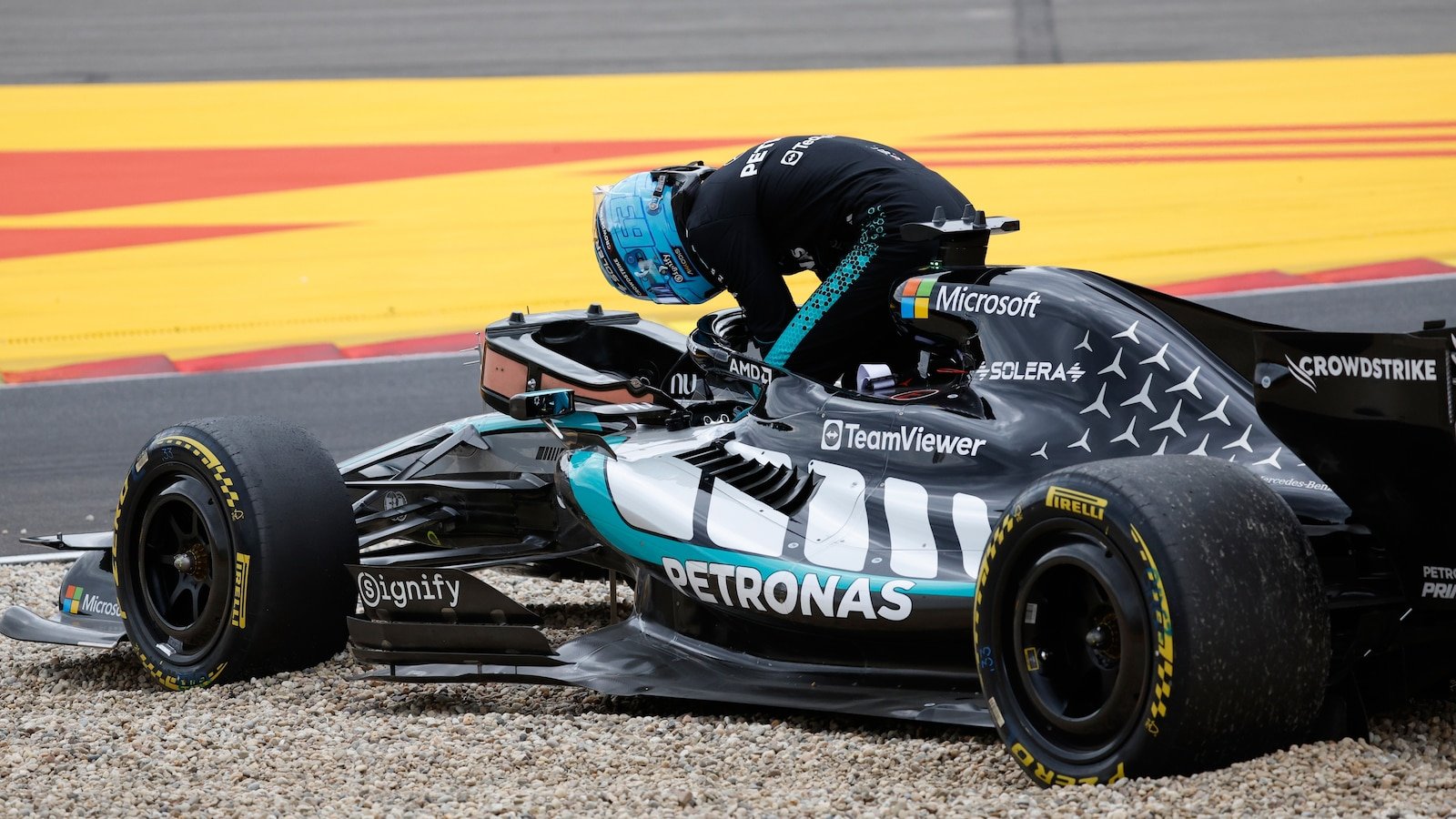
Kimi Antonelli raced to his sixth win of the season, almost doubling his lead, while his Mercedes teammate and title rival George Russell got stuck in the gravel after a collision with Lewis Hamilton.
In an angry radio message to Mercedes, Russell demanded to know why he had an “unacceptable” power failure that had gotten him back into a fight with Hamilton in the first place.
“The irony of the age; more knowledge than ever before in human history, but even more secrets,” commented 1996 champion Damon Hill on X on a video in which Mercedes team boss Toto Wolff blamed a software problem that affects all cars with Mercedes engines.
“I have to feel for (Russell). What does he have to do? All a bit strange because his car is different from Kimi’s. Performance wise they should be identical. We’ll no doubt hear more about this soon,” Hill also posted.
On Saturday, Russell complained about driving “with one hand behind his back” in qualifying after losing straight-line speed to Antonelli for no apparent reason. The team’s track engineering manager, Andrew Shovlin, called it “a clear loss that we cannot explain by driving style.”
The fact that Formula 1 is introducing electric power in 2026 means that the hardware that makes up the car – the turbo engine, the tires, even the battery – only tells half the story.
The rest is often not entirely clear even to the drivers. It’s a world full of algorithms and mission maps that can suddenly slow a car even though there seems to be no reason for the driver in the cockpit.
With the exception of the optional boost button for overtaking, algorithms mostly release power in a way that is not directly related to the driver’s use of the accelerator pedal. So-called “deployment maps” determine how much energy must be released depending on the vehicle’s position on the route.
Without the battery, the car runs at just under half the engine’s power, a feeling that Max Verstappen compares to driving a Formula 3 car.
That’s why Russell fell so far behind Hamilton’s chasing group on Sunday, and that seems to be the reason why Antonelli lost the lead to Max Verstappen shortly before and then regained it again.
Mercedes is not the only team affected by an unexpected power drain this season, just the team with the biggest impact on the title fight. Within the teams, some drivers, like Russell, appear to be more affected than others.
McLaren’s Oscar Piastri has become a prominent critic of the impact of computer-aided decision-making on outcomes.
His season began with a power distribution conundrum when Piastri couldn’t even start his home race in Australia. During what was supposed to be a routine, gentle run to the starting grid, a sudden increase in power sent him flying into the guard rails.
For now, Russell just has to hope he copes better with the boost at this week’s Hungarian Grand Prix.
“Down, we get back up. No matter how many times,” he posted on social media on Monday. “So many difficult moments this year, but I won’t stop fighting.”
___
AP Car Racing:
https://abcnews.com/Sports/wireStory/mystery-software-quirks-transforming-formula-1-title-race-134917053
