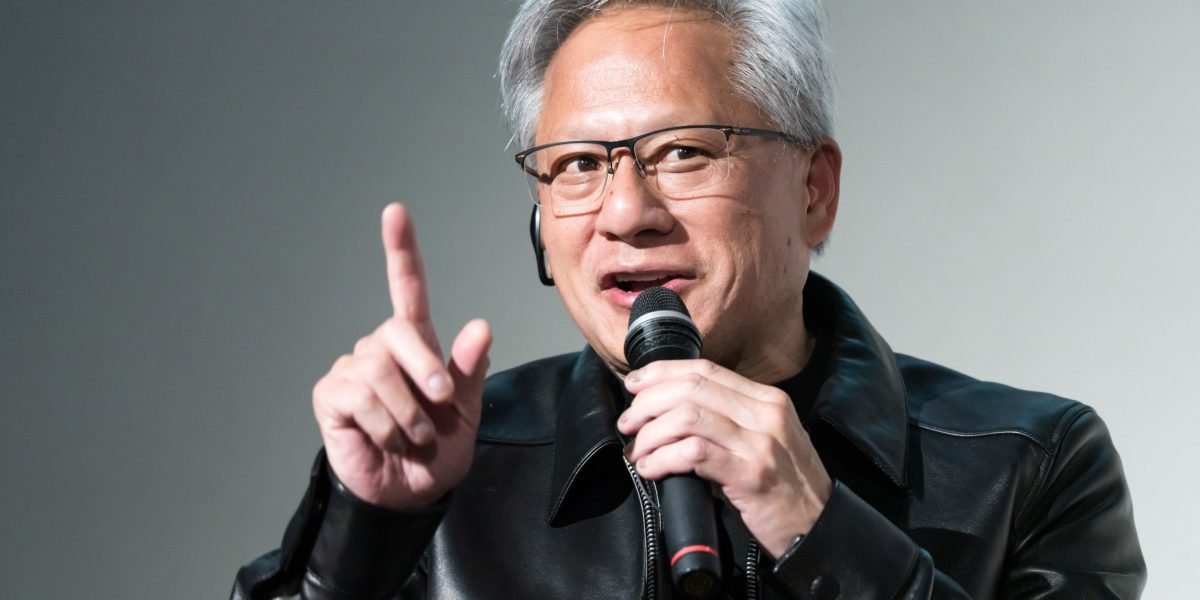
Jensen Huang penned his first-ever
The letter instead argued that open AI models should be retained as the basis for American leadership, suggesting that Huang and those like him seriously fear that this will not be the case.
“Open models strengthen security and cybersecurity, accelerate innovation and diffusion, and enable sovereignty,” Huang wrote. “The world needs both closed-border models and open-border models.”
He drew a direct parallel between today’s battle over open-weight AI and the open-source software movement of the 1980s, arguing that just as open-source code became the foundation of the modern Internet despite initial skepticism, open AI models must be allowed to thrive rather than face “premature limitations.”
The letter has about 25 signatories, including Microsoft, Meta, Hugging Face, Andreessen Horowitz, Perplexity and IBM, and makes three central claims: Open models expand economic access for startups and universities, they increase competition by preventing some companies from controlling the technology, and they actually improve security by allowing more researchers to examine code and patch vulnerabilities rather than relying on a small number of closed “single points of failure.”
Additionally, distillation – the practice of training one model on the results of another – is defended as a legitimate, long-standing research technique that should not be equated with theft, although this remains a lively controversy.
“Software developed by the open source community now powers most of the Internet,” the letter says, and underlies the systems used by the world’s largest technology companies as well as the U.S. military and federal agencies for critical tasks such as scientific research and cybersecurity. Open source has done much more than just lower the cost of software, the letter continues – it has created a “common knowledge base upon which generations of American engineers and entrepreneurs have built their institutional sovereignty.”
The post comes as Washington debates whether to restrict Chinese open-weight models like Moonshot AI’s Kimi K3, which launched on July 16 and is among the most powerful models around. White House adviser Michael Kratsios has accused Moonshot of using distillation to copy a US model to build Kimi K3, making the distillation debate even more exciting.
A week before Huang took office, Chinese President Xi Jinping made his first appearance at the World AI Conference in Shanghai on July 17, delivering a keynote speech in which he explicitly claimed the same “openness” for China. He called for “a symphony of global cooperation” rather than “a solo effort by a single country” and urged the world to “stand together against the over-extension of the national security approach in the area of AI” – which was interpreted by analysts as a direct swipe at US export controls. Xi also emphasized a “people-centered” approach and pledged to work with Africa, Latin America, Asia and the BRICS to prevent “new historical injustices” in access to AI, backing this up with concrete offers such as 5,000 AI training slots for developing countries.
The day before Xi’s speech, 29 countries – including Russia, Pakistan, Indonesia, Brazil and Kazakhstan – signed an agreement in Shanghai in the presence of UN Secretary-General António Guterres to establish the World Artificial Intelligence Cooperation Organization (WAICO), a Shanghai-based organization designed to compete with the US-led AI government. Some analysts questioned whether the tech world was splitting into rival blocs.
The timing creates a real problem for U.S. coalition messaging: Xi now occupies the same “pro-openness, anti-restriction” rhetorical space that Huang claimed in his letter for American industry, just from a rival capital. Add to that Huang’s own track record of praising Chinese models – he’s previously said “China will win the AI race” and recently called China’s open models “excellent” – making the Nvidia CEO more aligned with Beijing’s narrative than the more hawkish stance of OpenAI and Anthropic, both of which are noticeably absent from the open letter and have warned Washington about the risks of strong Chinese open models.
For this story, Assets Journalists used generative AI as a research tool. An editor checked the accuracy of the information before publication.
https://fortune.com/2026/07/24/jensen-huang-open-source-letter-nvidia-kimi/
