

Table of Contents
Article summary
- The Illinois State Board of Education recently released a guidance document to help schools and districts make decisions about whether and how to use artificial intelligence in classrooms and school operations.
- Illinois lawmakers called for the guidance amid growing concerns about the misuse of AI and the harmful effects it can have on student learning.
- The 409-page document includes the disclosure that some of the content was developed using AI tools such as ChatGPT. One advocate says disclosure is a good example of how AI can be used ethically.
This summary was written by the reporters and editors who worked on this story.
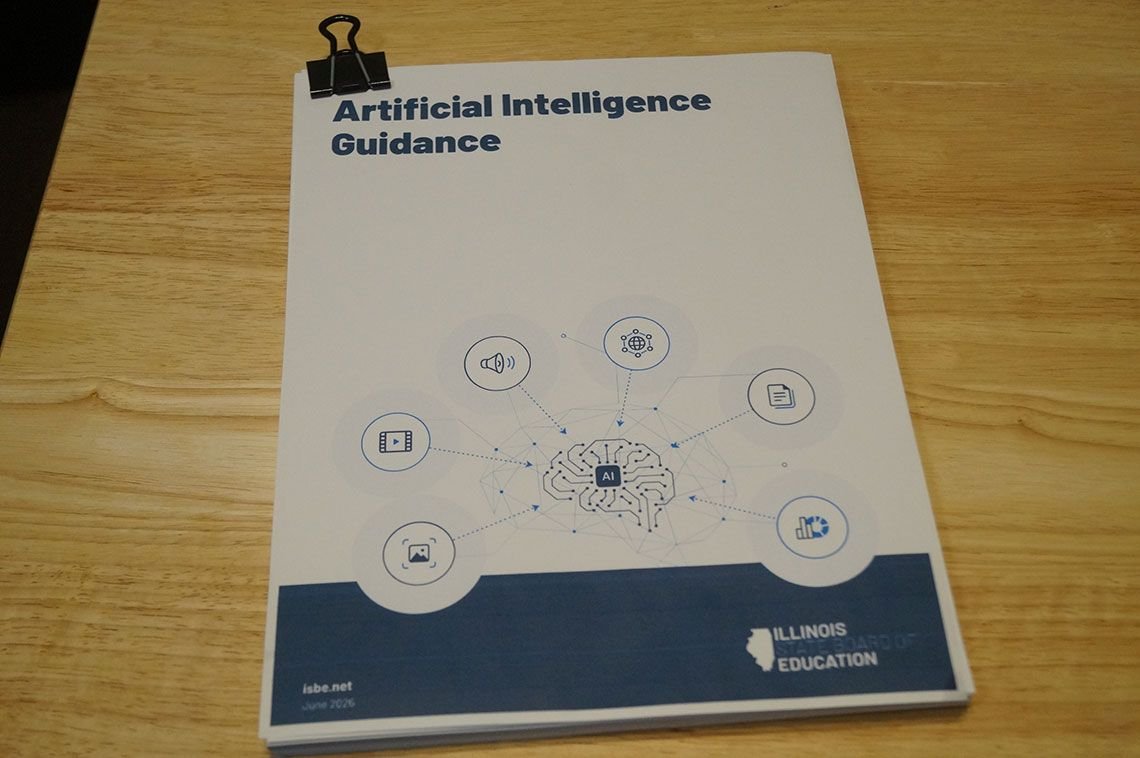
SPRINGFIELD – The Illinois State Board of Education recently released new guidelines on how schools should and should not use artificial intelligence in K-12 education.
However, one of the most notable aspects of the AI guidelines is that they were written using popular AI programs such as ChatGPT, Claude and Gemini.
Bill Curtin, policy director for the nonprofit advocacy group Teach Plus in Illinois, one of the groups that pushed for the guidelines, called it an example of how AI should be treated in academia.
“Up front they said, ‘We used AI,’ and they made it very clear and explicit how they used AI,” Curtin told Capitol News Illinois. “And that actually builds trust, because these days you can look at almost anything someone writes and wonder if it’s AI. It’s much better to say up front, ‘We used AI, and here is, and here’s where the human element is really still visible in this guide.'”
Growing concerns about AI
The guidance was issued after the General Assembly passed a law in 2025 requiring ISBE to develop guidelines for the use of AI in education. The Senate Bill of 1920 came amid growing concerns about students using AI programs like ChatGPT to help them with research or even writing essays.
At the same time, teachers and administrators were also looking for guidance on constructive ways to use AI for things like developing lesson plans or grading students’ work.
A 2024 survey of Illinois educators conducted by Teach Plus and the Illinois Digital Educator Alliance (IDEA) found widespread concern that misuse of AI could jeopardize student learning. Respondents also expressed concerns that AI systems could jeopardize student privacy and expose them to inaccurate or even harmful information.
“Schools are behind,” said one educator who took part in the survey. “Students use AI a lot, but we don’t have anything on site. It’s a bit like the Wild West at the moment.”
The legislation directed ISBE to develop guidance that would include, among other things, “specific ways to use artificial intelligence at the district, school, and classroom levels to inform teaching and learning practices.”
It also called for guidelines on “best practices for developing students’ competency in artificial intelligence and for engaging students in age-appropriate discussions about the responsible and ethical use of artificial intelligence.”
ISBE instructions
These guidelines were published on July 9th. The 409-page document was developed with input from a distinguished panel of experts in education, technology and public policy. But it also includes a note saying: “AI was used in the initial drafts of these guidelines (mainly ChatGPT, but to a lesser extent Claude and Gemini).”
It goes on to say that after developing the first language, the authors used AI prompts to find links and check whether external resources were publicly verifiable and available.
The note also states that AI was used to generate and edit the graphic figures used in the document. And it says AI was used to refine the text by asking questions like “What could be missing from this section” or “What would be clearer in this section.”
And in places where AI has been used to generate information, the note says information was verified outside of AI.
However, the guidelines themselves emphasize that teaching and learning are shaped by human relationships and experiences and that artificial intelligence is only a tool to inform teaching and learning and not a replacement for human interaction.
“Our responsibility is to help schools leverage new technologies in ways that strengthen instruction, protect students, and build trust for informed AI use between districts and the families and communities they serve,” state Education Secretary Tony Sanders said in a statement.
The document itself is rich in academic and educational language. And while it doesn’t provide any rules or regulations about how schools and districts should use AI, it does offer some practical advice for teachers and other professionals considering using AI in the classroom or school operations.
For example, a section on selecting AI applications includes a list of questions teachers might ask before choosing an AI product, such as “What is the learning problem I am solving – and is AI the right tool for this problem?” And: “If AI wasn’t available tomorrow, what would I do instead – and is that actually better for the learning goal?”
But when it comes to stopping students from using AI as a tool to cheat, Curtin says it’s a problem teachers have faced since the advent of calculators and personal computers.
“Students always found ways to cheat and teachers always responded,” he said. “This is a matter of practice. Given enough time to catch up and learn AI, they will find ways to adapt in the classroom to ensure students are still learning. This is a matter of practice, not policy.”
“A policy issue,” he continued, “is to provide the framework for teachers to develop students’ skills, ethics, and ways of thinking so that they can be truly successful and apply them ethically.”
Capitol News Illinois is a nonprofit, nonpartisan news service that distributes state government coverage to hundreds of news outlets across the state. It is funded primarily by the Illinois Press Foundation and the Robert R. McCormick Foundation.
https://capitolnewsillinois.com/news/illinois-state-board-of-education-issues-ai-guidance-written-with-help-from-ai/
